
Contact Us
Contact Us
At Chrysalis Psychology & Wellbeing, our psychologists in Hobart provide evidence-based perinatal mental health support for all parents during pregnancy and the first year of parenthood. We also offer telehealth psychology across Australia. Please contact us for more information.
.svg)
Everyone told you this would be the happiest time of your life. Nobody warned you about this.
The perinatal period, from conception through the first year of a baby's life, is one of the most significant transitions a person can experience. It brings joy, wonder, and meaning. It also brings sleep deprivation that no one can quite prepare you for, identity upheaval, relationship strain, physical change, and for many people, mental health challenges that are both common and under-recognised.
Perinatal mental health refers to the emotional and psychological wellbeing of people during pregnancy and the postnatal period. It encompasses a wide range of experiences, from adjustment and stress to anxiety, depression, birth trauma, and in some cases, more severe conditions that require urgent care.
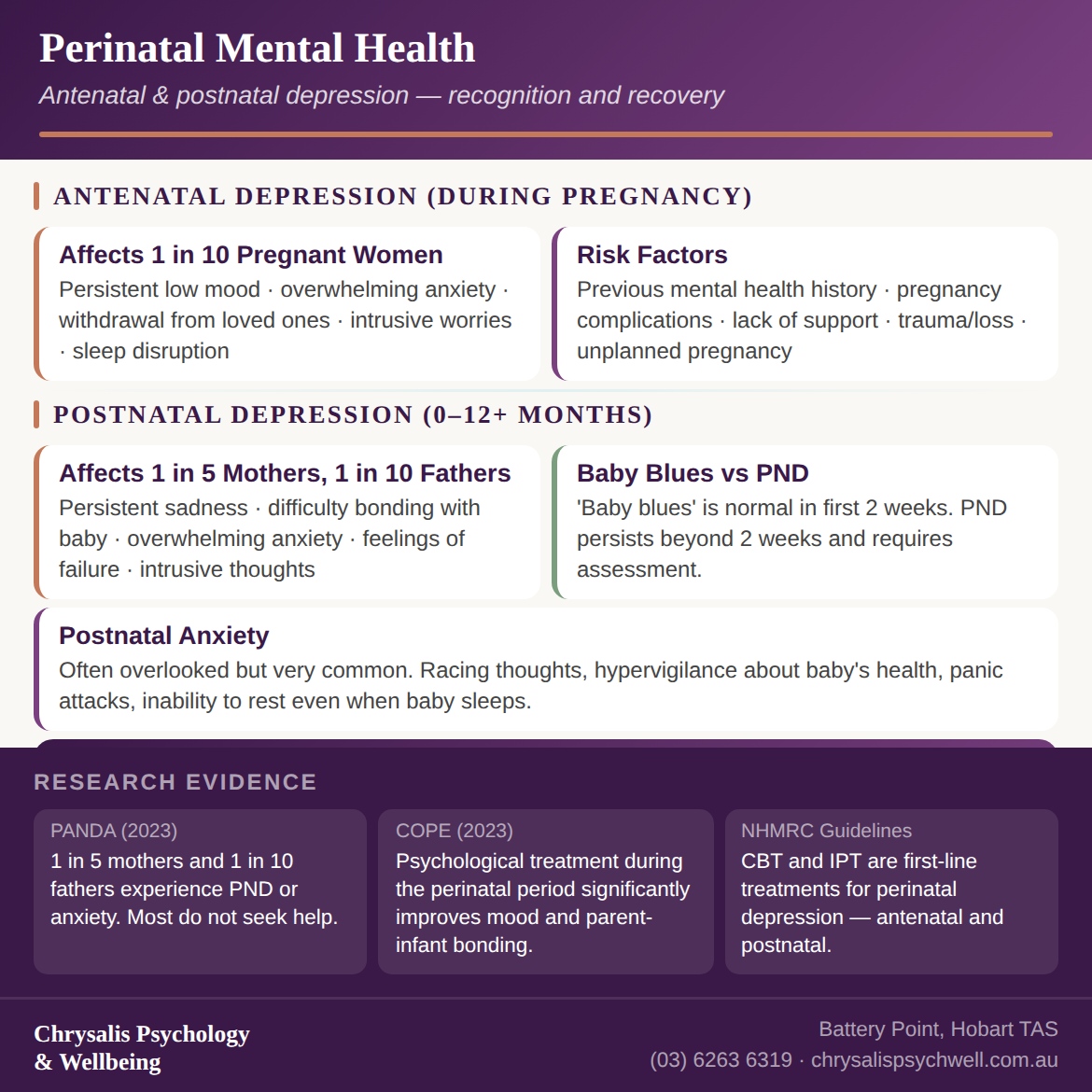
The Perinatal Mental Health Consortium Australia estimates that up to 1 in 5 women and 1 in 10 men experience a perinatal mental health condition, making it one of the most prevalent health presentations in new families [1].
Perinatal anxiety is at least as common as perinatal depression, yet receives less attention. It may involve excessive worry about the health of the baby, intrusive thoughts about harm coming to the baby or to yourself, panic attacks, or intense health anxiety during pregnancy. Research published in the Archives of Women's Mental Health found that perinatal anxiety affects approximately 15 to 20 per cent of pregnant women [2]. Perinatal anxiety responds well to evidence-based psychological treatment.
Exhaustion is also one of the most common and distressing features of the perinatal period. See Blog: Why Am I Always Tired? A Psychologist’s Guide to Understanding Exhaustion
Depression during pregnancy(antenatal depression) and after birth (postnatal depression) are among the most common perinatal mental health presentations. They involve persistent low mood, exhaustion, loss of interest or pleasure, difficulty bonding with the baby, and feelings of hopelessness or worthlessness that go beyond the normal adjustment to new parenthood.
Birth trauma refers to the psychological distress that can follow a traumatic childbirth experience, whether or not the birth involved objective medical emergency. What matters in determining whether an experience is traumatic is the person's subjective experience:feelings of loss of control, fear for life, or experiencing the birth as overwhelming or violating.
Research suggests that up to 30 percent of women rate their birth experience as traumatic, and that 4 to 6 percent develop PTSD as a result [3]. Birth trauma can affect bonding with the baby, relationships with partners, and decisions about future pregnancies.
Cognitive Behavioural Therapy (CBT): Adapted for the perinatal period, CBT addresses worry, perfectionism, and self-critical thinking that often intensify during pregnancy and the adjustment to new parenthood. See Blog: What Is CBT, and Why Do So Many Psychologists Use It?
Interpersonal Therapy (IPT): IPT focuses on the relationship changes, role transitions, and social isolation that often accompany new parenthood, and research suggests it may be a beneficial first-line treatment option for perinatal depression (Kang et al., 2020). See Blog: The Loneliness You Cannot Quite Explain: How Interpersonal Therapy Can Help
EMDR for Birth Trauma: EMDR is a structured approach that research suggests may help process traumatic birth experiences and ease their ongoing psychological impact. See Blog: When Trauma Gets Stuck: How EMDR Therapy Helps Your Brain Process What Talk Therapy Alone Cannot
Compassion Focused Therapy (CFT): CFT works with the shame and self-criticism that frequently accompany perinatal mental health difficulties, supporting a gentler relationship with yourself during this transition. See Blog: The Spill You Cannot Stop Replaying: Making Peace With Your Inner Critic
Acceptance and Commitment Therapy (ACT): ACT supports new parents to make room for difficult thoughts and feelings, such as guilt, intrusive worries, or grief for life before parenthood, while staying connected to the kind of parent they want to be. See Blog: When You Are Exhausted by Your Own Thoughts
Dialectical Behaviour Therapy (DBT): DBT skills support emotion regulation and distress tolerance during the intense demands of early parenthood, alongside interpersonal effectiveness skills for navigating changed relationships and asking for support. See Blog: When Your Emotions Hit Like a Wave: How DBT Skills Help You Steady Yourself
Telehealth from home: Our telehealth service allows you to access support from the privacy and comfort of home - because attending face-to-face sessions with a newborn is not always possible.
For immediate telephone support, PANDA (Perinatal Anxiety and Depression Australia) provides confidential helpline support on 1300 726 306.
Your first session is a warm, confidential space to talk about how you are experiencing pregnancy or parenthood. We listen without judgement, take time to understand your specific situation, and work with you to build a supportive, practical plan.
Sessions are available face-to-face at our Battery Point rooms in Hobart, Tasmania, and via telehealth for clients anywhere in Australia. We accept Medicare Mental Health Treatment Plans, NDIS (self-managed and plan-managed), DVA, Open Arms, National Redress Scheme, work insurance, and private health insurance. Self-referral is welcome.
[1] Perinatal Mental Health Consortium Australia (2023). Perinatal mental health statistics.https://www.cope.org.au
[2] Goodman, J.H., et al.(2016). CALM: A multisite RCT of an Internet intervention for women with perinatal anxiety. Journal of Clinical Psychiatry, 77(7), e828–e835.
[3] Ayers, S., et al. (2016).The aetiology of post-traumatic stress following childbirth. Psychological Medicine, 46(6), 1121–1134.
[4] Australian Psychological Society (2018). Evidence-based Psychological Interventions.https://psychology.org.au


.webp)
