The Loneliness You Cannot Quite Explain: How Interpersonal Therapy Can Help

The Loneliness You Cannot Quite Explain

You moved to Hobart eighteen months ago, and you still eat lunch alone most days. You tell yourself it takes time to make friends as an adult, and that is true. But you have also noticed something else: when someone does reach out, a part of you finds a reason to say you are busy.

You are lonely, and somehow also the one making yourself a little more lonely, and you cannot quite work out how both things can be true at once. Maybe it does not look like isolation from the outside. You have colleagues, a family group chat, people who would probably say yes if you asked them for a coffee. But something about actually reaching out, about actually being known, feels harder than it should.

This is a more common experience than it feels like in the moment, and it is not a character flaw or a sign that something is wrong with you. It is something psychology has a name for, and more importantly, something there is a structured way to work through.

Difficulty forming or sustaining close relationships is one of the more under-recognised forms of psychological distress. It rarely announces itself the way anxiety or panic might. It shows up as a quiet ache, a habit of self-protection, or a pattern of pulling back right when connection is within reach.

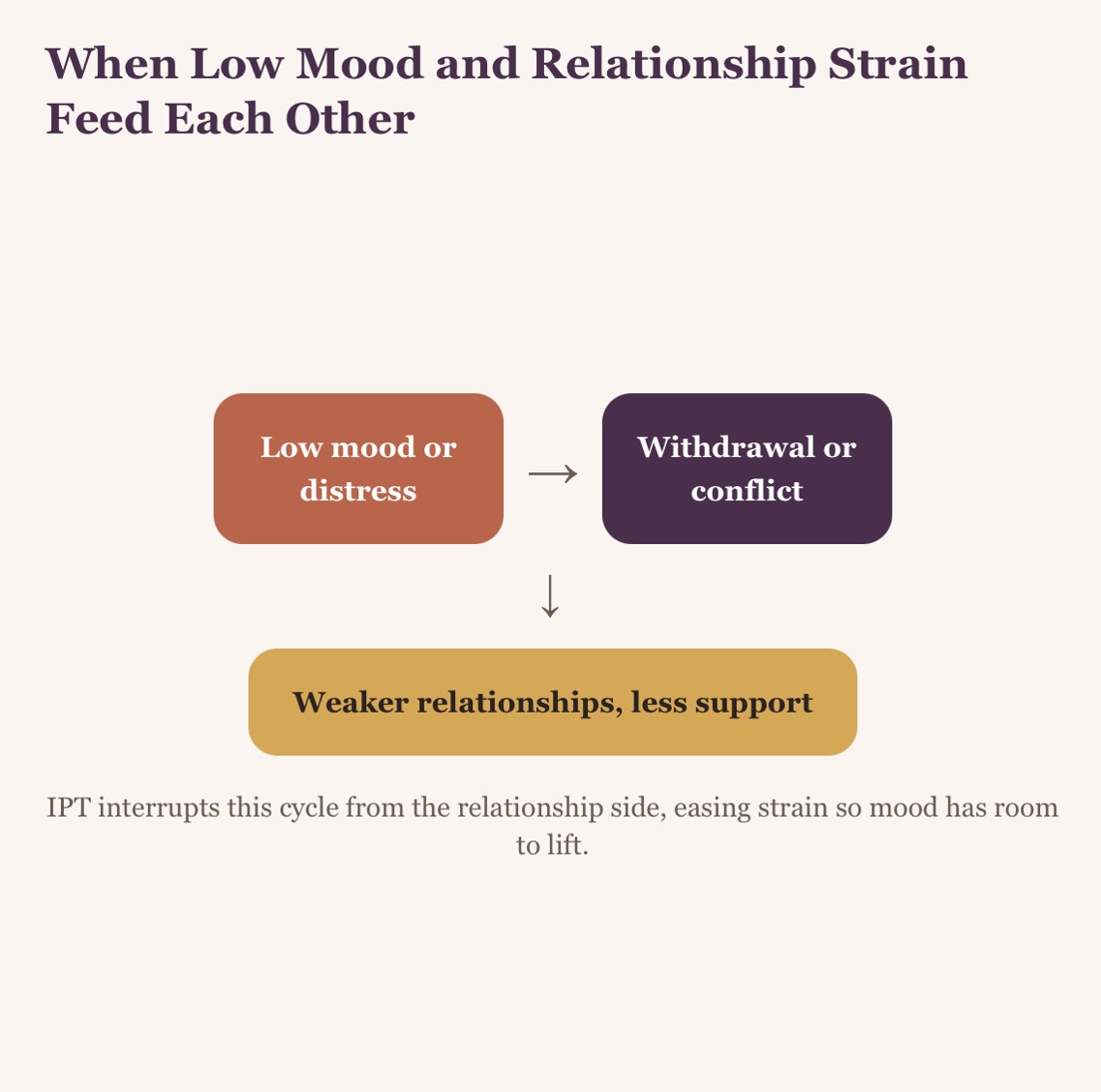
Interpersonal therapy, usually shortened to IPT, is a structured, evidence-based psychological therapy that works directly with this kind of difficulty. Rather than treating your relationships as background detail to your mental health, IPT treats them as central to it. It rests on a well-researched premise: emotional distress and the quality of our relationships shape each other, and working with one can ease the other.

This is different from assuming the solution is simply to try harder to be social, or to wait until it feels easier. IPT treats the pattern itself, the pulling back, the reasons you find, as something worth understanding and working through in a structured way, alongside whatever else is going on for you.

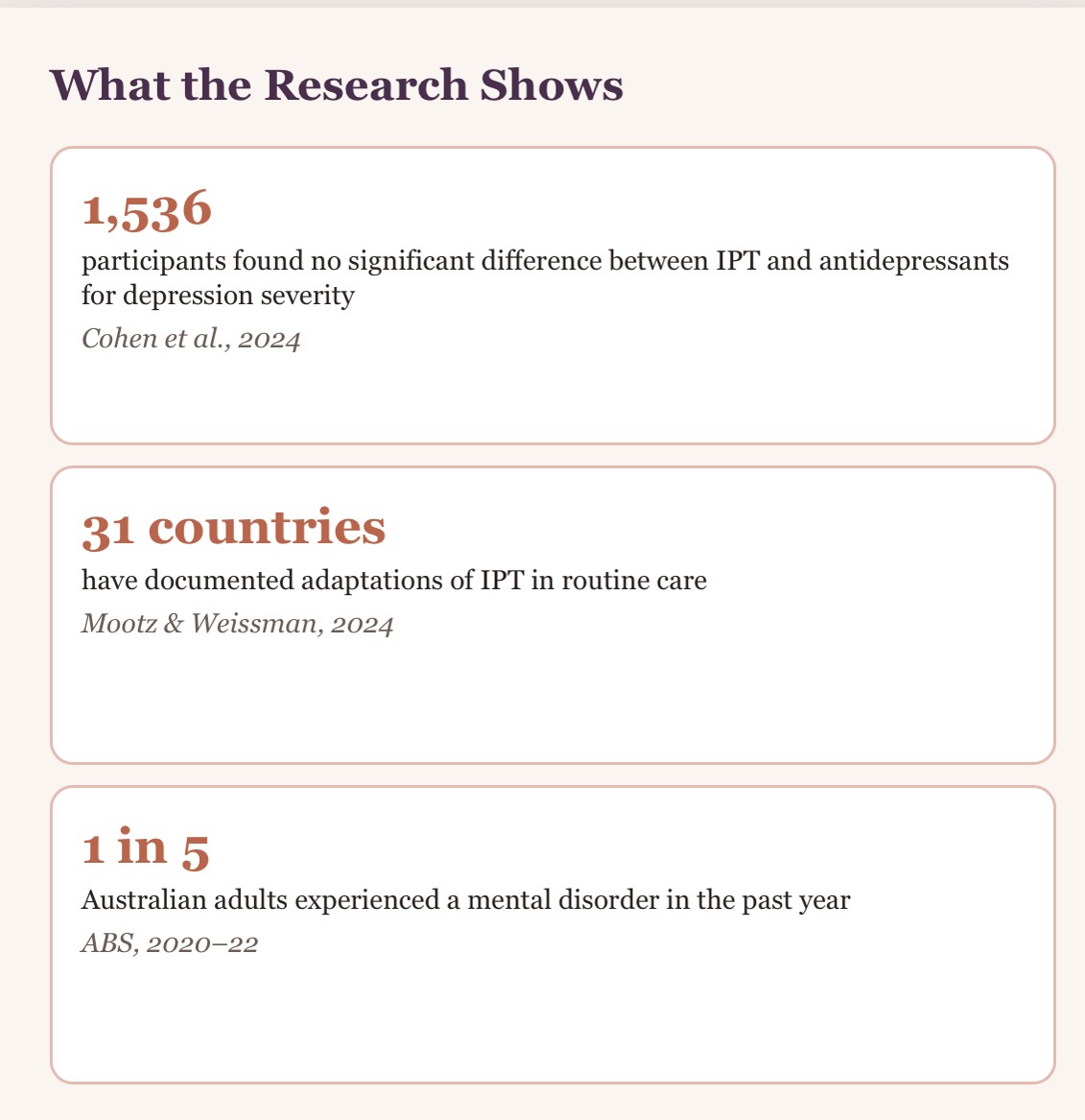
In Australia, the 2020 to 2022 National Study of Mental Health and Wellbeing found that approximately one in five adults experienced a mental disorder in the previous year (Australian Bureau of Statistics, 2023), with relationship strain, isolation, and major life transitions frequently reported alongside these experiences.

IPT itself has a substantial research base. A 2024 individual participant data meta-analysis drawing on 1,536 participants across nine randomised controlled trials found no significant difference between IPT and antidepressant medication on measures of depression severity after treatment (Cohen et al., 2024), positioning IPT as a genuine first-line option rather than a fallback. The approach has also been adapted into routine care across 31 countries (Mootz & Weissman, 2024), reflecting a wide and still-growing international evidence base.


Clinical understanding of isolation and difficulty connecting has also evolved since IPT was first developed. Many clinicians now understand this pattern as connected to a person's broader relationship style, shaped over time, rather than a single problem to solve in a handful of sessions. In practice, this means therapy tends to move at a pace that respects how long these patterns take to form.

If this sounds familiar, a few things may help before you are ready to consider therapy, or alongside it. Naming the pattern to yourself, without judgment, is often a useful first step: noticing when you decline an invitation out of habit rather than genuine preference, for instance, rather than assuming it reflects how you actually feel. Small, low-pressure steps toward connection, a short message to someone you have been meaning to reach out to, or accepting one invitation you would usually decline, can matter more than a single, larger gesture.

It is also worth knowing that professional support does not require things to have reached a crisis point. Many people begin IPT while things are manageable but not comfortable, well before a formal diagnosis might apply. Therapy in this context is less about fixing something broken and more about building a different relationship with connection itself.

This applies just as much to grief, a stuck dispute with someone you love, or a life transition that has quietly reshaped your relationships, as it does to loneliness. The common thread across all four areas is that the relationship, not just the mood attached to it, becomes part of what therapy actually works with.

If loneliness, a stuck relationship, grief, or a difficult life transition is affecting your day-to-day wellbeing, a psychologist trained in IPT can help you work through it in a structured way, at a pace that suits you.

You do not have to work this out alone, and you do not have to wait until things feel unmanageable to ask for support. The team at Chrysalis Psychology & Wellbeing offers Interpersonal Therapy (IPT) face-to-face in Battery Point and via telehealth across Australia. Call (03) 6263 6319 or visit our Interpersonal Therapy (IPT) page to find out whether this approach may be right for you.

Related Reading

Reference List 

  • Australian Bureau of Statistics. (2023). National Study of Mental Health and Wellbeing, 2020–22. ABS, Australian Government.
  • Cohen, Z. D., Breunese, J., Markowitz, J. C., Weitz, E. S., Hollon, S. D., Browne, D. T., Rucci, P., Corda, C., Menchetti, M., Weissman, M. M., Bagby, R. M., Quilty, L. C., Blom, M. B. J., Altamura, M., Zobel, I., Schramm, E., Gois, C., Twisk, J. W. R., Wienicke, F. J., Cuijpers, P., & Driessen, E. (2024). Comparative efficacy of interpersonal psychotherapy and antidepressant medication for adult depression: A systematic review and individual participant data meta-analysis. Psychological Medicine, 54(14), 3785–3794. https://doi.org/10.1017/S0033291724001788
  • Kang, H. K., John, D., Bisht, B., Kaur, M., Alexis, O., & Worsley, A. (2020). Effectiveness of interpersonal psychotherapy in comparison to other psychological and pharmacological interventions for reducing depressive symptoms in women diagnosed with postpartum depression in low- and middle-income countries: A systematic review. Campbell Systematic Reviews.
  • Klerman, G. L., Weissman, M. M., Rounsaville, B. J., & Chevron, E. S. (1984). Interpersonal psychotherapy of depression. Basic Books.
  • Mootz, J. J., & Weissman, M. M. (2024). Implementing interpersonal psychotherapy globally: A content analysis from 31 countries. Psychological Medicine, 54(16), 4493.