Contact Us
Contact Us
Sometimes the most healing thing is realising you are not the only one. The other people in the room have lived a version of what you have lived. They understand without you having to explain. Group therapy at Chrysalis Psychology & Wellbeing is built on that quiet, grounding moment of recognition. Each program is small, structured, and led by registered psychologists. You learn evidence-based skills, practise them in a safe space, and walk out with strategies you can use straight away.
.svg)
Group programs offer something that individual therapy cannot: the experience of being witnessed and supported by others walking the same road. A meta-analysis of group psychotherapy outcomes published in the American Psychologist (Burlingame et al., 2016) found group therapy to be as effective as individual therapy across a range of conditions, with the added benefit of social learning, peer feedback, and reduced isolation. Each Chrysalis group is capped at a small number of participants, runs for a defined number of sessions (typically 6 to 12 weeks), and follows a structured curriculum. You receive a clear schedule before you join, and your psychologist works with you in advance to confirm that the group fits your goals.
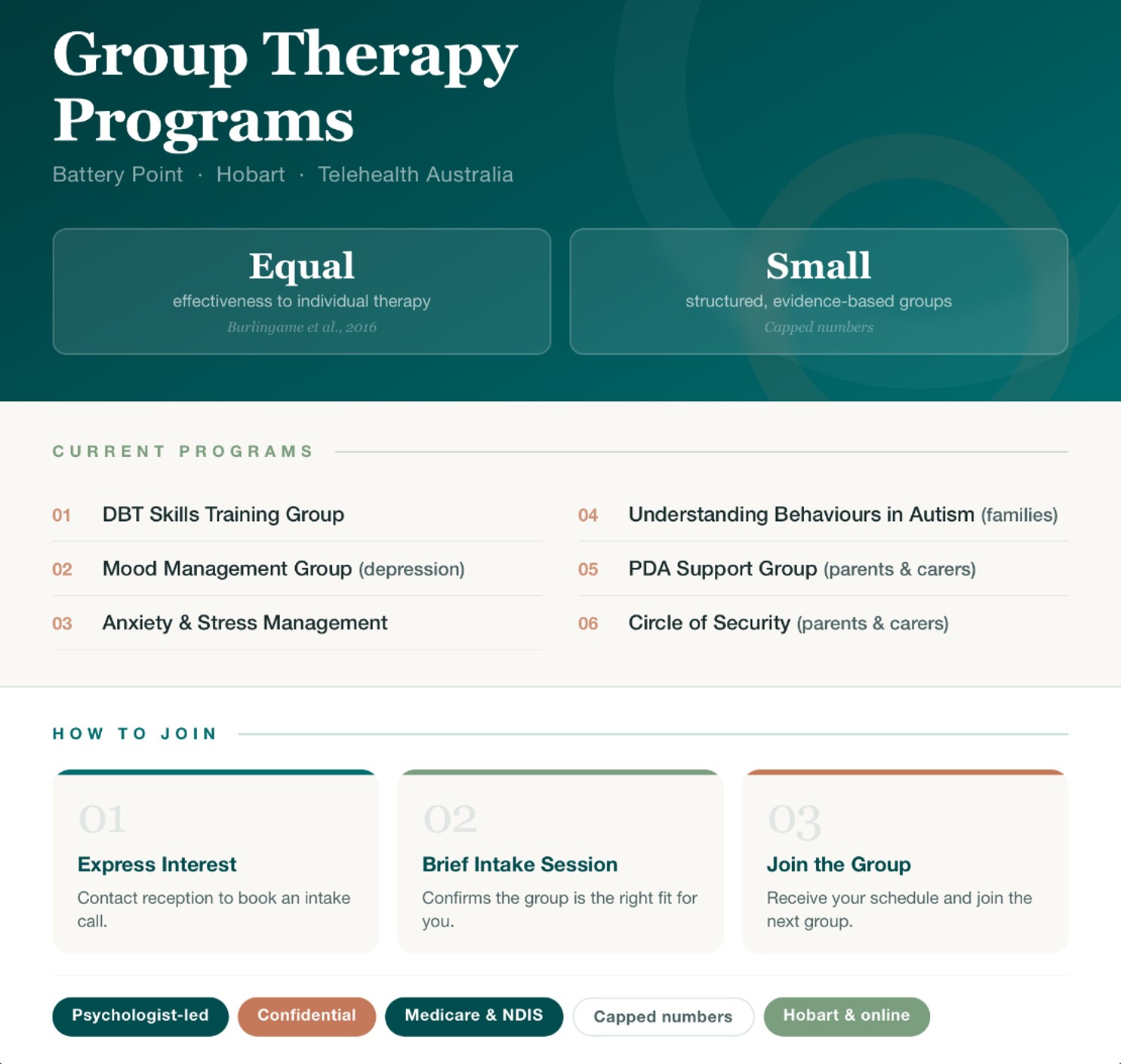
We run a rotating calendar of programs based on community demand and clinical need. Current and recurring programs include:
Dialectical Behaviour Therapy (DBT) Skills Training Group: a program covering mindfulness, distress tolerance, emotion regulation, and interpersonal effectiveness. Designed for individuals experiencing emotion regulation difficulties, repeated relationship conflict, or self-defeating behaviour patterns. We run a group for young adults, adults, and for neurodivergent adults.
Mood Management Group: a structured program for adults living with low mood, depression, or significant emotional ups and downs. Evidence-based tools drawn from CBT and behavioural activation.
Anxiety and Stress Management Group: practical skills for managing generalised anxiety, panic, and chronic stress. Includes psychoeducation, regulation skills, and graded exposure principles.
Understanding Behaviours in Autism: a program for parents, partners, and family members of autistic individuals. Builds shared language, reduces miscommunication, and supports more attuned daily interactions.
Pathological Demand Avoidance (PDA) Support Group: for parents and carers of children with PDA. Shared strategy, emotional support, and practical guidance from a psychologist with experience in the profile.
Circle of Security (CoS) Parenting Program: an evidence-based, 8-week early intervention program and framework designed to strengthen parent-child attachment.

Our autism understanding group helps families, partners, and individuals develop a clearer picture of how autism shapes communication, sensory experience, and social patterns. Sessions are practical: real situations, concrete strategies, and the chance to hear how other families have navigated similar moments. Suitable for parents of autistic children, partners of autistic adults, and adults exploring their own diagnosis. Held in a non-judgemental, identity-affirming space.
Depression affects approximately one in six Australians at some point in their life (Australian Institute of Health and Welfare, 2024). Our mood management group draws on cognitive behavioural therapy and behavioural activation, the two most evidence-supported approaches for depression. Across the program you learn how mood, thoughts, and behaviour reinforce each other, and you build a personal toolkit you can return to long after the group ends.
Anxiety is the most common mental health condition in Australia (Australian Bureau of Statistics, 2023). This group is for adults whose anxiety has begun to narrow their life: the tasks they avoid, the sleep they lose, the conversations they over-prepare. Across the program you learn to identify the patterns that fuel anxiety, develop reliable regulation strategies, and rebuild engagement with what matters.
Parenting a child with Pathological Demand Avoidance can be exhausting and isolating, particularly when standard parenting strategies seem to make things worse. Our PDA support group brings together parents and carers to share strategies that work, learn from a psychologist familiar with the PDA profile, and build a supportive community of people who genuinely understand.
Parenting can leave you wondering whether you are reading your child correctly, especially in the moments that feel hardest. Circle of Security is an internationally recognised, attachment-based program built on over fifty years of developmental research into how children form secure relationships with their caregivers. This group is for parents who want to understand their child’s emotional needs more deeply: the bids for closeness, the moments of distress, the messages inside difficult behaviour. Across the program you learn to read your child’s cues, repair ruptures with confidence, and reflect on the patterns you bring to parenting from your own history.
We run our groups face-to-face at our Knopwood House rooms in Battery Point, with selected programs offered online for participants across Hobart, regional Tasmania, and the rest of Australia.
Group programs at Chrysalis follow a brief intake process to ensure the group is the right fit for your situation:
Step 1:
Contact our reception to book an intake call. Tell us which program interests you.
Step 2:
A short individual session with one of our psychologists confirms the group is suitable. This protects both you and the group dynamic.
Step 3:
You receive the program schedule, fees information, and join the next available cohort.
Most groups attract Medicare rebates (with a Mental Health Treatment Plan), and NDIS participants can use plan funding for groups within scope. Private health extras may also apply.
.webp)


.webp)
