
Contact Us
Contact Us
At Chrysalis Psychology & Wellbeing, our psychologists in Hobart help children, young people, and adults find and use their voice with clarity, confidence, and care. We also offer telehealth psychology across Australia. Please contact us for more information.
.svg)
You agreed to help again, even though you were already stretched thin. You let the comment slide, even though it stung. You sat in the meeting with a good idea and said nothing, because the moment passed before you could find the words. On the way home you replayed every version of the conversation you wish you had had.
There is a particular kind of exhaustion that comes from consistently not saying what you mean, not asking for what you need, or not holding the line on things that matter to you. It is not just tiring. Over time, it erodes your sense of yourself.
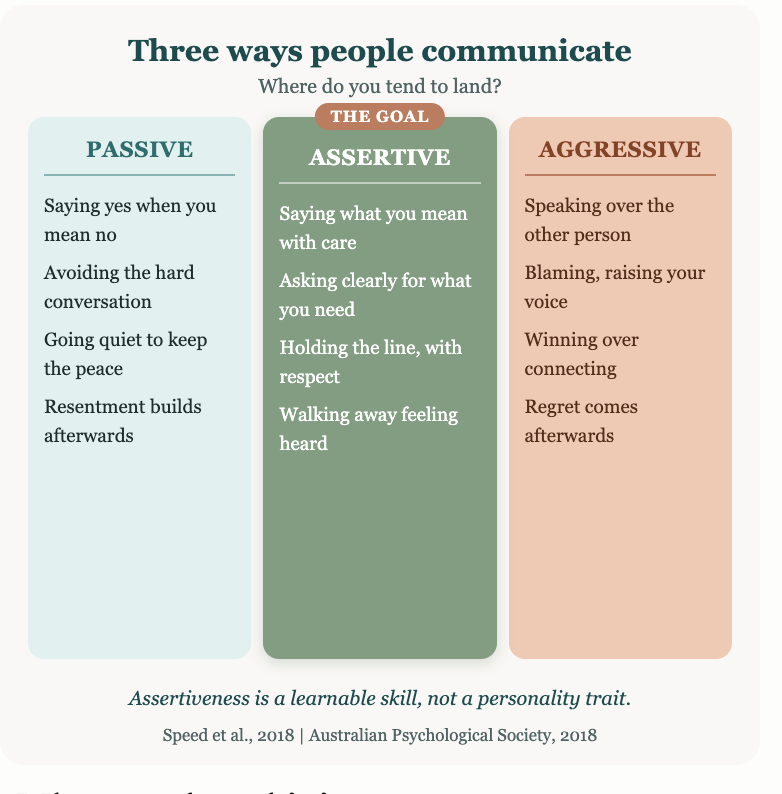
Assertive communication is the ability to express thoughts, feelings, needs, and boundaries in a way that is direct, honest, and respectful of both yourself and others. It sits in the space between passivity, which leaves your needs unmet, and aggression, which damages relationships.
Research consistently shows that assertiveness is a learnable skill, and that developing it improves self-esteem, reduces anxiety, and strengthens relationships [1].
Most people tend toward one of two patterns in difficult conversations. Some become passive, saying less than they mean, avoiding conflict, or agreeing to things they do not actually want. Others become reactive, raising their voice, shutting down, or saying things they later regret. Assertiveness is the third path, and it can be practised and developed.
Difficulty with assertiveness may show up as:
These patterns often connect with social anxiety, low self-esteem, and difficulty with emotion regulation. Working on assertive communication often supports these areas at the same time.
Many adults struggle with assertiveness in specific contexts. You might be confident in some areas of life but find yourself silenced in certain relationships, at work, with authority figures, or in high-stakes conversations.
You might notice:
If you are dreading a conversation with your manager, sitting on feedback you cannot deliver, or feeling overlooked in meetings, assertive communication therapy can help you find the words and the steadiness to use them. Workplace assertiveness is a particularly common reason adults reach out, and it is one of the most practical skills to build.
The Australian Psychological Society recognises assertiveness training as an effective component of treatment for anxiety, depression, and relationship difficulties [2].
At Chrysalis Psychology & Wellbeing, we help adults understand the beliefs that make assertiveness feel unsafe, and build practical communication skills that fit their real relationships and environments. For couples working on communication together, see our couples therapy service. Learn more about our individual therapy sessions in Hobart and Australia-wide.
Children and young people also benefit significantly from developing assertive communication skills. These skills protect them in social and academic settings, support healthy peer relationships, and build the foundation for confident self-expression throughout adolescence and adulthood.
Families and educators may notice young people who:
At Chrysalis Psychology & Wellbeing, we provide developmentally appropriate support that helps young people practise assertiveness skills in a safe, guided environment.
We explore where your communication style comes from, including early experiences, family dynamics, cultural expectations, and the beliefs you hold about what happens when you speak up.
You will learn practical techniques for expressing needs clearly, setting limits with care,and navigating disagreement without aggression or withdrawal. Skills include “I” statements, graduated exposure to assertive situations, and strategies for managing anxiety during difficult conversations. Our psychologists draw on Cognitive Behavioural Therapy, Acceptance and Commitment Therapy, and Dialectical Behaviour Therapy skills to help you build assertive communication.
If you would benefit from learning these skills alongside others working on similar goals,our group therapy programmes include DBT skill straining, which has a strong assertiveness focus.
One of the most widely used tools in assertiveness training is the DESC script. It gives you a simple structure for difficult conversations, particularly when you feel your words slipping away under pressure. DESC stands for Describe, Express, Specify, Consequences.
Describe the situation factually, without judgement. Stick to what happened, not what you assumed about it. For example: “In the last three meetings, I have been interrupted before finishing my point.”
Express how you feel using an “I” statement. This keeps the focus on your experience rather than the other person’s character. For example: “I feel frustrated and unheard when this happens.”
Specify what you would like to be different. Be clear and concrete. Vague requests rarely produce change. For example: “I would like to finish my thought before others respond.”
Consequences names what will improve if the change happens, or sometimes what will follow if it does not. For example: “I think we will get to better decisions if everyone has space to contribute.”
The DESC scriptis not a magic formula, and it will feel awkward the first few times you use it. That is normal. Like any new skill, it becomes more natural with practice.Our psychologists at Chrysalis Psychology & Wellbeing help you adapt the script to the real conversations and relationships in your life, so it sounds like you and works in your context, particularly when anxiety makes your words slip away underpressure.
Assertiveness is often blocked by beliefs such as “If I say no, they will not like me” or “My needs are not as important as theirs.” We help you identify and shift these patterns so that speaking up feels more natural and less threatening.
We work on the real conversations and relationships that matter to you, not just abstract skills. Meet our team of psychologists in Hobart.
Your first session is about understanding. We listen to what is happening for you, how things show up in your day, and what you hope to change. Together we create a plan that feels clear, supportive, and manageable. Therapy at Chrysalis Psychology & Wellbeing moves at a pace that feels safe while still supporting steady progress. You remain in control of the process.
Sessions with our psychologists are available face-to-face at our Battery Point rooms in Hobart, Tasmania, and via telehealth for clients anywhere in Australia. Our psychologists are experienced in working with Medicare Mental HealthTreatment Plans, DVA, Open Arms, National Redress Scheme, NDIS (self-managed and plan-managed), WorkCover, and private health insurance.
[1] Speed, B.C. et al.(2018). Assertiveness training: A forgotten evidence-based treatment. Clinical Psychology: Science and Practice, 25(1). https://doi.org/10.1111/cpsp.12216
[2] Australian Psychological Society (2018). Evidence-based Psychological Interventions. https://psychology.org.au/for-the-public/psychology-topics/evidence-based-psychological-interventions
[3] Beyond Blue (2024). Healthy relationships and communication. https://www.beyondblue.org.au


.webp)
