
Contact Us
Contact Us
At Chrysalis Psychology & Wellbeing, our psychologists in Hobart provide safe, trauma-informed support using evidence-based approaches including EMDR and trauma-focused CBT. Our psychologists are also available via telehealth across Australia. Please contact us for more information
.svg)
A car door slams and your body flinches before your brain catches up. A smell, asound, a particular tone of voice, and suddenly you are back there. Not remembering it. Reliving it.
You might not always know why your heart starts racing. Why you avoid certain places. Why some nights your sleep is shattered by dreams that feel more real than morning.
If this is your experience, it has a name. Post-Traumatic Stress Disorder, or PTSD, develops when the brain and body remain stuck in a state of threat long after the traumatic event has passed.
The ABS National Study of Mental Health and Wellbeing (2020–2022) found that PTSD is one of the most prevalent anxiety-related disorders in Australia, with 28.8 per cent of Australian shaving experienced an anxiety disorder, including PTSD, at some time in their life [1].
PTSD is not a sign of weakness. It is a normal nervous system response to abnormal events. When trauma overwhelms the brain’s ability to process what happened, the memory gets stored differently. It stays raw, vivid, and easily triggered.
PTSD might show up as:
Phoenix Australia, the national centre for posttraumatic mental health, notes that PTSD can develop after a single traumatic event or after repeated exposure to distressing experiences [2]. Not everyone who experiences trauma develops PTSD, but for those who do, effective treatment is available.
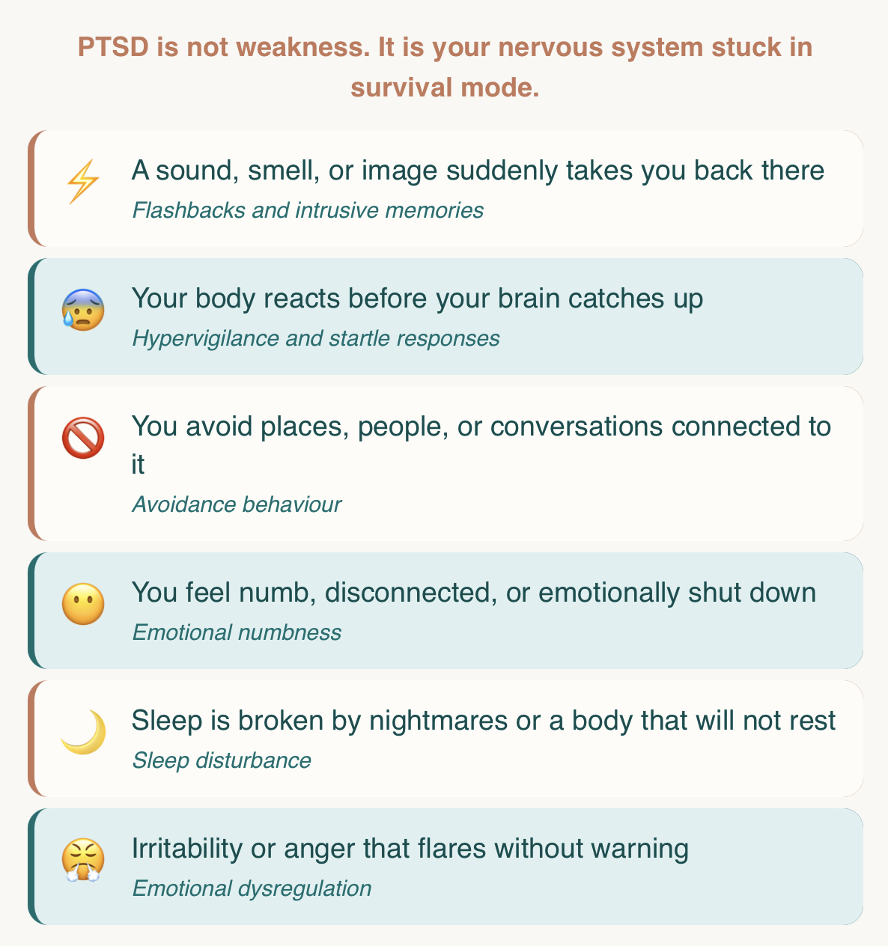
Adults with PTSD often describe feeling stuck. You might know the trauma is in the past, but your body and brain have not caught up. You may feel hypervigilant, emotionally numb, or caught between wanting to talk about what happened and wanting to forget it entirely.
You might notice:
At Chrysalis Psychology & Wellbeing, we offer individual psychology therapy to help adults understand how trauma affects the nervous system, develop strategies to feel more grounded, and process traumatic memories safely using EMDR, Schema Therapy, and trauma-focused CBT.
Children and adolescents may experience PTSD differently from adults. Many do not have the language to explain what they feel, and their symptoms often show through behaviour or physical responses.
Families may notice:
At Chrysalis Psychology & Wellbeing, we offer individual psychology therapy to provide supportive, developmentally sensitive care that helps young people understand their emotions, build emotional safety, and regain confidence in daily life.
Our psychologists use trauma-informed, evidence-based treatments. Primary approaches include:
EMDR helps the brain reprocess traumatic memories so they become less distressing and less intrusive. Through guided bilateral stimulation, EMDR supports the nervous system to resolve traumatic memories without requiring detailed retelling of the event. EMDR is recommended by the World Health Organisation as an effective treatment for PTSD [3].
Schema Therapy helps you identify and change deep-rooted emotional patterns that developed early in life. By understanding unmet childhood needs, you can heal past wounds and build healthier relationships.
CBT-T is a structured therapy that helps individuals understand how trauma shapes thoughts, emotions, and behaviours. It supports gradual processing of trauma memories, reduces avoidance, and helps rebuild a sense of safety and control. Phoenix Australia recommends CBT-T as a first-line treatment for PTSD [2].
We begin with strategies that help regulate the nervous system and build a foundation of stability before working on deeper trauma material.
You will learn practical tools for managing intrusive memories, reducing hyperarousal, and staying present.
Your first session is about understanding. We listen to what is happening for you, how things show up in your day, and what you hope to change. Together we create a plan that feels clear, supportive, and manageable.
Therapy at Chrysalis Psychology & Wellbeing moves at a pace that feels safe while still supporting steady progress. You remain in control of the process.
Sessions with our psychologists are available face-to-face at our Battery Point rooms in Hobart, Tasmania, and via telehealth for clients anywhere in Australia. Our psychologists are experienced in working with Medicare Mental Health Treatment Plans, DVA, NDIS (self-managed and plan-managed), WorkCover, National Redress Scheme, and private health insurance.
[1] Australian Bureau of Statistics (2023). National Study of Mental Health and Wellbeing, 2020–2022.https://www.abs.gov.au/statistics/health/mental-health/national-study-mental-health-and-wellbeing/latest-release
[2] Phoenix Australia (2021). Australian Guidelines for the Prevention and Treatment of Acute Stress Disorder, PTSD and Complex PTSD.https://www.phoenixaustralia.org/australian-guidelines-for-ptsd/
[3] World Health Organisation (2013). Guidelines for the Management of Conditions Specifically Related to Stress.https://www.who.int/publications/i/item/9789241505406
[4] Australian Psychological Society (2018). Evidence-based Psychological Interventions.https://psychology.org.au/for-the-public/psychology-topics/evidence-based-psychological-interventions


.webp)
