
Contact Us
Contact Us
There is a particular kind of loneliness that lives inside a relationship that is no longer working. The same conversations on loop. The same arguments in the same words. The space between you has grown wider than either of you wanted it to, and neither of you knows quite when it happened.
Couples therapy at Chrysalis Psychology & Wellbeing is the work of slowing that pattern down, naming it together, and rebuilding the bridge that brought you to each other in the first place. We support couples through repair, through reconnection, and through some of life’s hardest transitions, with care that is evidence-based and inclusive of every kind of relationship.
.svg)
Every relationship is unique. We work with couples at every stage and in every configuration: dating, engaged, married, long-term, blended families, polyamorous, and ethically non-monogamous structures, LGBTQIA+ relationships, and neurodivergent partnerships. Our work is identity-affirming, culturally aware, and free of assumptions about what a relationship should look like.
Many couples come to us because something specific has broken down. Others come because something has been quietly off for years. Both are valid reasons to begin. Common reasons couples seek therapy include:
Improving communication: learning to express thoughts and feelings clearly, and to listen with empathy rather than defensiveness. Communication patterns are learnable, and small changes compound quickly.
Resolving recurring conflict: addressing the same arguments that keep returning in different costumes. The work is identifying the underlying themes (often unmet needs, attachment fears, or values mismatches) that fuel surface disagreements.
Rebuilding trust and intimacy: after rupture, betrayal, distance, or long stretches of unhappiness. Repair is possible when both partners are willing.
Navigating life transitions: marriage, parenthood, blending families, career relocation, illness, retirement, grief. Transitions reorganise relationships, and therapy provides a space to do that reorganising together.
Enhancing relationship satisfaction: even relationships that are working can benefit from intentional time invested in each partner being known, valued, and understood.

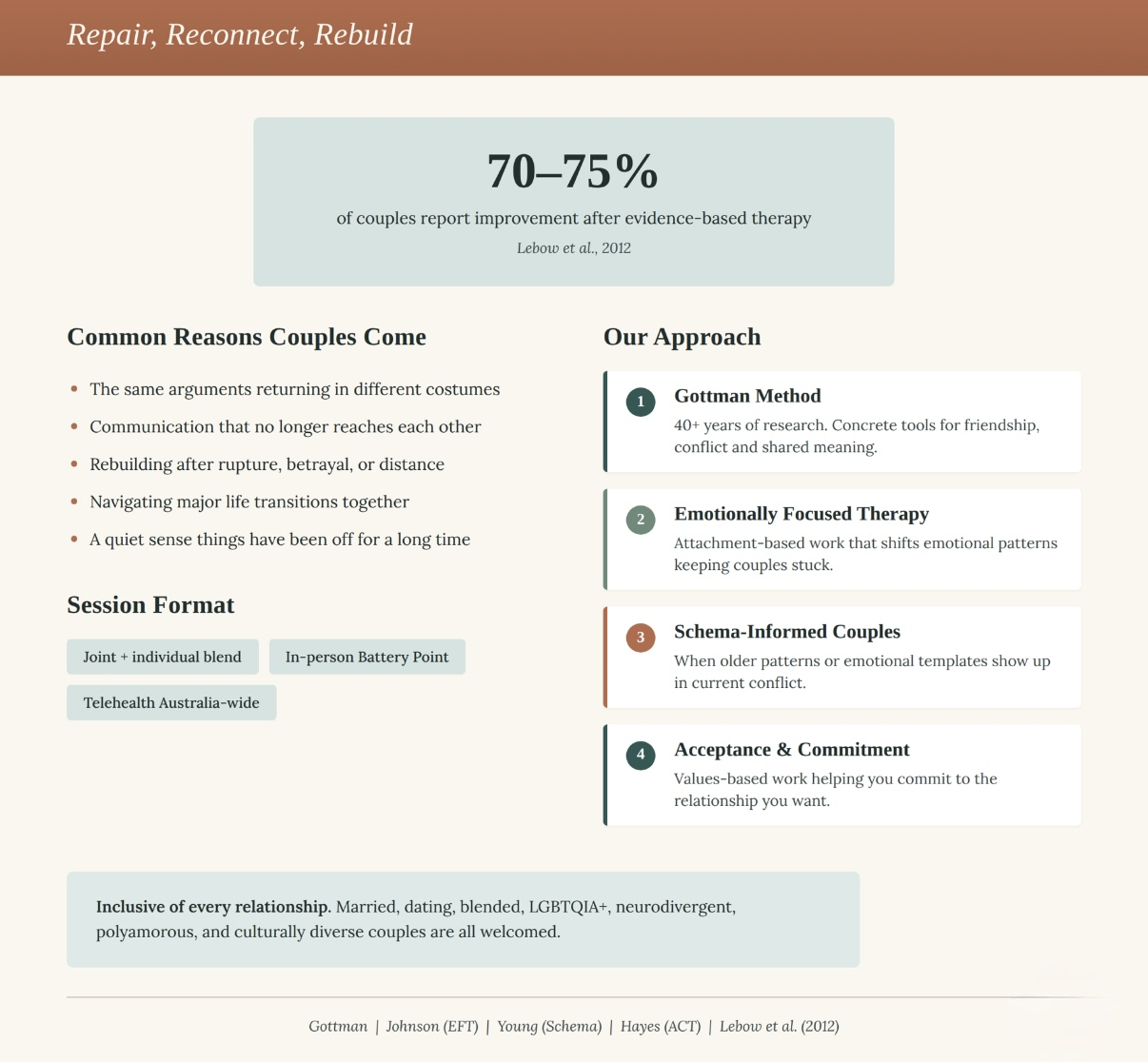
Our couples work draws on the most empirically supported relationship therapy frameworks. Research published in the Journal of Marital and Family Therapy and reviewed by the Australian Psychological Society indicates that 70 to 75 per cent of couples report meaningful improvement after evidence-based couples therapy (Lebow et al., 2012).
Gottman Method: based on more than 40 years of research observing thousands of couples. Identifies predictors of relationship success and provides concrete tools for friendship, conflict, and shared meaning.
Emotionally Focused Therapy (EFT): an attachment-based approach that helps partners understand and shift the emotional patterns that keep them stuck. Strong research support for couples in distress.
Schema-Informed Couples Therapy: useful when childhood patterns or longstanding emotional templates show up in the relationship. Helps partners recognise the older stories that play out in current conflict.
Acceptance and Commitment Therapy for Couples (ACT): values-based work that helps couples commit to the relationship they want, even in the presence of difficulty.
We welcome all couples, including:
1- Married couples
2- Dating, engaged, and long-term partners
3- LGBTQIA+ relationships
4- Neurodivergent partnerships (where one or both partners are autistic, ADHD, or both)
5- Polyamorous and ethically non-monogamous relationships
6- Couples from all cultural and faith backgrounds
7- Couples considering separation who want to do that process thoughtfully and with care
The first session includes both partners. Your psychologist gathers history, hears each of your perspectives on what brought you in, and works with you to identify what you would each like to change. From session two, we typically alternate between joint sessions and individual sessions early in treatment, before settling into ongoing joint work. Couples therapy is not about deciding who is right. It is about understanding the pattern, slowing it down, and giving both of you new options for how to be in the relationship.
Couples can meet face-to-face at our Knopwood House rooms in Battery Point, or attend together via secure telehealth from anywhere in Australia. Telehealth couples therapy works well when both partners can join from a private space (the same room or separate rooms both work).


.webp)
