
Contact Us
Contact Us
At Chrysalis Psychology & Wellbeing, our trauma psychologists in Hobart help children, young people, and adults understand the impact of trauma and build the skills needed to move toward safety and recovery. We also offer telehealth psychology across Australia. Please contact us for more information.
.svg)
Something happened. Maybe recently. Maybe a long time ago. Maybe it was one moment that changed everything, or maybe it was years of something that slowly wore you down.
You have tried to move on. You have told yourself it is in the past. But your body has not got the message. You still flinch. You still avoid. You still feel a knot in your stomach when something reminds you, even when you cannot quite explain what it is reminding you of.
Trauma is not about what happened to you. It is about how your nervous system responded to what happened, and how those responses continue to shape your daily life.
Phoenix Australia, the national centre for posttraumatic mentalhealth, describes trauma as an experience that overwhelms a person’s capacity to cope, leaving lasting effects on emotional, psychological, and physical wellbeing [1].
Trauma is not defined by the event alone, but by how the nervous system reacts and adapts. What overwhelms one person may not overwhelm another, and that is not a measure of strength or weakness. It is biology.
Common trauma responses include:
The Australian Institute of Health and Welfare (AIHW) reports that trauma and adverse experiences are significant risk factors for a range of mental health conditions, including anxiety, depression, and PTSD [2].
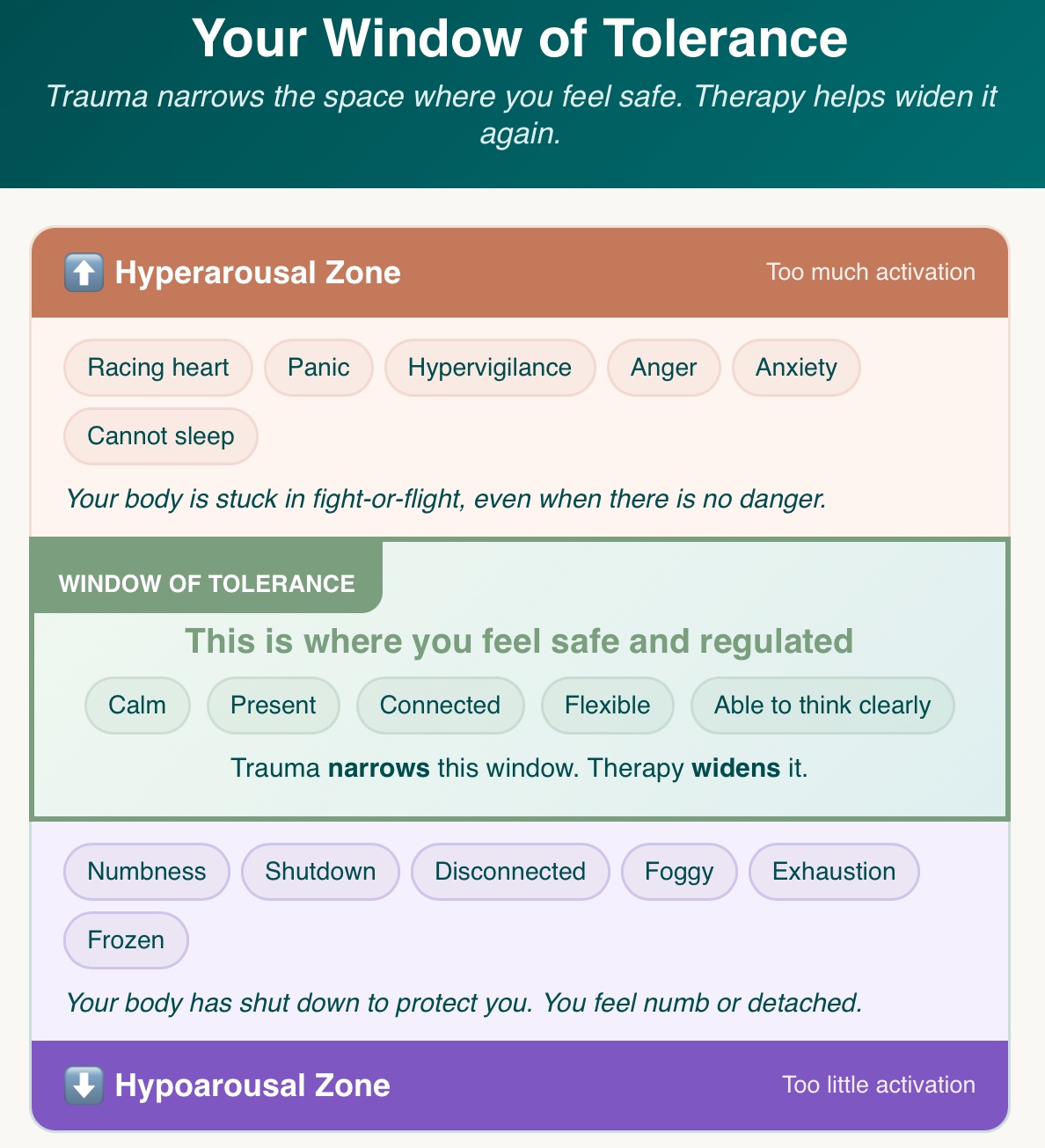
Trauma in adulthood can stem from recent events, past experiences, or long-term stress. Many adults describe feeling stuck in emotional patterns, unsure why they react strongly at times, or unable to relax even in safe situations.
You might notice:
At Chrysalis Psychology & Wellbeing, we help adults understand their nervous system, create emotional safety, and learn strategies that support stability, healing, and resilience. We use a range of individual psychology techniques including EMDR, Schema Therapy, and Trauma-Focused CBT

Children and adolescents often show trauma through behaviour, emotions, or physical responses rather than words. They may not be able to describe what has happened or how it affects them.
Families may notice:
At Chrysalis Psychology & Wellbeing, we provide developmentally sensitive support that helps young people understand their feelings, build emotional safety, and develop tools to navigate daily life.
We use trauma-informed, evidence-based approaches that prioritise safety, understanding, and gradual change.
EMDR helps the brain process distressing memories in a safe and structured way. The World Health Organisation recommends EMDR as an effective treatment for trauma-related conditions [3].
Schema Therapy helps you identify and change deep-rooted emotional patterns that developed early in life. By understanding unmet childhood needs, you can heal past wounds and build healthier relationships.
CBT-T helps individuals understand how trauma affects their thoughts, emotions, and behaviours. It supports people to gently process trauma memories and rebuild a sense of safety and control.
We start by building grounding strategies, regulation skills, and stability before working on deeper trauma material.
Our psychologists support you to rebuild confidence, reconnect with meaningful relationships, and regain a sense of safety in daily life.
Your first session is about understanding. We listen to what is happening for you, how things show up in your day, and what you hope to change. Together we create a plan that feels clear, supportive, and manageable.
Therapy at Chrysalis Psychology & Wellbeing moves at a pace that feels safe while still supporting steady progress. You remain in control of the process.
Sessions with our psychologists are available face-to-face at our Battery Point rooms in Hobart, Tasmania, and via telehealth for clients anywhere in Australia. Our psychologists are experienced in working with Medicare Mental Health Treatment Plans, DVA, NDIS (self-managed and plan-managed), WorkCover, and private health insurance.
[1] Phoenix Australia (2021). Australian Guidelines for the Prevention and Treatment of Acute Stress Disorder, PTSD and Complex PTSD.https://www.phoenixaustralia.org/australian-guidelines-for-ptsd/
[2] Australian Institute of Health and Welfare (2024). Mental health: Prevalence and impact. https://www.aihw.gov.au/mental-health
[3] World Health Organisation (2013). Guidelines for the Management of Conditions Specifically Related to Stress. https://www.who.int/publications/i/item/9789241505406


.webp)
