
Contact Us
Contact Us
At Chrysalis Psychology & Wellbeing, our psychologists in Hobart and via telehealth across Australia help people understand why their brain is stuck in worry mode and learn how to turn the volume down. Please contact us for more information.
.svg)
You have already thought about what could go wrong today. And tomorrow. And next week. You have mentally rehearsed conversations, planned for problems that have not happened, and checked your phone more times than you can count.
Other people seem to let things go. You cannot. Your mind is always on. Always scanning. Always asking, “But what if?”
If worry has become the background noise of your life, you may be experiencing Generalised Anxiety Disorder, or GAD. It is more common than you might think.
The Australian Bureau of Statistics National Study of Mental Health and Wellbeing (2020–2022) found that anxiety disorders are the most frequently diagnosed group of mental disorders in Australia, with GAD being one of the most common forms [1].
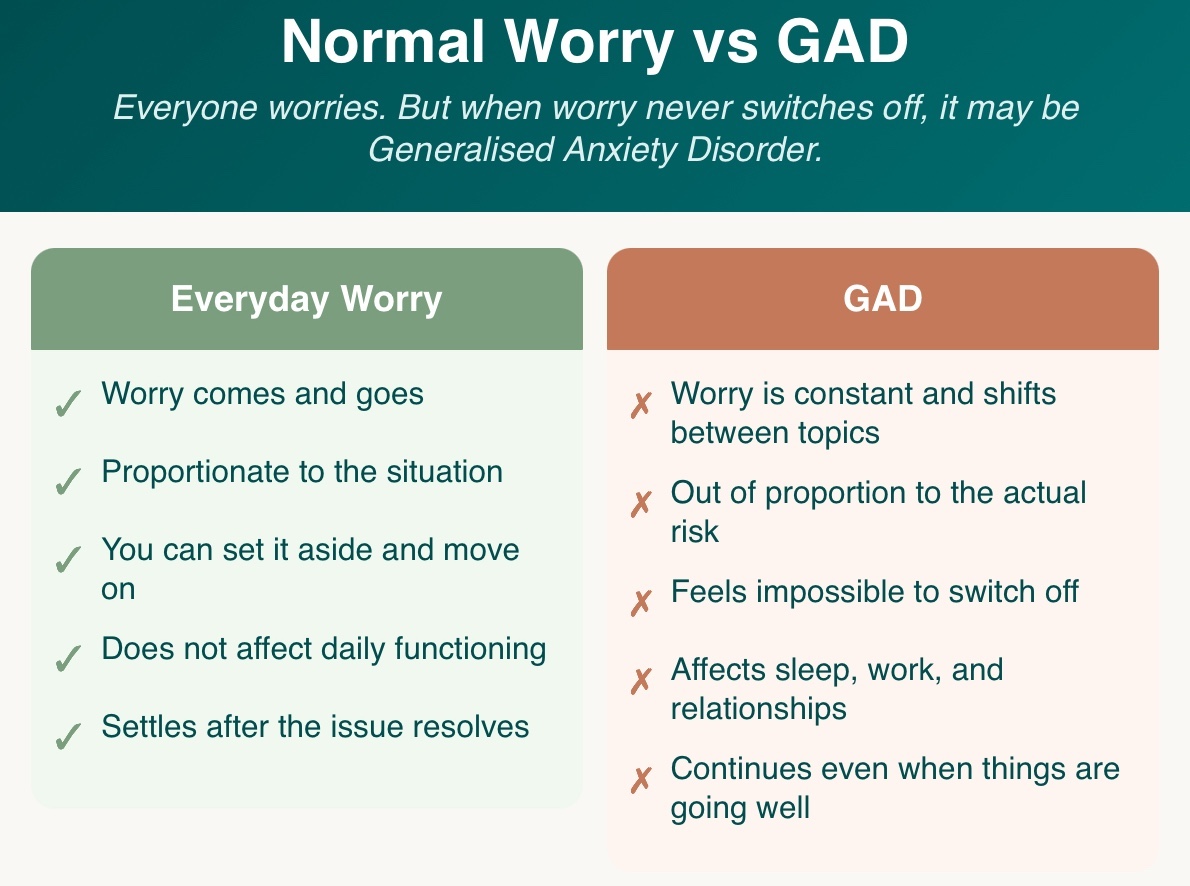
Everyone worries sometimes. That is normal. But with GAD, worry becomes persistent, difficult to control, and out of proportion to the situation. The worry shifts from one topic to another, making it feel constant and exhausting.
GAD might look like:
GAD is different from everyday stress because the worry is disproportionate, persistent, and difficult to switch off.
Adults with GAD often describe feeling constantly “switched on.” You might look calm on the outside, but inside, your brain is running through worst-case scenarios, mentally preparing for things that may never happen.
You might notice:
At Chrysalis Psychology & Wellbeing, we use a range of individual psychology techniques to help adults reduce unhelpful worry patterns, build tolerance for uncertainty, and develop strategies that support calm and confidence in daily life.
Children with GAD worry about many things, often all at once. They may worry about school, friendships, family safety, natural disasters, or whether they have done something wrong. Their worries can feel very real and very urgent.
Families might notice:
At Chrysalis Psychology & Wellbeing, we use a range of individual psychology techniques to help young people understand worry, learn that uncertainty is manageable, and build coping skills that grow with them.
Our approach is practical, evidence-based, and designed for your real life.
We help you see how worry operates: what triggers it, what keeps it going, and why telling yourself “just stop worrying” does not work.
You will learn practical techniques for catching worry early, responding to anxious thoughts more flexibly, and calming your nervous system when it is running hot.
GAD is often fuelled by a need to know that everything will be okay. We help you build confidence in your ability to cope with not knowing, which is one of the most powerful shifts in anxiety treatment.
Our psychologists use CBT, acceptance and commitment therapy (ACT) and nervous system regulation techniques. These approaches are recommended by the Australian Psychological Society [2] and supported by international clinical guidelines [3].
Your first session is about understanding. We listen to what is happening for you, how things show up in your day, and what you hope to change. Together we create a plan that feels clear, supportive, and manageable.
Therapy at Chrysalis Psychology & Wellbeing moves at a pace that feels safe while still supporting steady progress. You remain in control of the process.
Sessions with our psychologists are available face-to-face at our Battery Point rooms in Hobart, Tasmania, and via telehealth for clients anywhere in Australia . Our psychologists are experienced in working with Medicare Mental Health Treatment Plans, DVA, NDIS (self-managed and plan-managed), WorkCover, and private health insurance.
[1] Australian Bureau of Statistics (2023). National Study of Mental Health and Wellbeing, 2020–2022.https://www.abs.gov.au/statistics/health/mental-health/national-study-mental-health-and-wellbeing/latest-release
[2] Australian Psychological Society (2018). Evidence-based Psychological Interventions in the Treatment of Mental Disorders.https://psychology.org.au/for-the-public/psychology-topics/evidence-based-psychological-interventions
[3] National Institute for Health and Care Excellence (NICE) (2020). Generalised anxiety disorder and panic disorder in adults: management. https://www.nice.org.uk/guidance/cg113


.webp)
