
Contact Us
Contact Us
At Chrysalis Psychology & Wellbeing, our psychologists in Hobart help children, young people, and adults build a more compassionate and balanced view of themselves. We also offer telehealth psychology across Australia. Please contact us for more information.
.svg)
You got the promotion, but you are waiting to be found out. You handled a difficult conversation well, but all you can think about is what you should have said differently. Someone compliments you and your first instinct is to dismiss it.
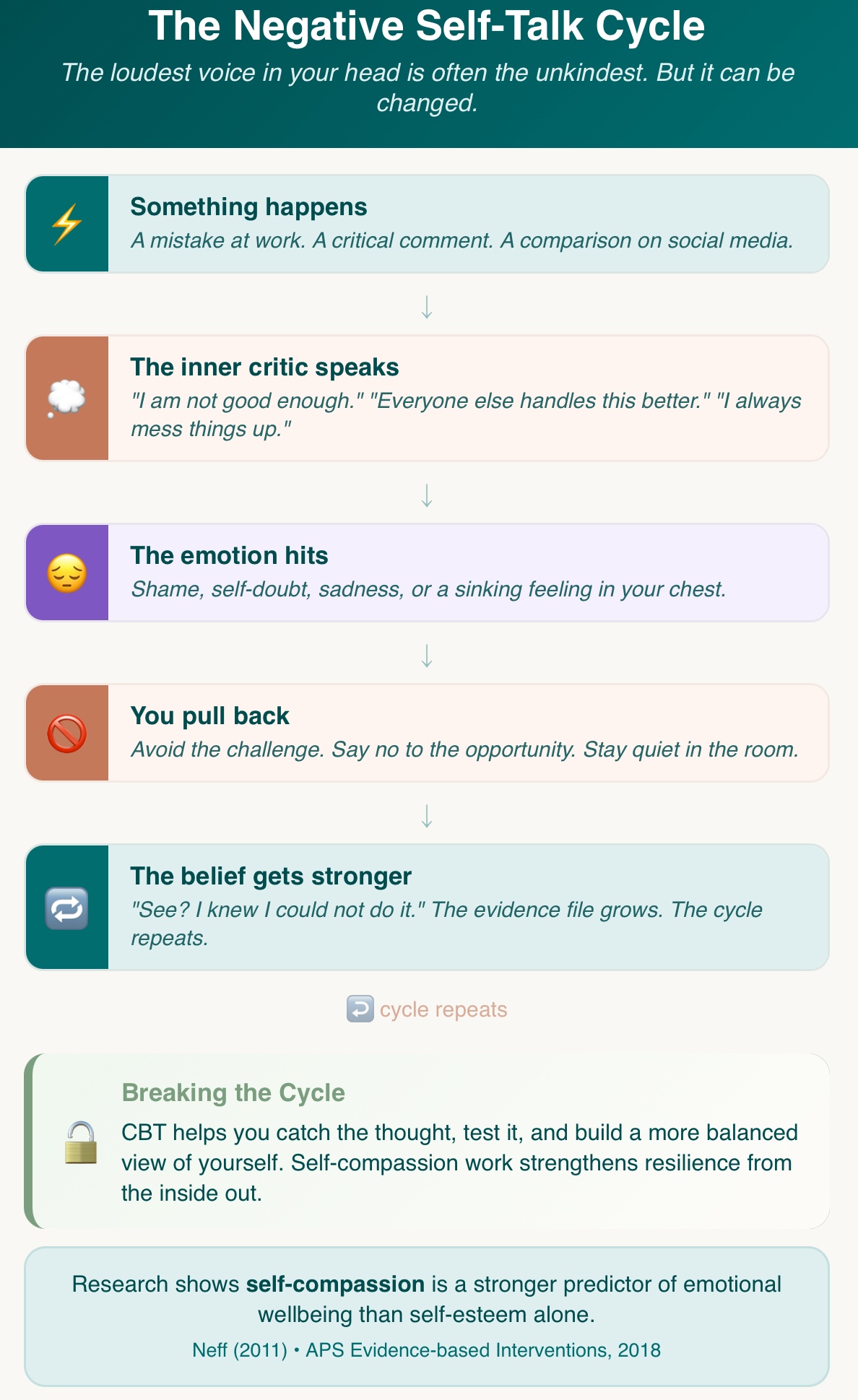
That voice inside your head, the one that says you are not good enough, not smart enough, not trying hard enough, is relentless. It turns achievements into flukes and mistakes into evidence of who you really are.
Low self-esteem is not a personality flaw. It is a pattern, and patterns canchange.
Research consistently shows that self-esteem is influenced by life experiences, relationships, and thinking habits, all of which can be addressed in therapy [1].
Self-esteem refers to how we value ourselves. Confidence relates to how capable we feel indifferent situations. When either is low, daily life can feel harder than it needs to be.
Low self-esteem might show up as:
Adults may experience reduced self-esteem due to work stress, relationship difficulties, burnout, health concerns, or past experiences. Many people describe feeling capable on the outside but uncertain or self-doubting internally.
You might notice:
At Chrysalis Psychology & Wellbeing, we use a range of individual psychology techniques to help adults build self-understanding, challenge unhelpful beliefs, and develop confidence that feels grounded and authentic.
Children and young people are still developing their sense of self. Self-esteem challenges can show up through behaviour, emotions, or social withdrawal.
Families may notice:
At Chrysalis Psychology & Wellbeing, we provide developmentally appropriate support that helps young people recognise strengths, develop resilience, and build confidence.
Our teams approach is supportive, practical, and tailored to the individual.
We help individuals understand their inner dialogue and develop a kinder, more balanced relationship with themselves. Research by Kristin Neff and colleagues demonstrates that self-compassion is a stronger predictor of emotional wellbeing than self-esteem alone [2].
We support you to recognise and shift negative thinking patterns that undermine confidence.
We develop tools to manage setbacks, mistakes, and criticism more effectively.
We support gradual exposure to challenges that build competence and self-belief.
Your first session is about understanding. We listen to what is happening for you, how things show up in your day, and what you hope to change. Together we create a plan that feels clear, supportive, and manageable.
Therapy at Chrysalis Psychology & Wellbeing moves at a pace that feels safewhile still supporting steady progress. You remain in control of the process.
Sessions with our psychologists are available face-to-face at our Battery Point rooms in Hobart, Tasmania, and via telehealth for clients anywhere in Australia. Our psychologists are experienced in working with Medicare Mental Health Treatment Plans, DVA, Open Arms, NDIS (self-managed and plan-managed), WorkCover, National Redress Scheme, and private health insurance
[1] Australian Psychological Society (2018). Evidence-based Psychological Interventions. https://psychology.org.au/for-the-public/psychology-topics/evidence-based-psychological-interventions
[2] Neff,K.D. (2011). Self-Compassion: The Proven Power of Being Kind to Yourself. William Morrow. https://books.google.com.au/books?hl=en&lr=&id=PDAEzLL9mscC&oi=fnd&pg=PT7&dq=Neff,K.D.+(2011).+Self-Compassion:+The+Proven+Power+of+Being+Kind+to+Yourself.+William+Morrow.&ots=Afw3j6ov45&sig=HN2aFZXmFgP0Qa77FOpwZ52loew#v=onepage&q&f=false
[3] BeyondBlue (2024). Building resilience and self-esteem. https://www.beyondblue.org.au/the-facts


.webp)
