
Contact Us
Contact Us
At Chrysalis Psychology & Wellbeing, our psychologists in Hobart helps people of all ages and life stages understand the sources of their stress, rebuild their capacity, and develop practical strategies that create real breathing room. We also offer telehealth psychology across Australia for people who cannot attend in person. Please contact us for more information.
.svg)
There is always something. A deadline that keeps moving. A family member who needs more than you have left. A financial worry that sits just beneath every other thought. You keep moving because that is what you do. But you notice your patience is shorter than it used to be. Your sleep is lighter. The things you used to enjoy feel like obligations.
You tell yourself you will slow down when things settle. But things never quite settle. And somewhere between keeping up and keeping it together, you have stopped knowing how you actually feel.
Stress is a normal part of life. But when it becomes chronic, or when it escalates into burnout, it affects your physical health, your emotional wellbeing, your relationships, and your capacity to function.
The Australian Psychological Society Stress and Wellbeing Survey consistently identifies Australian adults as experiencing high levels of personal stress, with work, health, and financial pressures cited as the most common sources [1].
Stress is the body and brain responding to demand. In short bursts, it can sharpen focus and motivate action. But when stress is prolonged or overwhelming, those same systems that were designed to protect you begin to wear you down.
Stress may show up as:
The World Health Organisation identifies stress as a significant contributor to a range of physical and mental health conditions when left unmanaged, including anxiety disorders, depression, and cardiovascular disease [2]. Addressing stress proactively is one of the most protective things you can do for your long-term health and wellbeing.
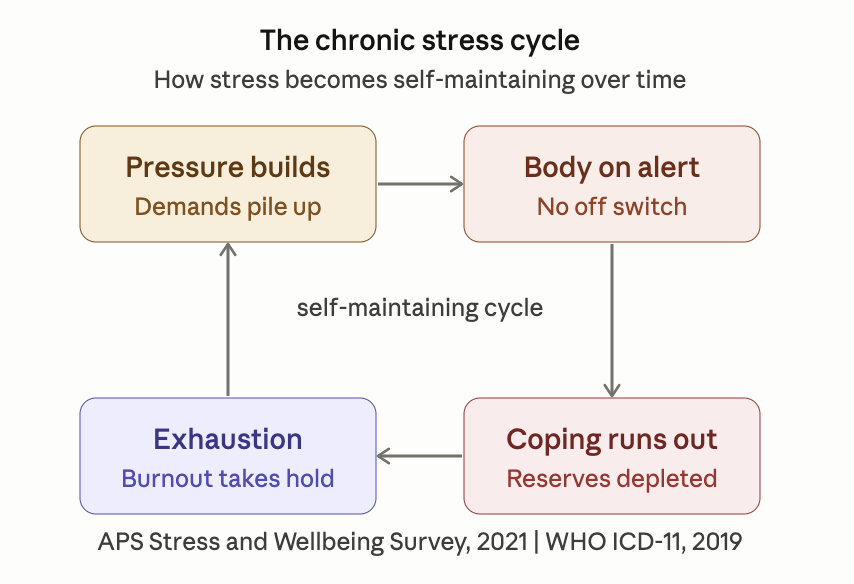
Burnout is aspecific and serious form of chronic work-related stress. Recognised by the World Health Organisation as an occupational phenomenon, burnout is characterised by exhaustion, increasing mental distance from work, and reduced professional effectiveness [2].
You may be experiencing workplace burnout if you notice:
Burnout is not a sign of weakness. It is a sign that you have been giving more than your system can sustainably provide. At Chrysalis Psychology & Wellbeing, our psychologists in Hobart works with adults across a range of industries and professional roles to rebuild capacity, restore boundaries, and reconnect with meaningful work. Telehealth sessions are also available Australia-wide.
Children and young people experience stress differently from adults, but it is no less real. Academic pressure, social dynamics, family stress, and life transitions can all significantly affect a young person's wellbeing.
Families may notice:
At Chrysalis Psychology & Wellbeing, we provide developmentally appropriate support that helps young people understand their stress responses, develop coping skills, and rebuild a sense of confidence and calm.
Our approach is practical, evidence-based, and tailored to your life.
We explore what is driving your stress, how it shows up in your body and behaviour, and what is getting in the way of recovery.
You will learn practical tools for calming the nervous system, managing overwhelm, and responding to stress more flexibly. The Australian Psychological Society recommends ACT and CBT as evidence-based approaches for stress and burnout [3].
We support you to reconnect with what matters to you and build boundaries that protect you renergy and wellbeing over the long term.
We help you identify changes to sleep, physical activity, social connection, and daily structure that support genuine recovery from chronic stress.
Your first session is about understanding. We listen to what is happening for you, how things show up in your day, and what you hope to change. Together we create aplan that feels clear, supportive, and manageable.
Therapy at ChrysalisPsychology & Wellbeing moves at a pace that feels safe while stills upporting steady progress. You remain in control of the process. Sessions with our psychologists are available face-to-face at our Battery Point rooms in Hobart, Tasmania, and via telehealth for clients anywhere in Australia. Our psychologists are experienced in working with Medicare Mental Health Treatment Plans, DVA, Open Arms, National Redress Scheme, NDIS (self-managed and plan-managed), WorkCover, and private health insurance.
[1]Australian Psychological Society (2021). Stress and Wellbeing Survey. https://psychology.org.au/for-the-public/psychology-topics/stress
[2] World Health Organisation (2019). Burn-out an occupational phenomenon: International Classification of Diseases. https://www.who.int/news/item/28-05-2019-burn-out-an-occupational-phenomenon-international-classification-of-diseases
[3]Australian Psychological Society (2018). Evidence-based Psychological Interventions in the Treatment of Mental Disorders. https://psychology.org.au/for-the-public/psychology-topics/evidence-based-psychological-interventions
[4] Australian Bureau of Statistics (2023). National Study of Mental Health andWellbeing, 2020-2022. https://www.abs.gov.au


.webp)
