
Contact Us
Contact Us
At Chrysalis Psychology & Wellbeing, our psychologists in Hobart provide comprehensive ADHD assessment and evidence-based therapy for children, adolescents, and adults. We also offer telehealth psychology across Australia. Please contact us for more information.
.svg)
You have always had to work harder to keep up. Lists everywhere, forgotten again. You sit down to do one thing and forty minutes later you are somewhere else entirely, with no clear memory of how you got there. The ideas come fast and brilliant, and then disappear before you can catch them.
You have been called
Or maybe you are a parent watching your child struggle: the homework battles, the teacher comments, the child who is clearly bright but cannot seem to organise their world. The frustration on both sides. The worry underneath it.
ADHD (Attention Deficit Hyperactivity Disorder) is an neurodevelopmental condition affecting attention regulation, impulse control, and executive functioning.
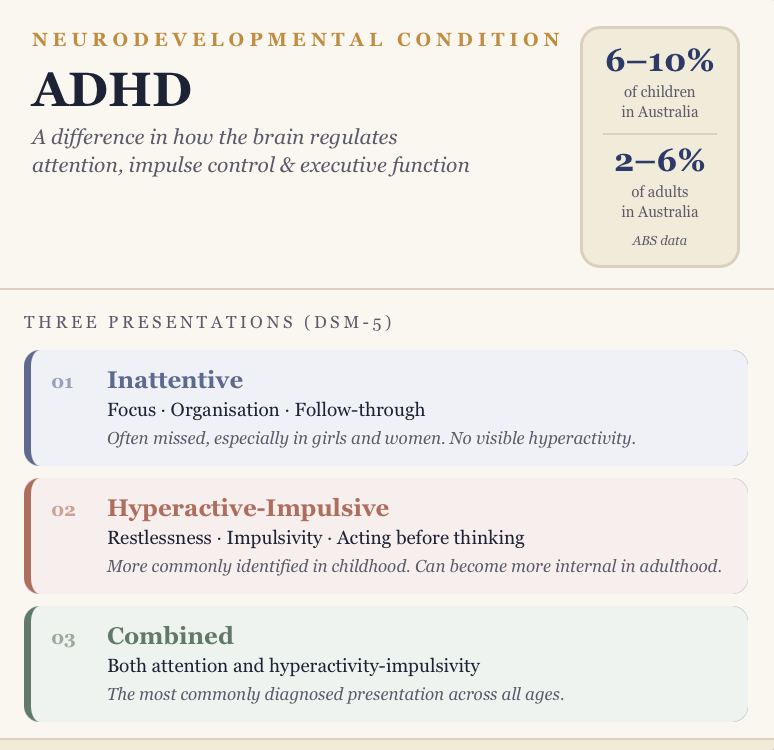
The Australian Bureau of Statistics estimates that ADHD affects approximately 6 to 10 per cent of children and 2 to 6 per cent of adults in Australia, making it one of the most prevalent neurodevelopmental conditions across the lifespan [1].
ADHD is a difference in how the brain regulates attention, impulse control, and executive function. It is not a failure of intelligence or effort. Research using neuroimaging has demonstrated consistent differences in brain structure and function in individuals with ADHD, particularly in areas involved in executive functioning, working memory, and reward processing [2].
ADHD presents in three types as defined by the DSM-5 [3]:
ADHD does not look the same across ages. In children, it may be most visible as hyperactivity, impulsivity, and difficulty in structured settings. In adolescents and adults, hyperactivity often becomes more internal, presenting as restlessness, racing thoughts, and chronic underperformance relative to ability. Many adults with ADHD were not diagnosed in childhood and have spent years developing compensatory strategies that eventually become insufficient under the demands of adulthood.
Adult ADHD is significantly under diagnosed. Many adults arrive at assessment having spent their lives believing they were lazy, disorganised, or simply not trying hard enough. A diagnosis in adulthood often brings profound relief: a framework that finally explains a lifetime of experiences that never made sense before.
Adults with ADHD commonly experience difficulties in work performance and career progression, relationship management, financial organisation, emotional regulation, and chronic procrastination. Co-occurring anxiety, depression, and sleep difficulties are common and frequently develop as secondary consequences of unmanaged ADHD over time.
For children and young people, an accurate ADHD assessment can be a turning point. It replaces confusion and blame with understanding, and opens the door to practical strategies and school-based supports that make a genuine difference. The earlier ADHD is identified and supported, the better the educational and social outcomes for the child.
Children with ADHD benefit from approaches that build executive functioning skills, manage frustration, and support the development of organisation and self-regulation. Family involvement is an important part of treatment, and we work with parents to develop consistent, effective approaches across home and school settings.
A comprehensive ADHD assessment provides a definitive diagnostic picture and, critically, a set of practical, individualised recommendations that go beyond a simple yes or no answer.
Our assessments include clinical interviews, behavioural rating scales, review of developmental history, and cognitive testing where indicated.
Cognitive testing is not required for every ADHD assessment but adds significant value where symptom presentation is complex, co-occurring conditions are suspected, or specific school or workplace accommodations are being sought.
Please see our assessment services page and our blog post on cognitive testing in ADHD and autism assessments for more information.
Diagnosis is the beginning, not the end. Psychological therapy for ADHD builds the practical skills, strategies, and self-understanding that translate a diagnosis into meaningful improvement in daily life.
CBT for ADHD: Adapted CBT for ADHD addresses the thought patterns and behavioural habits that maintain ADHD-related difficulties, including procrastination, avoidance, and negative self-beliefs that have developed over years of struggling [4].
Executive functioning coaching: We build practical systems for organisation, time management, task initiation, and working memory that are genuinely adapted to the way an ADHD brain works.
Emotion regulation skills: Emotional dysregulation is a core feature of ADHD for many people. We draw on DBT skills and other evidence-based approaches to build capacity for managing intense emotions.
NDIS support: We provide ADHD-related psychology under NDIS Improved Daily Living and can provide assessment reports for NDIS access and plan reviews.
For assessments, your initial session gathers background information and history before we proceed to the assessment itself.
Assessment typically involves two to three appointments followed by a feedback session where results are explained in plain, practical language. For therapy, your first session is about understanding your specific ADHD profile and what you want to be different.
Sessions are available face-to-face at our Battery Point rooms in Hobart, Tasmania, and via telehealth for clients anywhere in Australia. We accept Medicare Mental Health Treatment Plans, NDIS (self-managed and plan-managed), DVA, National Redress Scheme and private health insurance.
[1] Australian Bureau of Statistics (2023). Attention Deficit Hyperactivity Disorder (ADHD). https://www.abs.gov.au/statistics/health/health-conditions-and-risks
[2] Cortese, S. (2012). The neuroscience and genetics of ADHD: From animal models to clinical translation.Neuroscience & Bio behavioral Reviews, 36(4), 1120–1133.
[3] American Psychiatric Association (2022). Diagnostic and Statistical Manual of Mental Disorders (5thed., text revision). American Psychiatric Publishing.
[4] Safren, S.A. et al.(2010). Cognitive behavioral therapy vs relaxation with educational support form edication-treated adults with ADHD. JAMA, 304(8), 875–880.


.webp)
