
Contact Us
Contact Us
At Chrysalis Psychology & Wellbeing, our psychologists in Hobart help children, young people, and adults build emotional awareness, strengthen regulation skills, and develop healthier ways of responding to challenges. Our psychologists are also available via telehealth across Australia. Please contact us for more information.
.svg)
One moment you are fine. The next, a small frustration hits and suddenly everything is too much. You snap. You cry. You shut down. Or you feel nothing at all, which somehow feels worse.
You know your reactions are out of proportion. You can see it afterwards. But in the moment, it is like a wave that takes over before you can catch it.
If this is your experience, you are not broken. Emotion regulation is a skill, and like any skill, it can be strengthened.
The Australian Psychological Society recognises that difficulties with emotion regulation are a common factor across many mental health conditions, including anxiety, depression, and trauma-related presentations [1].
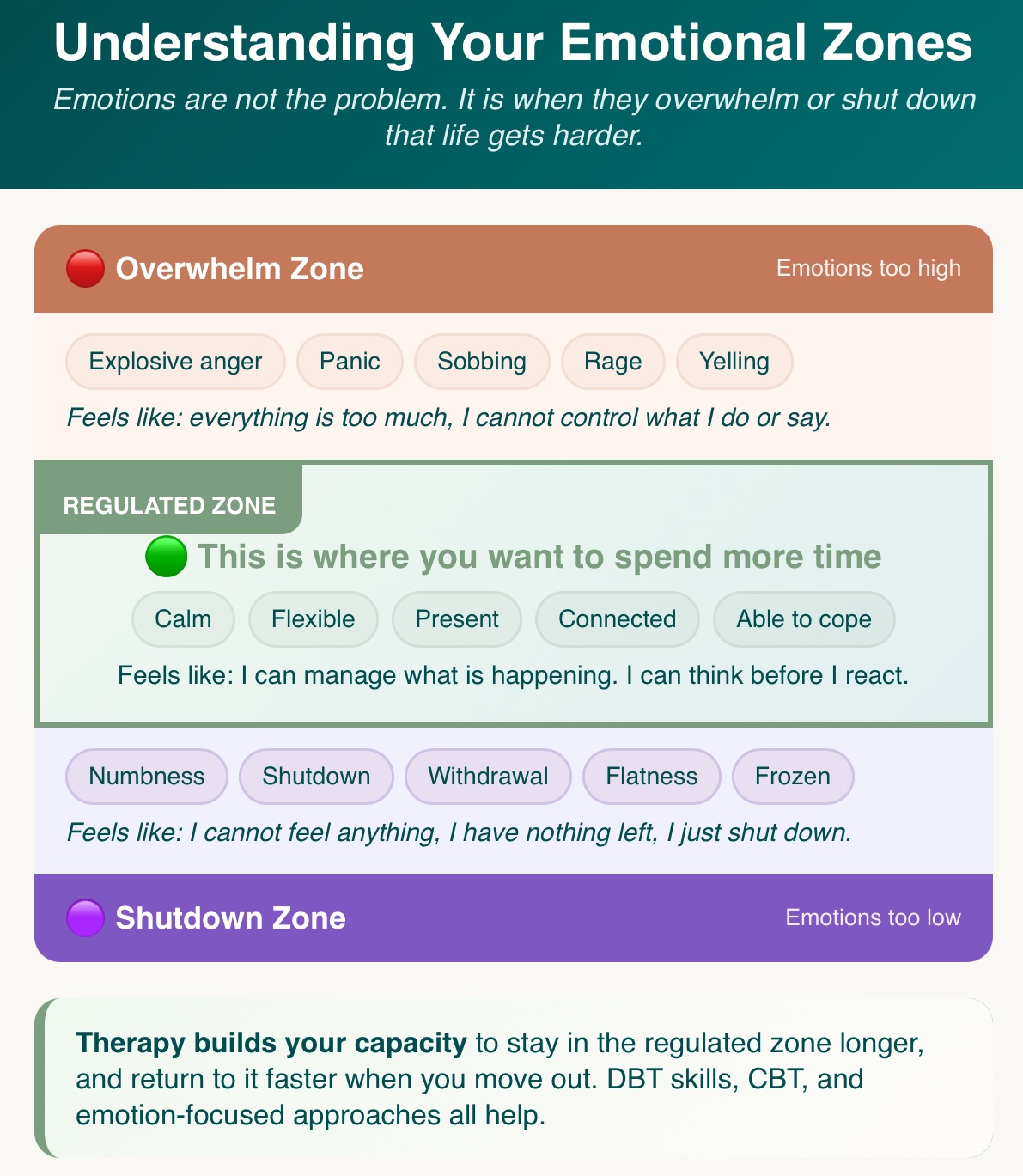
Emotion regulation refers to our ability to recognise, understand, and manage emotions in a way that supports wellbeing and everyday functioning. When regulation is difficult, feelings can become overwhelming, unpredictable, or hard to settle.
Difficulties with emotion regulation may show up as:
Emotion regulation difficulties can be influenced by temperament, life experiences, stress, trauma, neurodiversity, or ongoing demands. They are not a personal failing, and they can be improved with the right support.
Adults may experience emotion regulation difficulties while managing work, relationships, parenting, health concerns, or major life transitions. Many people describe feeling “on edge,” emotionally drained, or reactive in ways that do not reflect how they want to respond.
You might notice:
At Chrysalis Psychology & Wellbeing, we offer a range of individual psychology techniques to help adults understand their emotional patterns, strengthen coping strategies, and build greater emotional flexibility and resilience.
Children and young people are still learning how to understand and manage emotions. When regulation is difficult, families often see the results before they understand the cause.
You might notice:
At Chrysalis Psychology & Wellbeing, we provide developmentally appropriate support that helps young people build emotional awareness, coping skills, and confidence in managing their feelings.
Our approach is practical, compassionate, and evidence-informed.
We help individuals recognise emotions, body signals, and early warning signs of overwhelm.
We teach tools to calm the nervous system, reduce emotional intensity, and recover more quickly after stress. Our psychologists draw on dialectical behaviour therapy(DBT) skills, which are specifically designed to strengthen emotion regulation[2]. We offer DBT in individual psychology and group therapy.
We provide guidance to help adults support children’s emotional development in everyday settings.
Your first session is about understanding. We listen to what is happening for you, how things show up in your day, and what you hope to change. Together we create a plan that feels clear, supportive, and manageable.
Therapy at Chrysalis Psychology & Wellbeing moves at a pace that feels safewhile still supporting steady progress. You remain in control of the process.
Sessions with our psychologists are available face-to-face at our Battery Point rooms in Hobart, Tasmania, and via telehealth for clients anywhere in Australia. Our psychologists are experienced in working with Medicare Mental Health Treatment Plans, DVA, Open Arms NDIS (self-managed andplan-managed), WorkCover, National Redress Scheme and private health insurance.
[1] Australian Psychological Society (2018). Evidence-based Psychological Interventions. https://psychology.org.au/for-the-public/psychology-topics/evidence-based-psychological-interventions
[2] Linehan,M.M. (2015). DBT Skills Training Manual. Guilford Press. https://www.guilford.com/books/DBT-Skills-Training-Manual/Marsha-Linehan/9781462516995
[3] BeyondBlue (2024). Mental health information and support. https://www.beyondblue.org.au/the-facts


.webp)
