
Contact Us
Contact Us
At Chrysalis Psychology & Wellbeing, our psychologists provide neurodiversity-affirming autism assessment and autism therapy in Hobart, with telehealth options across Australia. We assess and support children, teenagers, and adults, including those exploring a possible late diagnosis. Our work is grounded in the National Autism Strategy 2025-2031 and the latest research on autistic experience.
.svg)
There is a moment, often after years of feeling subtly out of step, when something clicks. A friend mentions autism. You read an article about late-diagnosed women. You watch your child organise their toys in a particular order, again, and notice the calm in their face when nobody interrupts. You start to wonder. Not because something is wrong, but because something might finally make sense.
Autism is a neurological difference, not a disease, and not something caused by parenting. Autistic brains process the world differently. It shapes how a person processes sensory information, communicates, relates to others, and engages with the world. The experience of autism is highly individual: no two autistic people are the same.
People with autism often think in patterns, notice details others miss, feel deeply, and bring honesty and depth to their relationships and work. Autism also brings real challenges, particularly when the surrounding world is built for a different kind of brain.
According to the Australian Bureau of Statistics, approximately 1 in 40 Australians has autism, and that figure is rising as awareness grows and diagnostic practice improves. Autism is the largest single category in the National Disability Insurance Scheme, accounting for more than 30 percent of all NDIS participants. The Australian Government's National Autism Strategy 2025-2031, launched in 2025, recognises that diagnosis often happens later for girls, women, gender-diverse people, and those living in regional areas, and commits to closing this gap.
Autistic experience varies enormously from person to person, which is why the term"spectrum" is used. The areas below are not symptoms to be fixed. They are dimensions of autistic experience that can bring both strengths and challenges, depending on the environment.
Autism may present as:
Research published in The Lancet Psychiatry found that autistic people are significantly more likely to experience co-occurring conditions including anxiety, depression, ADHD, and sensory processing difficulties. Support that is genuinely autism-affirming and also addresses these co-occurring experiences is essential.
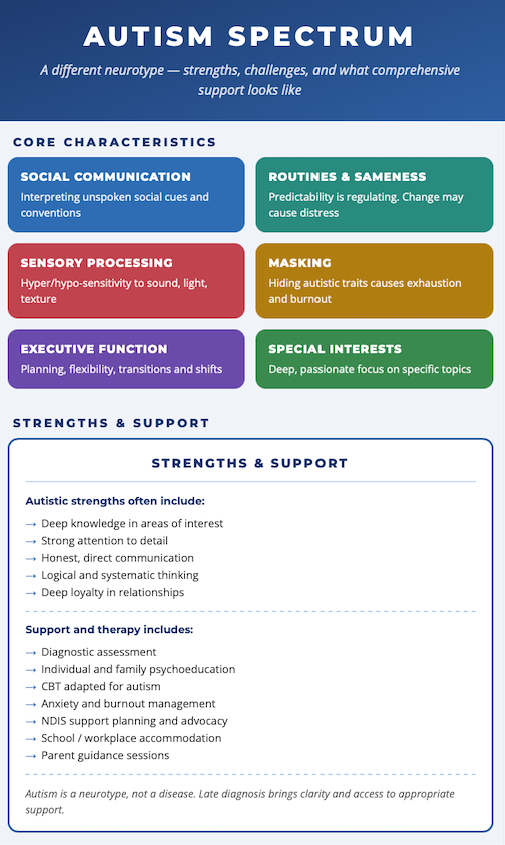
Many adults arrive at a formal autism assessment having spent years wondering why certain things feel harder for them than for others. Some have been previously diagnosed with anxiety, depression, or other conditions without the underlying autistic profile being recognised.
An autism assessment in adulthood can bring clarity, relief, and access to appropriate support. It can help explain a life time of social exhaustion, sensory overwhelm, or a persistent sense of not quite belonging. It can also open doors to NDIS funding and other supports for eligible individuals.
At Chrysalis Psychology & Wellbeing, our psychologists in Hobart conduct autism assessments for adults and provide ongoing therapy that is genuinely autism-affirming and tailored to each person's unique profile. Our telehealth psychology service makes therapy accessible for people across Australia.
For children and young people, an autism assessment can be a turning point. It provides language for experiences that may have been confusing or distressing. It gives families, schools, and other professionals a shared framework for understanding and supporting the child more effectively.
Early assessment and support can significantly improve outcomes in communication, social skills, emotional regulation, and academic participation. However, an assessment is valuable at any age. Many young people are identified during their teenage years, and targeted support at any stage makes a meaningful difference.
At Chrysalis Psychology & Wellbeing, we provide comprehensive autism assessments for children and young people, as well as individual therapy,and family support.
A comprehensive autism assessment is a process, not a single appointment. It is grounded in clinical interviewing, standardised tools, observation, and information from people who know the person well. The goal is not to label, but to understand.
Our autism assessment includes:
We follow neurodiversity-affirming practice as outlined in the National Autism Strategy 2025-2031 and current Australian research on autistic-led assessment design (Flower et al., 2025).
Our approach is always autism-affirming. We work to understand each person's individual profile of strengths and support needs before recommending any intervention.
Autism Assessment: We conduct comprehensive autism assessments using gold-standard tools. Our assessment reports are thorough, clearly written, and include practical, individualised recommendations. Please see our assessment services page for full information.
Individual Therapy: We provide therapy for children, adolescents, and adults addressing anxiety, emotional regulation, burnout, masking, sensory overwhelm, social navigation, and identity.
NDIS Support: We work with self-managed and plan-managed NDIS participants and can provide reports to support NDIS applications and plan reviews.
Our psychologists draw on CBT, ACT, DBT skills, and sensory-informed approaches, always tailored to the individual and their specific goals.
If you are exploring autism, it is worth knowing that 40 to 60 percent of people with autism also have ADHD. The two conditions interact in distinctive ways, and treatment is more effective when both are understood. We offer ADHD assessment alongside autism assessment, either separately or as a combined neurodevelopmental assessment.
For assessments, your initial session focuses on gathering developmental history and background information. Assessment typically involves multiple sessions across several appointments, followed by a feedback session where results and recommendations are explained in plain, practical language. For therapy, your first session is about understanding your experience and setting goals that matter to you.
Sessions are available face-to-face at our Battery Point rooms in Hobart and via telehealth across Australia. We accept Medicare Mental Health Treatment Plans, NDIS (self-managed and plan-managed), DVA, Open Arms, National Redress Scheme, and private health insurance.


.webp)
