
Contact Us
Contact Us
At Chrysalis Psychology & Wellbeing, our relationship psychologists in Hobart help individuals understand and navigate relationship difficulties of all kinds. We also offer telehealth psychology across Australia. Please contact us for more information.
.svg)
It is not that you do not try. You do. You think about what you are going to say before you say it. You tell yourself this time it will be different. And then something shifts in the room and you are back in the same pattern, the same argument, the same silence afterward that stretches out for days.
Or perhaps it is a different kind of difficult. The friendships that have faded without you knowing how to ask for what you need. The family member whose words stay with you long after the conversation ends. The intimacy in a relationship you value that has quietly become distant, and neither of you quite knows how to bridge it. The work colleague who triggers something old and familiar in you, and you cannot explain why.
Relationship difficulties are among the most common reasons people seek psychological support. Research from the Australian Institute of Family Studies confirms that the quality of close relationships is one of the strongest predictors of mental health and life satisfaction, and that relationship distress significantly elevates the risk of depression and anxiety [1].
Relationship difficulties can arise in any type of relationship: romantic partnerships, family relationships, friendships, or workplace relationships. They often involve recurring patterns of conflict, communication breakdown, emotional disconnection, or persistent feelings of being misunderstood, unseen, or unsupported.
Many relationship difficulties are maintained by patterns that developed long before the current relationship, often rooted in early attachment experiences. Attachment theory, developed by John Bowl by and extended by researchers including Mary Ainsworth, demonstrates that the ways we learned to relate to caregivers in childhood shape our expectations, fears, and behaviours in adult relationships [2]. Understanding your attachment patterns is often a powerful starting point for change
A meta-analysis published in Psychological Bulletin found that insecure attachment styles are significantly associated with relationship dissatisfaction, mental health difficulties, and interpersonal conflict across the lifespan [3]. The good news is that attachment patterns are not fixed. They can be understood and gradually changed through therapeutic work.
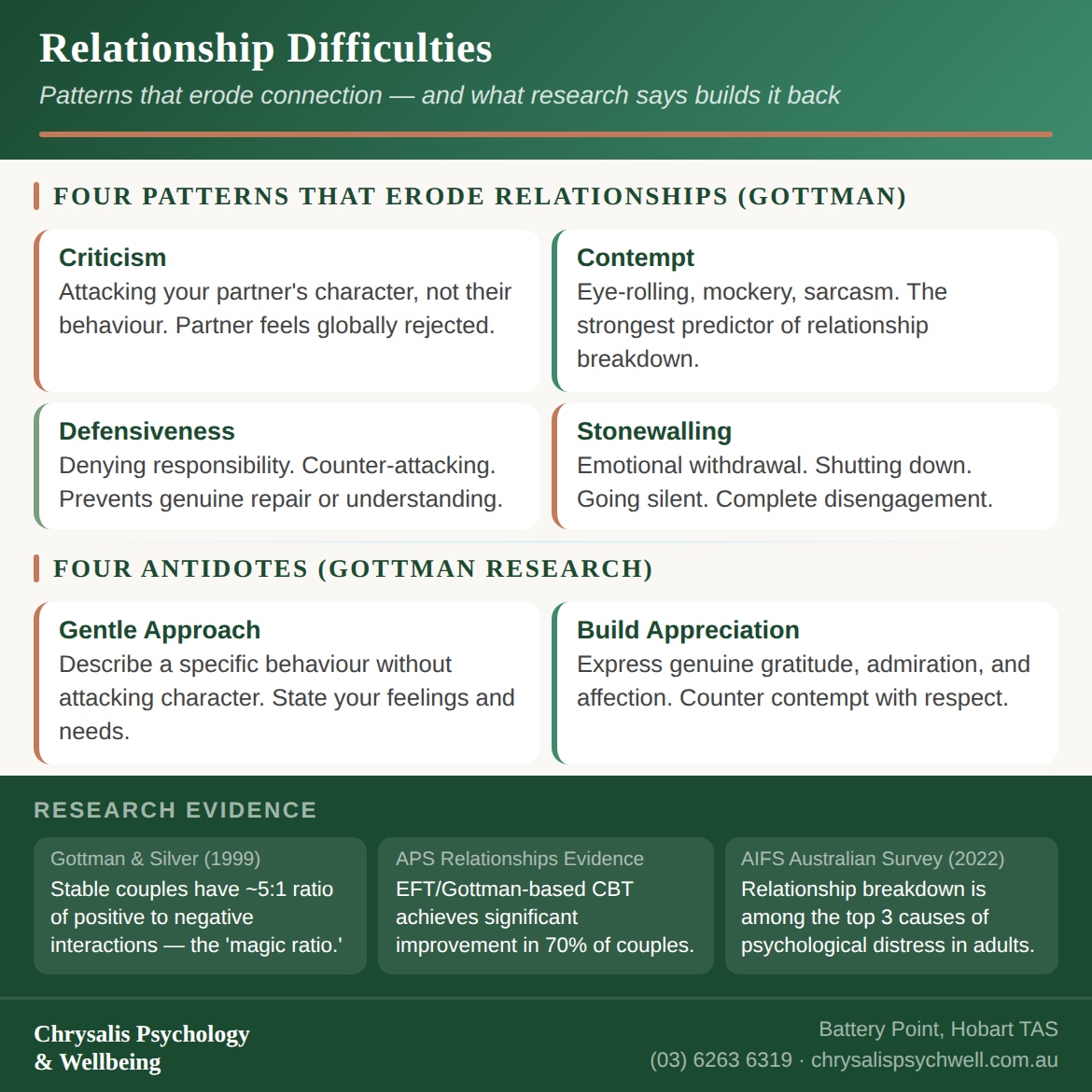
Attachment styles influence how we respond to closeness and distance in relationships. Someone with an anxious attachment style may find themselves preoccupied with the security of their relationships, prone to seeking reassurance, and intensely distressed by perceived rejection or withdrawal. Someone with an avoidant attachment style may value independence to the point of discomfort with emotional closeness, and may pull away when relationships become intimate.
Neither pattern is a character flaw. Both are understandable adaptations to early environments. Recognising your own patterns and understanding where they came from is the foundation for developing more satisfying and secure relationships.
At Chrysalis Psychology & Wellbeing, our team of psychologists in Hobart work with individuals to understand their relational patterns, process the experiences that shaped them, and develop new ways of relating that feel more authentic and sustainable. Our telehealth psychology service is available for clients across Australia.
Therapy for relationship difficulties is reflective, evidence-based, and tailored to your specific relational history and goals.
Attachment-informed therapy: We explore how early relational experiences shaped your current patterns, and work to build greater security and flexibility in how you relate to others.
Schema Therapy: Where relationship difficulties are rooted in deep core beliefs formed in early life, Schema Therapy addresses these directly. Read more Schema Therapy.
Internal Family Systems (IFS): IFS supports you to understand the different parts of yourself that show up in relationships, including the protective parts that may push people away or create conflict.
EMDR: Where past relational trauma is driving current patterns, EMDR can help process and release stuck emotional memories that are influencing present-day relationships. Read more about EMDR.
Cognitive Behavioural Therapy (CBT): CBT-based assertiveness training builds practical skills for expressing needs, setting limits, and communicating more effectively. Read more about CBT.
Interpersonal Therapy (IPT): Where relationship difficulties centre on ongoing disputes, a difficult life transition, or growing disconnection from others, IPT works directly with these relationship patterns to ease the distress connected to them. Read more about IPT.
Dialectical Behaviour Therapy (DBT): DBT's interpersonal effectiveness skills build practical ways to navigate conflict, ask for what you need, and stay connected to others even when emotions are running high. Read more about DBT.
Couples therapy: Where relationship difficulties involve a partner and both people are willing to attend, couples therapy provides a facilitated, evidence-based approach to working on the relationship together.
Your first session is a space to share your experience of the relationships that feel most difficult and what you are hoping might be different. We listen carefully, without judgement, and work to understand both the current difficulties and their deeper context before building a plan.
Sessions with our psychologists are available face-to-face at our Battery Point rooms in Hobart, Tasmania, and via telehealth for clients anywhere in Australia. We accept Medicare Mental Health Treatment Plans, NDIS (self-managed and plan-managed), DVA, Open Arms, National Redress Scheme, work insurance, and private health insurance. Self-referral is also welcome.
→ How Do You Know When It Is Time to Talk to Your GP AboutYour Mental Health?
→ The Wounded Child, the Inner Critic, and the Healthy Adult: A Guide to Schema Modes
→ When Trauma Gets Stuck: How EMDR Therapy Helps Your Brain Process What Talk Therapy Alone Cannot
[1] Australian Institute of Family Studies (2022). Relationships and Wellbeing. https://aifs.gov.au
[2] Bowl by, J. (1988). A Secure Base: Parent-Child Attachment and Healthy Human Development. Basic Books.
[3] Li, T., & Chan, D.K.(2012). How anxious and avoidant attachment affect romantic relationship quality differently: A meta-analytic review. European Journal of SocialPsychology, 42(4), 406–419.


.webp)
