
Contact Us
Contact Us
Acceptance and Commitment Therapy (ACT) is an evidence-based form of psychological therapy that helps people build a meaningful, values-driven life without requiring the elimination of difficult thoughts or feelings. Rather than teaching you to change or challenge what you think and feel, ACT helps you change your relationship with your inner experience - so that painful thoughts and emotions no longer need to control your behaviour or restrict your choices.
At Chrysalis Psychology & Wellbeing, our psychologists in Battery Point, Hobart deliver ACT-informed therapy for adults, adolescents, and families, available both face-to-face and via telehealth psychology anywhere in Australia.
ACT was developed in the 1980s by American psychologist Dr Steven C. Hayes at the University of Nevada and has been refined through decades of clinical research. It belongs to what researchers call the third wave of cognitive behavioural therapies, alongside DBT and Schema Therapy, representing a significant evolution in how psychological wellbeing is understood and treated.
The theoretical foundation of ACT is Relational Frame Theory (RFT), which proposes that human suffering is often maintained by the way people relate to their own thoughts and language - particularly through patterns of experiential avoidance and cognitive fusion with unhelpful mental content (Hayes et al., 2012). ACT addresses these patterns directly, without requiring the content of thoughts to change.
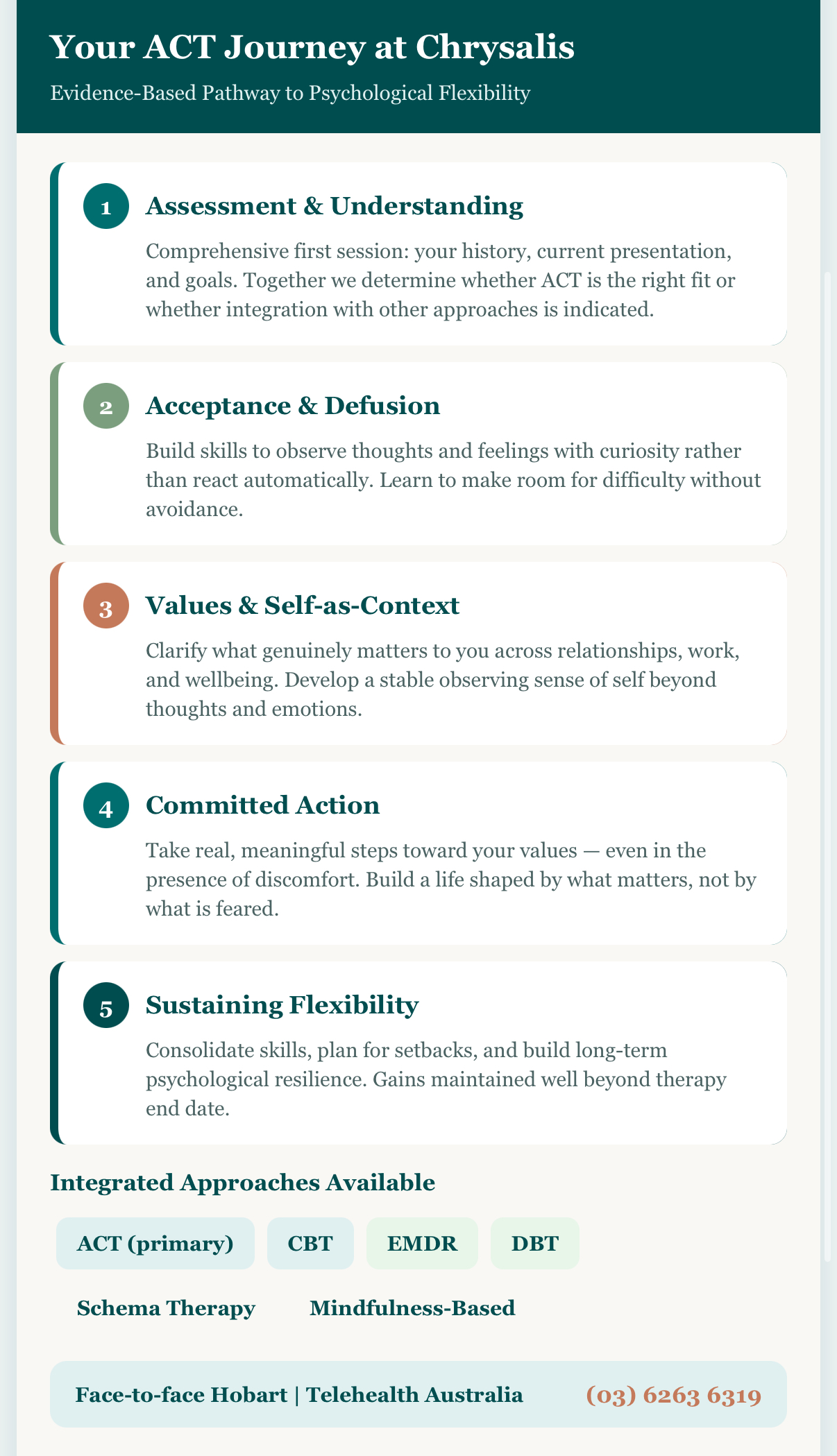
ACT has one of the most robust and well-replicated evidence bases in contemporary psychotherapy. A landmark review by Gloster and colleagues (2020, Journal of Contextual Behavioral Science) examined 20 meta-analyses covering 133 studies and more than 12,000 participants, finding ACT effective across a broad range of presentations including anxiety, depression, chronic pain, and substance use disorders, and generally superior to inactive controls and treatment as usual.
The evidence has continued to strengthen since. An overview of nine systematic reviews and 84 meta-analyses (Ma et al., 2024, The Journal of Pain) concluded that ACT reduces depression, anxiety, psychological inflexibility, and pain catastrophising in chronic pain, with functioning gains maintained at six to twelve months. Zhao and colleagues (2023, Annals of General Psychiatry) confirmed in a meta-analysis of randomised controlled trials that ACT produces significant and durable reductions in depressive symptoms, with improvements in psychological flexibility sustained well beyond treatment completion.
The Australian Psychological Society (APS) recognises ACT as a Level I evidence-based treatment for depression, anxiety disorders, chronic pain, and stress-related presentations.
.svg)
ACT addresses psychological difficulties through six interconnected processes. Each targets a different aspect of the patterns that maintain distress:
Developing openness and willingness to experience difficult internal states - thoughts, feelings, sensations - without unnecessary avoidance or suppression. Acceptance creates space for deliberate, values-aligned responses rather than automatic reactions.
Learning to observe thoughts as mental events rather than treating them as literal truths requiring immediate action. Defusion reduces the automatic influence of unhelpful thoughts on behaviour without requiring those thoughts to change or disappear (Hayes et al., 2012).
Cultivating flexible, open attention to what is happening in the present moment, rather than being absorbed in rumination or anticipatory worry. This capacity is associated with improved psychological wellbeing and regulatory flexibility.
Developing a stable, observing sense of self that is larger than any single thought, feeling, or experience. This perspective reduces over-identification with distressing internal states and supports greater psychological stability.
Identifying what genuinely matters across key life domains - relationships, work, health, community, personal growth - independent of what anxiety, depression, or avoidance has been directing. Values provide intrinsic motivation for meaningful action.
Taking meaningful, real-world steps in the direction of identified values, even in the presence of discomfort or uncertainty. Research consistently demonstrates that committed action based on values - rather than avoidance of fear - predicts sustained wellbeing (Kashdan & Rottenberg, 2010, Clinical Psychology Review).
At Chrysalis Psychology & Wellbeing, ACT may be offered as a primary therapeutic approach or integrated with CBT, EMDR, DBT, or Schema Therapy, depending on your individual circumstances and clinical presentation. ACT has well-established evidence across:
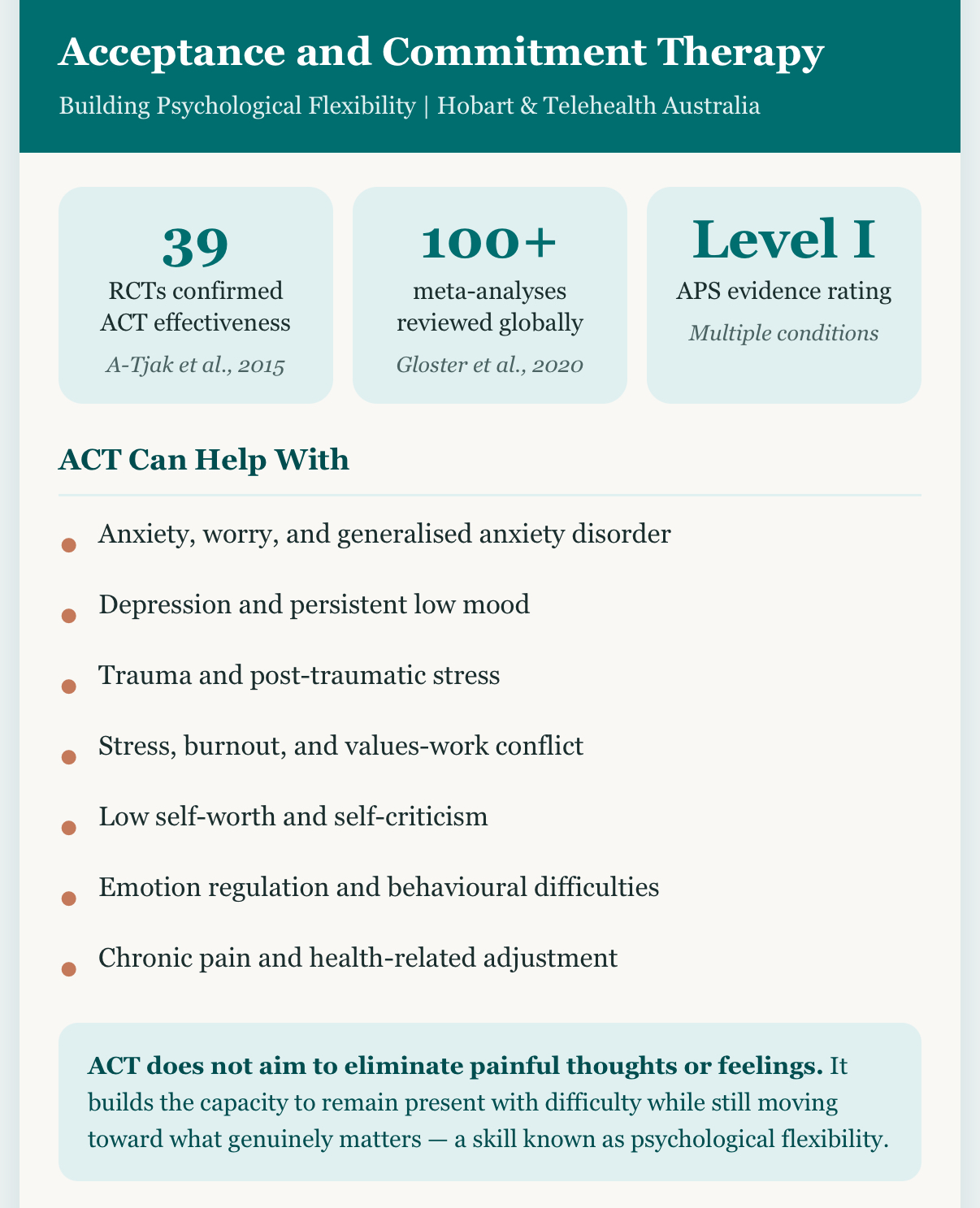
All therapy at Chrysalis begins with a comprehensive initial assessment to understand your specific presentation, personal history, and goals. Your psychologist will work collaboratively with you to determine whether ACT is the most appropriate primary approach, or whether integration with other evidence-based therapies is indicated. Funding, referral pathways, and the expected structure of treatment will be discussed at this stage.
ACT-informed sessions draw on experiential exercises, therapeutic metaphors, and mindfulness-based practices adapted to your individual context. The approach is active, practical, and collaborative - not passive or purely conversational.
Our team of psychologists maintain up-to-date training in third-wave cognitive behavioural therapies. We see clients from across Hobart, Tasmania, and Australia-wide via telehealth psychology. To enquire about current availability, please contact us.
Sessions at Chrysalis Psychology & Wellbeing can be accessed through the following funding pathways:
To book an initial appointment or discuss whether ACT may be suitable for you, contact Chrysalis Psychology & Wellbeing on (03) 6263 6319, by email at info@chrysalispsychwell.com.au, or online at chrysalispsychwell.com.au/contact-us.
All references are peer-reviewed international publications. Please review dates of access where relevant. References are formatted in APA 7th edition.


.webp)
