You have probably heard the letters before. Your GP might have mentioned it. A friend might have said their psychologist uses it. You might have seen it on a waiting room brochure or in an article you half-read at 11pm when you could not sleep.
CBT - Cognitive Behavioural Therapy.
But what does it actually mean? And more importantly, what does it feel like when you are the one sitting in the chair?
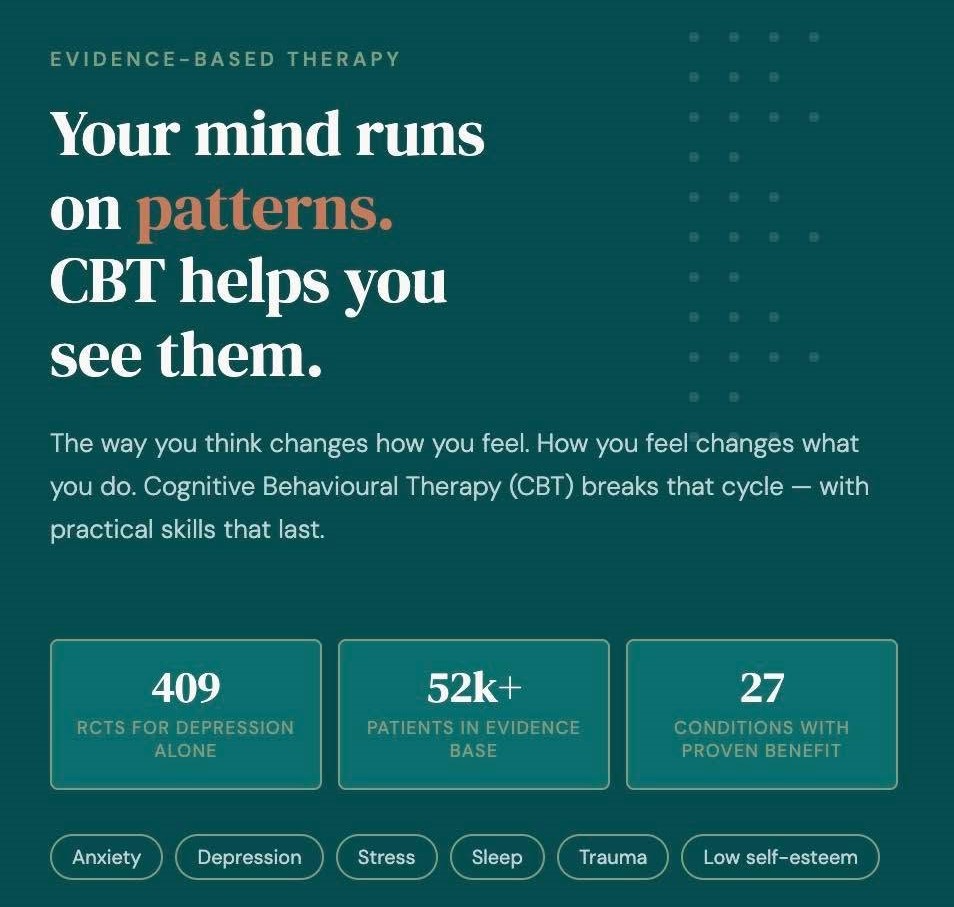
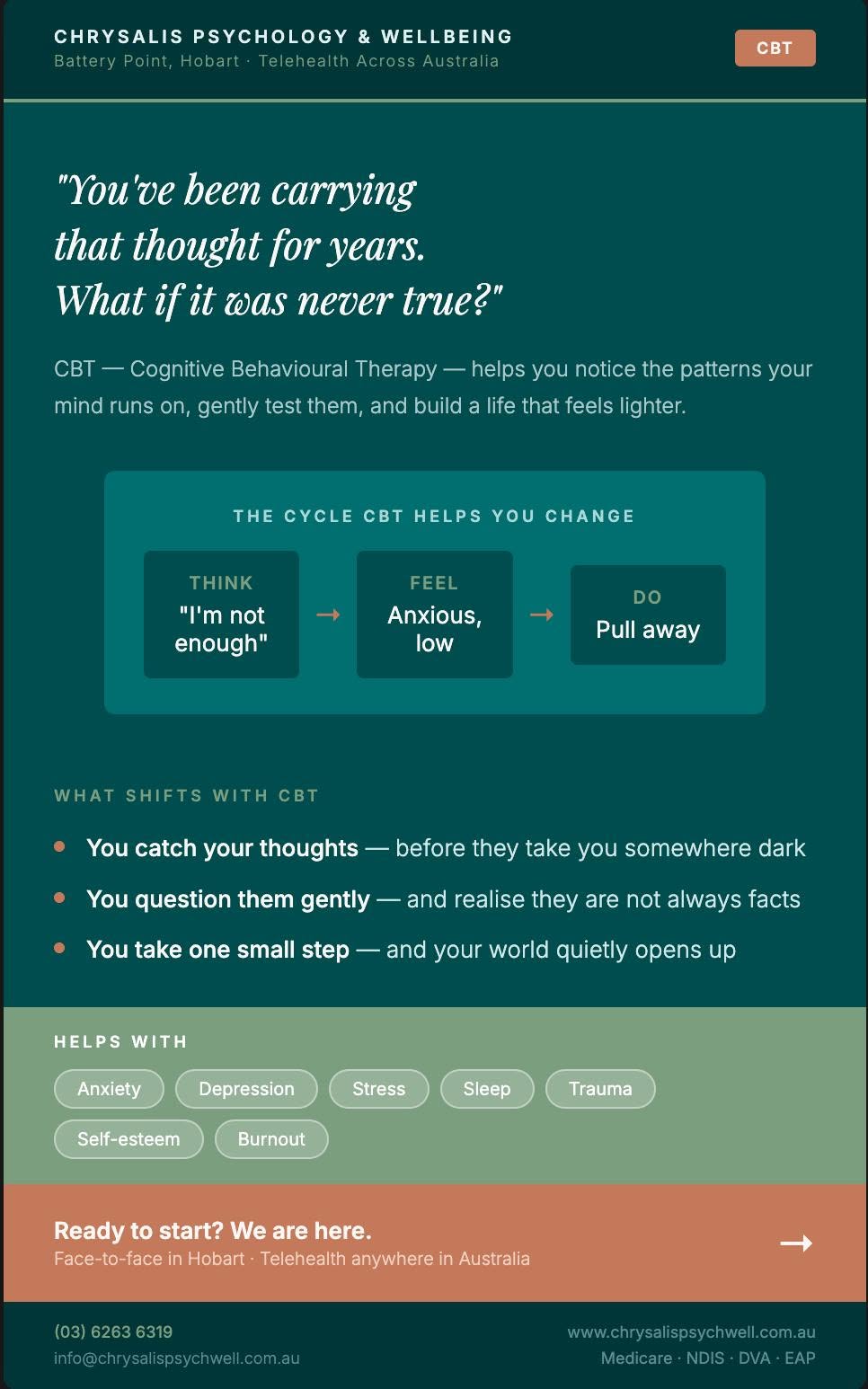
Here is the short version. CBT is built on one core idea: the way you think about a situation changes how you feel about it, and how you feel changes what you do.
That might sound obvious. But when you are inside it, it is anything but.
Think about the last time you lay in bed at 2am running through something that happened at work. You replayed the conversation. You imagined the worst outcome. Your chest got tight. Your stomach turned. By the time your alarm went off, you were exhausted and dreading the day before it had even started.
Nothing had actually changed overnight. But your mind had already decided how the day was going to go.
That is the cycle CBT helps you see. And once you can see it, you can start to change it.
If you are imagining someone asking you to lie on a couch and talk about your childhood for years, that is not CBT.
CBT is practical. Your psychologist will work with you to understand what is going on right now. Not your entire life history. Right now. What are the thoughts that keep showing up? What are you avoiding? Where is the pattern?
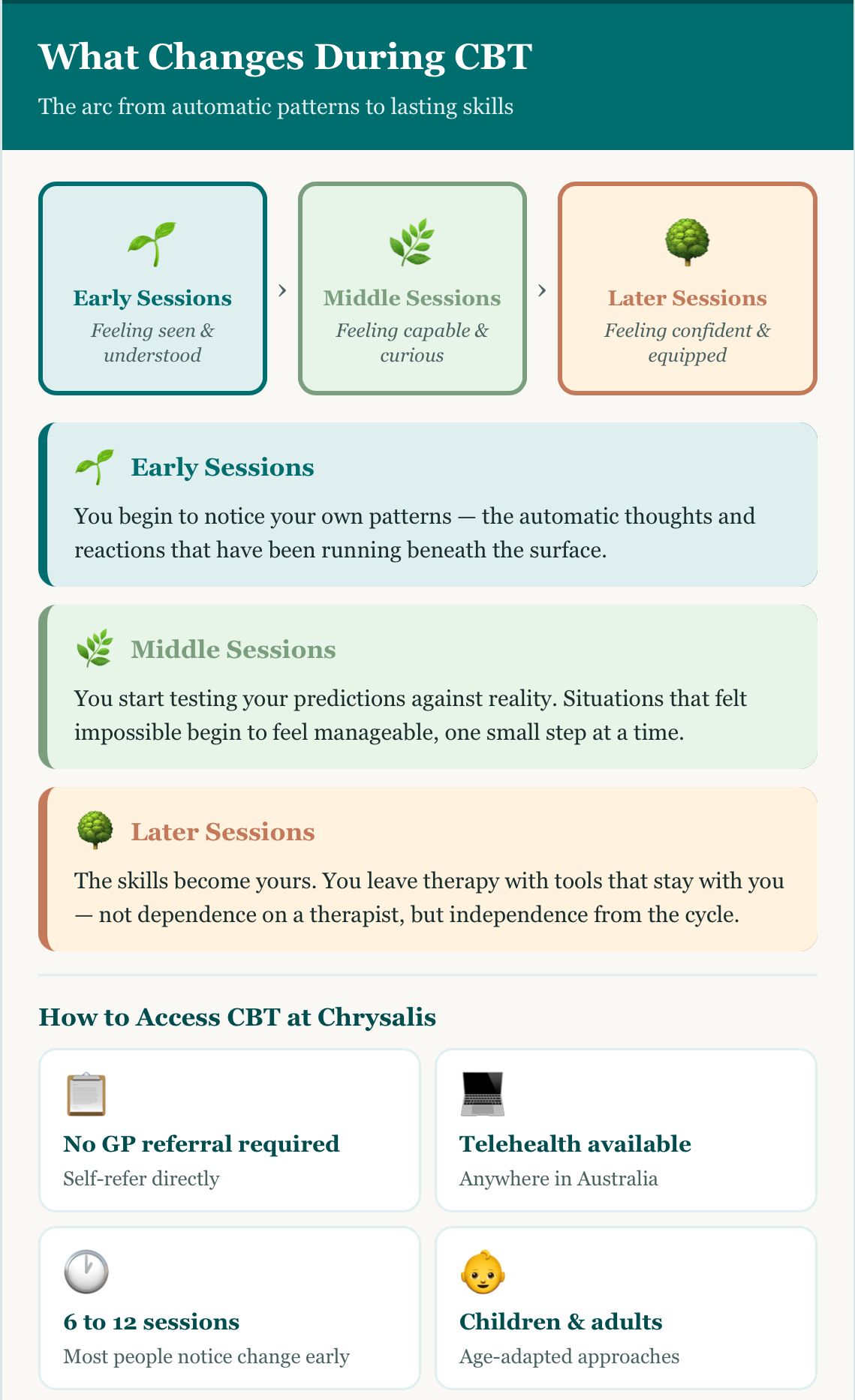
You might learn to notice when your mind jumps to the worst case scenario, and gently test whether that prediction is accurate. You might start doing things you have been putting off, one small step at a time, and notice how your mood shifts when you do. You might learn breathing or grounding techniques that help when your body goes into overdrive.
It is not magic. It is skill building. And like any skill, it gets easier with practice.
CBT is the most rigorously studied psychological treatment in the world. The evidence is not anecdotal. It comes from hundreds of independently replicated studies, conducted across different countries, cultures, age groups, and clinical settings.
In 2023, researchers published the largest meta-analysis ever conducted on a single type of psychotherapy for a specific condition. Analysing 409 randomised controlled trials with 52,702 patients, they found moderate to large effects for CBT in the treatment of depression, with benefits remaining significant at six-to-twelve-month follow-up. CBT was at least as effective as medication in the short term, and more effective at longer-term follow-up (Cuijpers et al., 2023, World Psychiatry).
Across anxiety disorders, panic, and social anxiety, CBT consistently produces large effect sizes. A comprehensive review found effect sizes ranging from g = 0.75 for major depression to g = 0.88 for social anxiety disorder, remaining significant even after adjusting for publication bias (Cuijpers et al., 2016).
Perhaps most striking is a panoramic meta-review that synthesised 494 systematic reviews covering 221,128 participants across 27 physical and mental health conditions. The conclusion: CBT produces consistent, meaningful benefits across virtually every condition it has been tested for, with a prediction interval suggesting it will remain effective even in conditions where research is still emerging (Fordham et al., 2021, Psychological Medicine).
This breadth of evidence is one of the reasons so many psychologists use CBT. It works across a remarkably wide range of conditions. Research consistently demonstrates benefit for anxiety, depression, stress and burnout, sleep difficulties, trauma, OCD, chronic pain, eating disorders, low self-esteem, and more.
It also works for children and young people. At Chrysalis, our psychologists adapt CBT to be age-appropriate and engaging, so younger clients can build skills they actually use in their everyday lives.
And for people living with chronic illness, including conditions such as multiple sclerosis, cancer, and chronic pain, CBT has shown clinically meaningful effects on both mental health symptoms and quality of life.
Yes. Multiple independent studies have found that CBT delivered via secure video is as effective as face-to-face sessions for the majority of conditions. Research comparing internet-delivered CBT with in-person CBT found no significant difference in outcomes across psychiatric and somatic disorders (Carlbring et al., cited in Dils et al., 2024).
If you are outside Hobart, or if attending in person is not practical, telehealth CBT is a well-supported option. We see clients right across Australia.
Most people start to notice changes within 6 to 12 sessions. Some people need fewer. Others, especially those with more complex or long-standing difficulties, benefit from a longer course. There is no fixed number. Your psychologist will work with you to find the pace that fits your situation.
If you have been thinking about seeing a psychologist but you are not sure what to expect, or if you have tried therapy before and it did not feel right, CBT might be worth considering. It is structured, practical, and designed to give you skills you can carry with you long after sessions end.
You do not have to have a diagnosis. You do not have to be in crisis. You just have to be ready to start.
Whether you are in Hobart, regional Tasmania, or anywhere else in Australia, support is available. Our psychologists offer CBT face-to-face in Battery Point, Hobart and via secure telehealth for clients everywhere in Australia.
Phone: (03) 6263 6319
Email: info@chrysalispsychwell.com.au
Website: www.chrysalispsychwell.com.au
Location: Knopwood House, Level 2, 38 Montpelier Retreat, Battery Point, Tasmania 7004
HealthLink EDI: chrypswb
Available face-to-face in Battery Point, Hobart and via telehealth across Australia.
Bhattacharya, S., Goicoechea, C., Heshmati, S., Carpenter, J.K., & Hofmann, S.G. (2023). Efficacy of cognitive behavioral therapy for anxiety-related disorders: a meta-analysis of recent literature. Current Psychiatry Reports, 25(1), 19-30.
Cuijpers, P., Miguel, C., Harrer, M., Plessen, C.Y., Ciharova, M., Ebert, D., & Karyotaki, E. (2023). Cognitive behavior therapy vs. control conditions, other psychotherapies, pharmacotherapies and combined treatment for depression: a comprehensive meta-analysis including 409 trials with 52,702 patients. World Psychiatry, 22(1), 105-115.
Dils, A., et al. (2024). The efficacy of cognitive behavioral therapy for mental health and quality of life among individuals diagnosed with cancer: a systematic review and meta-analysis. Cancer Medicine, 13, e70063.
Fordham, B., Sugavanam, T., Edwards, K., et al. (2021). The evidence for cognitive behavioural therapy in any condition, population or context: a meta-review of systematic reviews and panoramic meta-analysis. Psychological Medicine, 51(1), 21-29.
Hofmann, S.G., Asnaani, A., Vonk, I.J.J., Sawyer, A.T., & Fang, A. (2012). The efficacy of cognitive behavioral therapy: a review of meta-analyses. Cognitive Therapy and Research, 36(5), 427-440.
Mamukashvili-Delau, M., Koburger, N., & Dietrich, S. (2023). Long-term efficacy of internet-based cognitive behavioral therapy self-help programs for adults with depression. JMIR Mental Health, 10, e46925.
Meine, L.E., Weber, M.C., et al. (2024). A systematic review and meta-analysis of transdiagnostic cognitive behavioural therapies for emotional disorders. Nature Human Behaviour.