You are sitting in the car park. You have not turned the engine off yet. Your hands are still on the wheel.
The conversation happened forty minutes ago. The one you have replayed all afternoon. The one where you said something you did not entirely mean, and now your chest feels tight and your jaw will not unclench. You know you should drive home. You know you have things to do. But you cannot move because the feeling is too big, and the feeling has not finished with you yet.
This is what it is like when emotions arrive at full volume.
For some people, it has been like this for as long as they can remember. The smallest comment lands like a slap. The tiniest perceived rejection sends them spinning for hours. Joy is bigger. Hurt is bigger. Anger is bigger. They have been told all their lives that they are too sensitive. That they take things too personally. That they need to let it go.
If anyone could let it go, it would be them. They have tried. The trying has not worked.
Here is what almost no one explained.
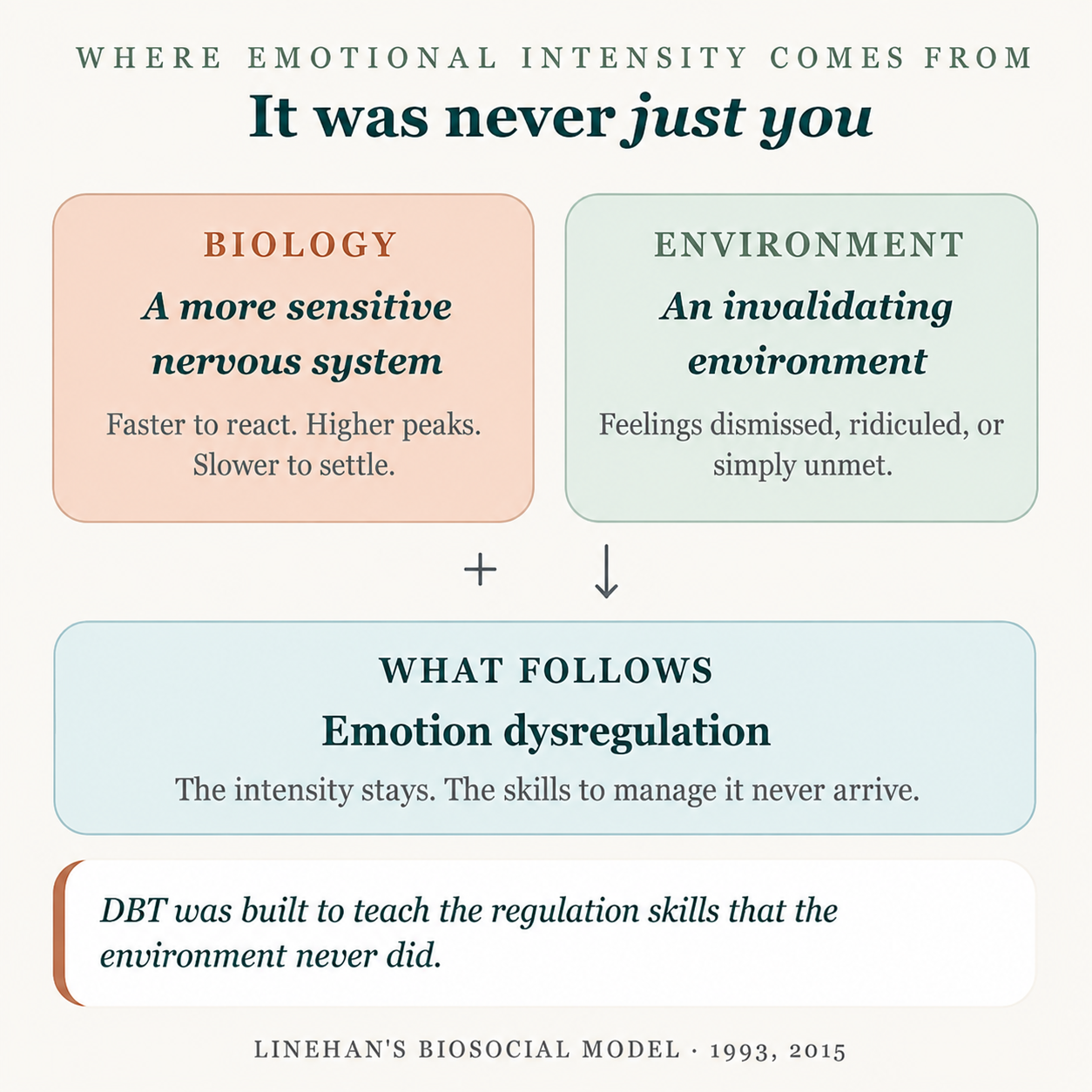
Some nervous systems are built to feel things more intensely. They respond more quickly to emotional cues. They take longer to settle once they have been activated. This is not a personality flaw. It is biology. Researchers describe this as emotional sensitivity, and there is now a substantial body of evidence describing how it shapes the way people experience their internal world (Linehan, 2015).
When a sensitive nervous system grows up in an environment where emotions were dismissed, ridiculed, or overwhelmed by louder needs, something specific happens. The emotions do not learn how to regulate themselves. The person is left with the intensity, but without the manual.
By adulthood, life with that combination can look like this. You overreact and then feel ashamed of overreacting. You shut down because feeling everything is exhausting. You agree to things you do not want and resent yourself afterwards. You burn the friendship to the ground rather than have one more uncomfortable conversation. You go from zero to one hundred in seconds and have no idea how it happened.
It is not your fault. And it is not a life sentence.

In the late 1980s, an American psychologist named Dr Marsha Linehan was working with women who experienced chronic suicidal thoughts and intense emotional distress. Standard cognitive therapy was not working for them. Telling someone whose emotions are at one hundred percent that their thoughts are irrational tends not to land.
So Linehan did something different. She combined cognitive-behavioural techniques with mindfulness practices and a radical idea borrowed from contemplative traditions. The idea was this. People do not need to be told they are wrong. They need to be accepted exactly as they are AND given the skills to change. Both at the same time.
She called it Dialectical Behaviour Therapy. DBT.
Today it is one of the most extensively researched psychological treatments in the world. A meta-analysis covering 21 studies and 1,673 adolescents found that DBT may produce meaningful reductions in self-harm and suicidal ideation when compared with control conditions (Kothgassner et al., 2021). Further reviews have shown that DBT can support emotion dysregulation across a range of presentations, including borderline personality disorder, binge eating disorder, and bulimia nervosa (Sanchez-Garcia et al., 2024; Vasiliu, 2021). The Australian Psychological Society identifies DBT as a standout evidence-based treatment for adults with borderline personality disorder (APS, 2018).
What makes it different is what it teaches. Not theories. Not insight. Skills.
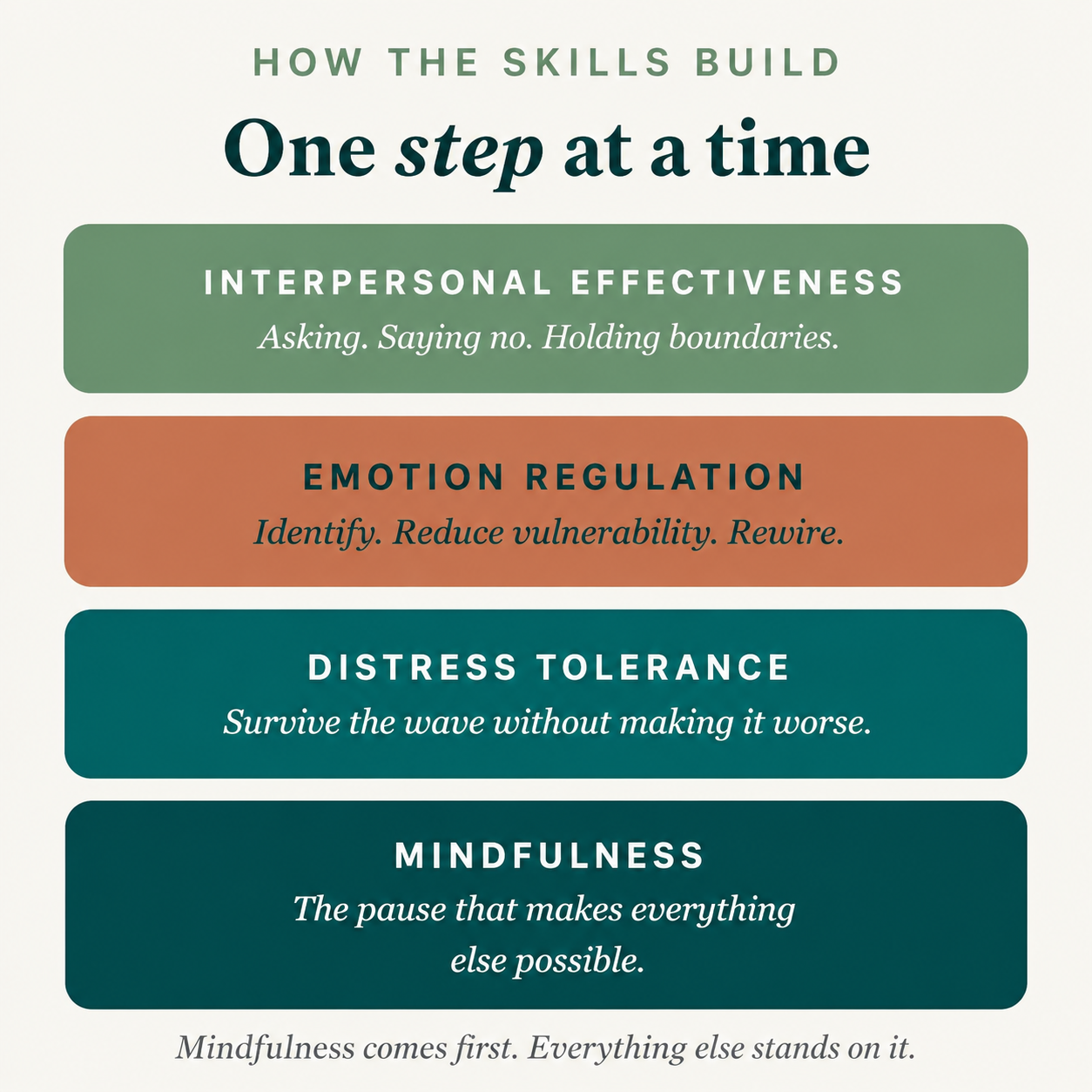
DBT is built around four sets of skills, taught in a specific order because they build on each other (Linehan, 2015).
Mindfulness comes first. Not as a relaxation exercise, but as a way of noticing what is happening inside you before you react to it. The argument has not finished. The wave has not crested. You are still in it. Mindfulness is the small, deliberate pause that keeps the wave from drowning you.
Distress Tolerance is what you reach for when the wave is at full height. It is the cold water on your face when nothing else will help. It is the radical acceptance that this moment is what it is, even though you wish it were not. It is the survival kit for the worst hours.
Emotion Regulation is the longer work. It teaches you to recognise what you are actually feeling, what your emotions are trying to signal, what makes you more vulnerable to spirals (poor sleep, skipped meals, an unfinished argument), and how to gradually rewire the patterns that have been running on autopilot.
Interpersonal Effectiveness is where it gets practical. How to say what you need without apologising for needing it. How to say no without months of guilt. How to stay in connection with people who matter without losing yourself in the process.

The wave is real. The skills are real too.
If your emotions feel like they are running your life, there are things you can begin to practise today.
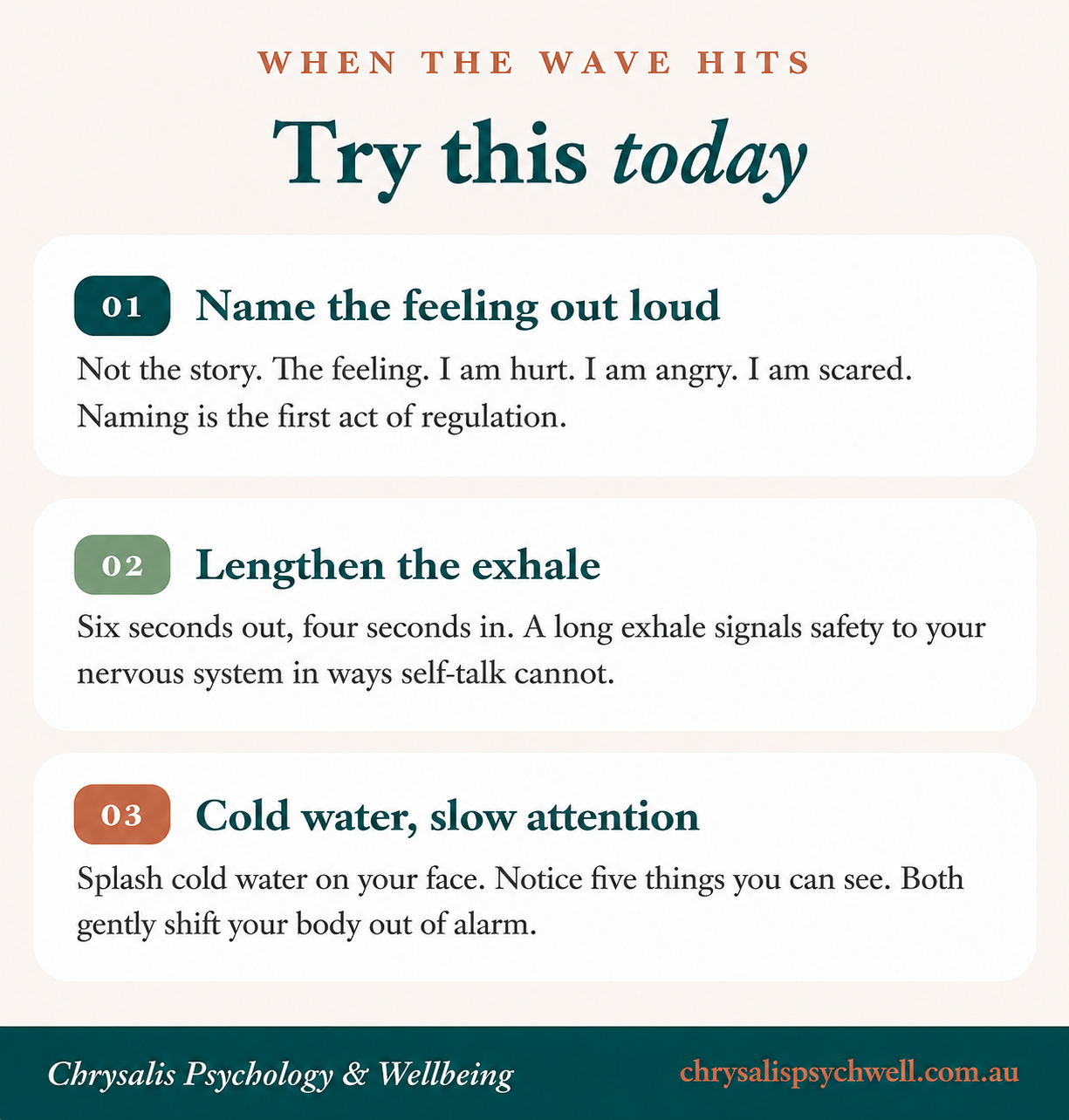
When the feeling arrives, name it out loud. Not the story. The feeling. I am angry. I am hurt. I am scared. Naming what is happening is the first act of regulation.
When the feeling is too big to think through, slow your breath. A long exhale signals safety to your nervous system in a way that no amount of self-talk can. Six seconds out, four seconds in. Repeat until the wave starts to come down.
And when you have tried everything you know and the feelings are still bigger than you can hold, that is information. Not failure. It means you may need a manual that no one ever gave you. There is one, and it is teachable.

At Chrysalis Psychology & Wellbeing, our psychologists are trained in DBT and a range of other evidence-based approaches. We work with people across Hobart, Battery Point, and the rest of Australia via secure telehealth, supporting them to build the skills that may change how emotions move through their lives.
You do not need a diagnosis. You do not need to wait until things get worse. You only need to be ready to learn that what you have been carrying alone has a name, and there is a path forward.
Phone: (03) 6263 6319
Website: www.chrysalispsychwell.com.au
Book a session: Contact us or call to discuss whether DBT may be right for you.