.png)
You have done the right things.
You went to see someone. You talked about what happened. You understand it. You can explain it clearly to anyone who asks.
But your body has not caught up with your brain.
You still flinch at that sound. You still avoid that road. You still wake at 2am with your heart pounding, replaying something that happened months or years ago. You still feel it in your chest, your stomach, your jaw, as if it is happening right now.
If that sounds familiar, there is a reason for it. And there is a name for it.
When something overwhelming happens, your brain processes it differently from an ordinary memory. Normally, memories get filed away as “things that happened in the past.” They still exist, but they feel finished. Settled.
Traumatic memories do not always get filed that way. Instead, they can get stuck in the brain’s alarm system, stored in a raw, unprocessed form. That is why a sound, a smell, a place, or even a feeling can suddenly pull you right back into the experience as if it is happening again.
This is not a sign of weakness. It is how the brain protects itself when something is too overwhelming to process in the moment. The problem is that the alarm keeps sounding long after the danger has passed.

EMDR stands for Eye Movement Desensitisation and Reprocessing. It is a structured, evidence-based therapy recommended by the World Health Organisation for treating trauma and PTSD (WHO, 2013).
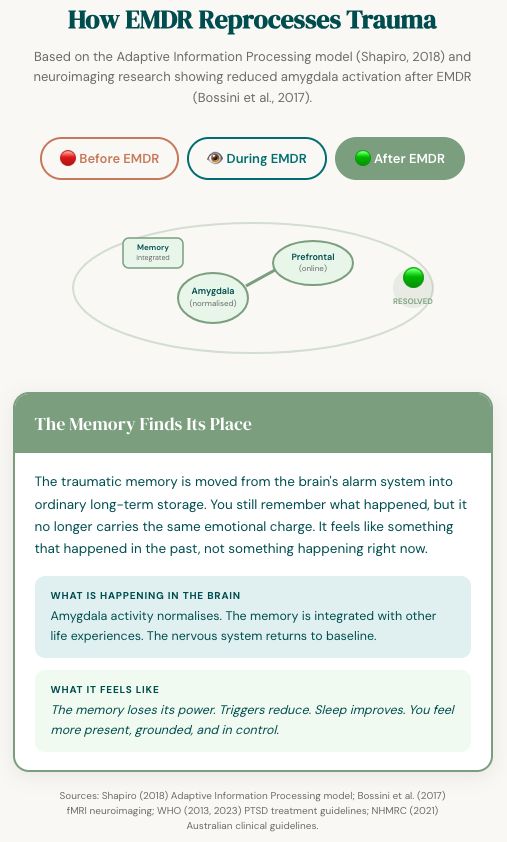
During EMDR, your psychologist guides you through the distressing memory while you follow a bilateral stimulus, usually eye movements or gentle tapping. This activates the brain’s natural processing system and helps move the memory from the “alarm” system into ordinary long-term storage.
It does not erase the memory. You will still remember what happened. But the intensity, the distress, and the “reliving” quality of it reduces, often significantly. The memory starts to feel like something that happened in the past, not something happening right now.
Traditional talk therapy helps you understand your experience, build coping strategies, and develop insight. These are valuable.
But for some people, understanding alone is not enough to shift what is happening in the body and the nervous system. You might be able to describe the event perfectly but still feel your heart race every time you think about it.
EMDR works at a different level. It targets the way the memory is stored in the brain, not just the way you think about it. This does not mean talk therapy has failed. It means there may be an additional approach that can help your brain do what it has been trying to do all along.

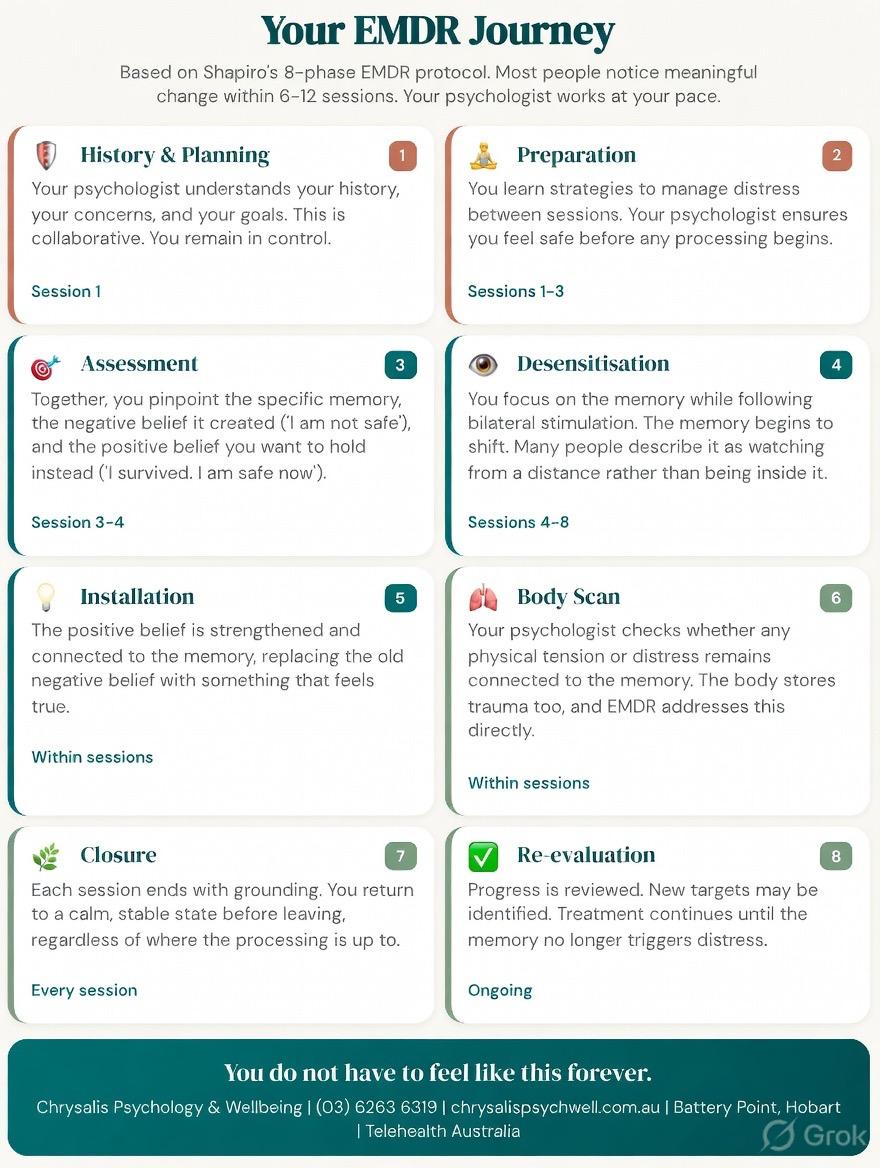
Your psychologist will spend time preparing you before any processing begins. You will learn grounding and calming techniques first. You are in control throughout, and you can pause at any time.
During processing, you will hold the distressing memory in mind while following the bilateral stimulus. Many people describe it as watching the memory from a distance rather than being inside it. Sessions typically last 50 to 90 minutes.
EMDR is available face-to-face at our Battery Point practice in Hobart and via secure telehealth for clients anywhere in Australia. When working online, your psychologist uses adapted bilateral stimulation methods such as butterfly tapping or auditory tones through headphones, which research supports as equally effective.

EMDR was originally developed for PTSD, but research now supports its use for anxiety, phobias, grief, panic, and distressing memories from accidents, assaults, medical events, or childhood experiences.
If you have ever thought “I have talked about this so many times but it still affects me,” EMDR may be worth exploring.
At Chrysalis Psychology & Wellbeing, many of our clinicians are trained in EMDR. Whether you are in Hobart, regional Tasmania, or anywhere in Australia, you can access EMDR therapy with us.
Learn more on our EMDR Therapy page: Click here
Phone: (03) 6263 6319
Email: info@chrysalispsychwell.com.au
Website: www.chrysalispsychwell.com.au
Why Am I Always Tired? A Psychologist's Guide to Understanding Exhaustion
Shapiro, F. (2018). Eye Movement Desensitization and Reprocessing (EMDR) Therapy (3rd ed.). Guilford Press.
World Health Organisation (2013). Guidelines for the Management of Conditions Specifically Related to Stress. Geneva: WHO.