
Book Now
Book Now
.svg)
You keep replaying the same conversation with your partner: the one that started about whose turn it was to call the electrician, and ended with both of you saying things neither of you meant. Or perhaps there is no argument at all, only a quiet distance that crept in after you became a parent, or a friendship that used to feel effortless and now takes real effort to maintain.
When distress keeps circling back to the people closest to you, the difficulty is rarely about the dishes, the calendar, or the last thing that was said. It is about the relationship itself, and how it is holding you. Interpersonal therapy, known as IPT, is built on this understanding. IPT is a structured, evidence-based approach that works directly with your relationships, rather than around them, to ease the distress connected to them.
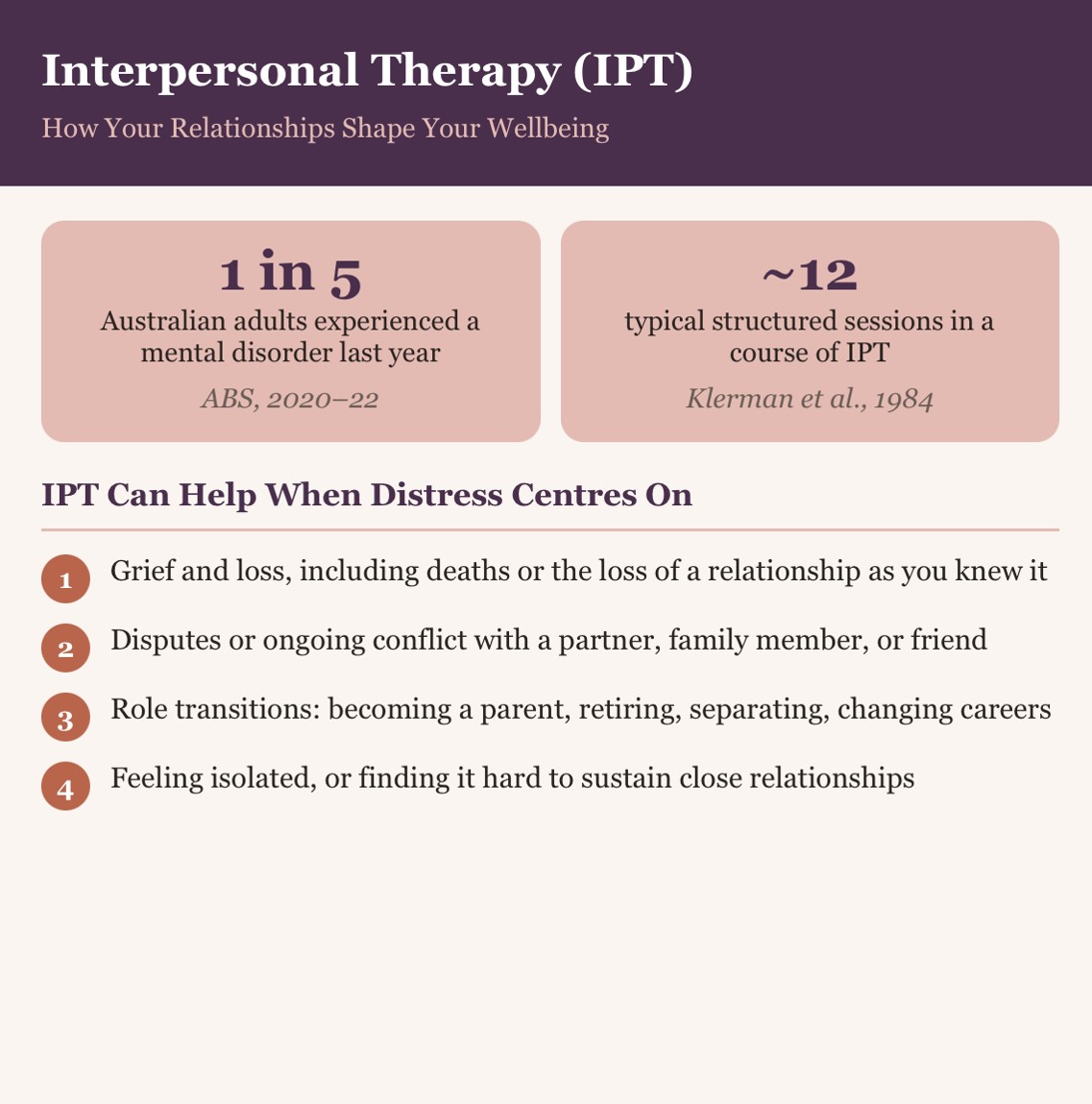
Interpersonal therapy (IPT) is a structured, time-limited psychological therapy that focuses on the connection between your relationships and your emotional wellbeing. It was developed in the 1970s by psychiatrists Gerald Klerman and Myrna Weissman as a research-based treatment for depression (Klerman et al., 1984) and has since been researched and adapted across a wide range of presentations and dozens of countries (Mootz & Weissman, 2024). It draws on attachment and interpersonal theory, and understands emotional wellbeing as something that develops, and can be supported, within a person's network of relationships rather than in isolation from it.
IPT rests on a straightforward premise, supported by decades of research: psychological distress rarely develops in isolation. It is shaped by, and often eases alongside, our closest relationships. Rather than focusing primarily on thought patterns or early life experiences, IPT works directly with what is happening in your relationships in the present. Sessions are structured and time-limited, building toward a defined ending negotiated with your psychologist at the outset, which distinguishes IPT from more open-ended forms of talking therapy and means you know from early on roughly what the course of treatment will involve.
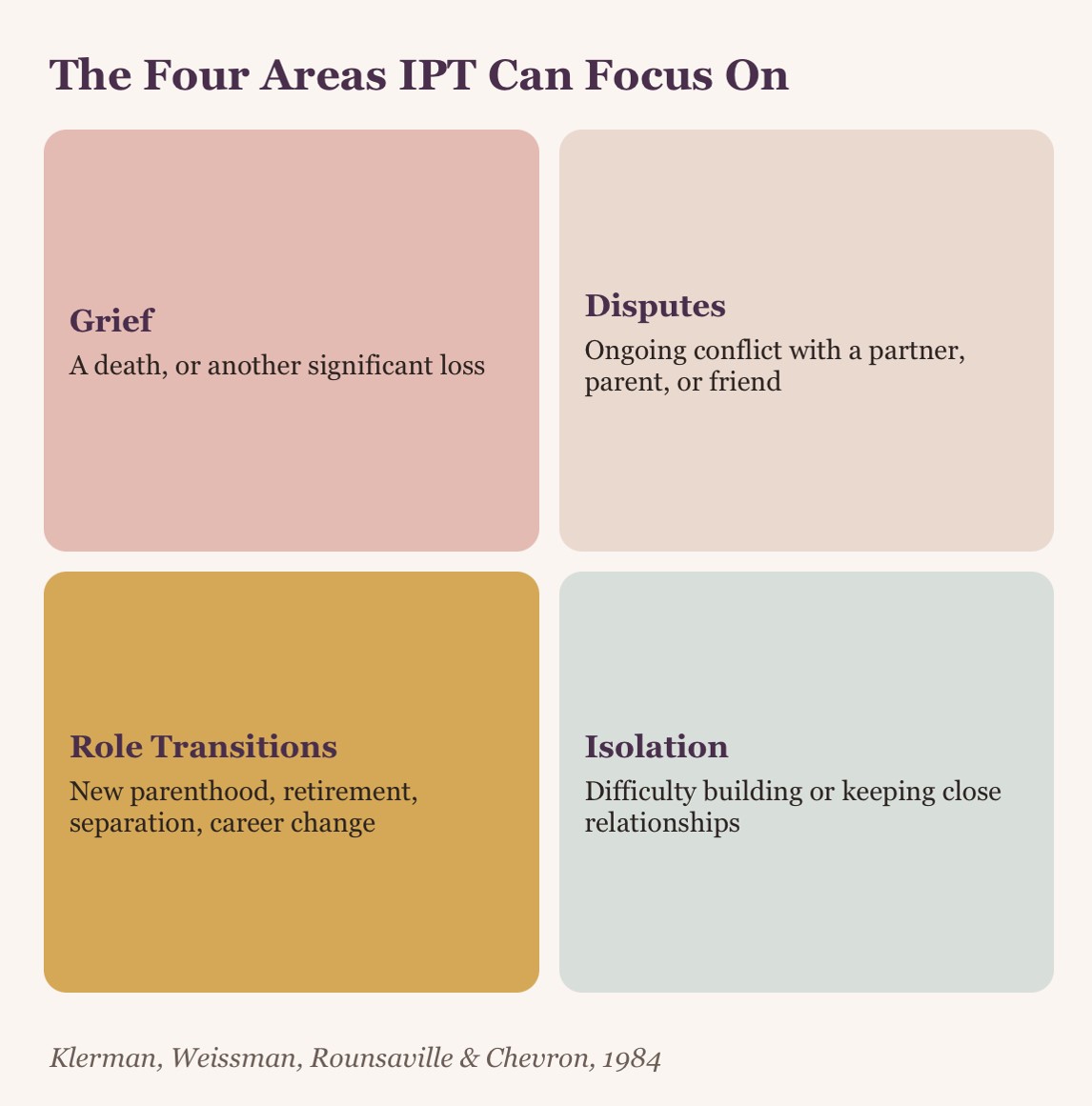
IPT organises relationship-related distress into four problem areas. Most people find that one, or sometimes two, resonate most closely with their own experience.
Your psychologist will work with you early in therapy to identify which of these areas best reflects your current situation, and this becomes the focus for the sessions that follow.
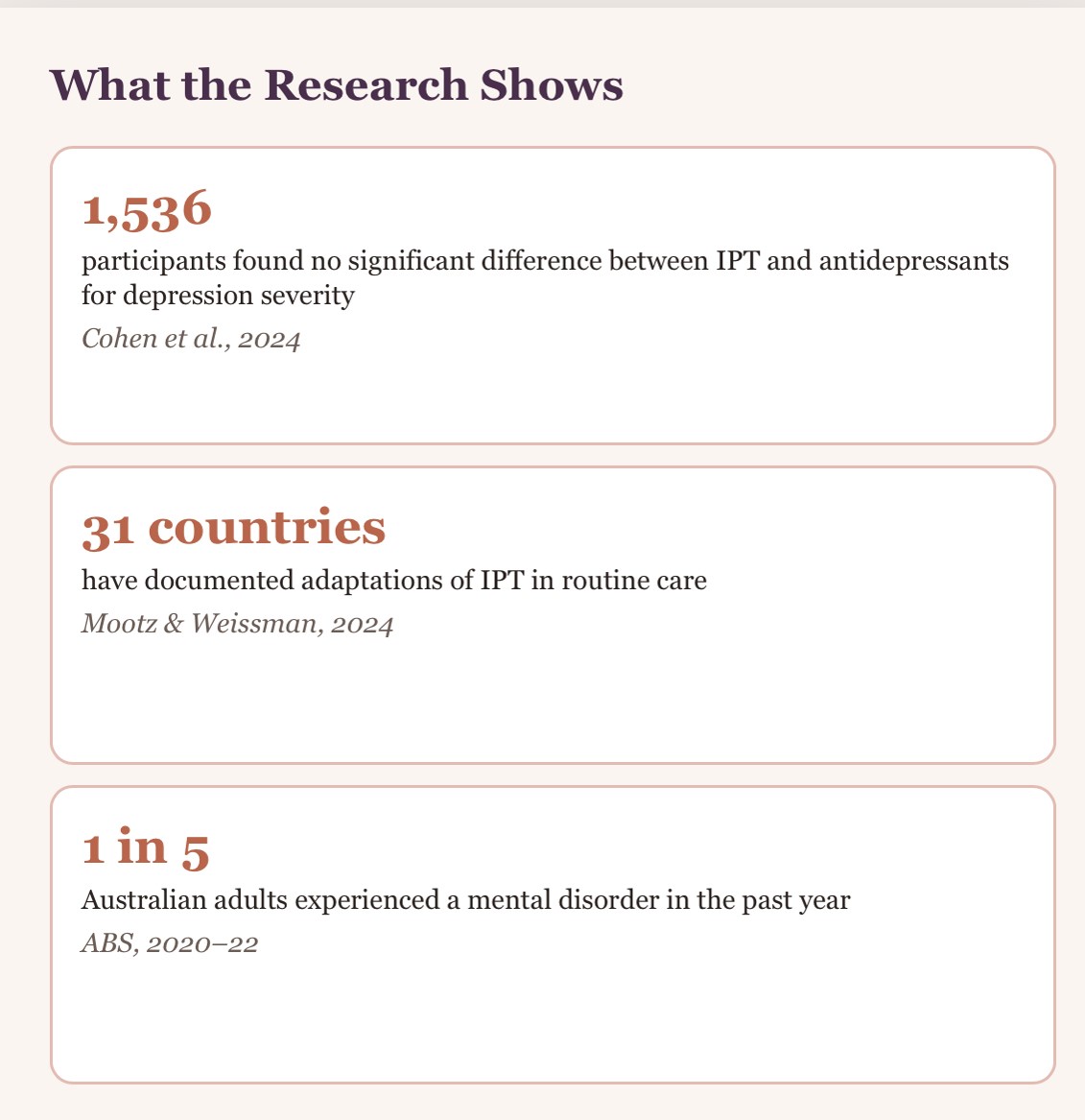
IPT is one of the more extensively researched psychological therapies. A 2024 individual participant data meta-analysis, drawing on data from 1,536 participants across nine randomised controlled trials, found no significant difference between IPT and antidepressant medication on measures of depression severity or social functioning after treatment (Cohen et al., 2024). This positions IPT alongside medication as a genuine first-line, evidence-based option for depression, rather than a fallback when medication is not preferred.
The evidence base extends beyond depression in adults. IPT has documented adaptations in routine mental health care across 31 countries (Mootz & Weissman, 2024), and research suggests it may also support people experiencing depression during the perinatal period, when role transition and identity change are often central to the distress (Kang et al., 2020).
In Australia, the 2020 to 2022 National Study of Mental Health and Wellbeing found that approximately one in five adults experienced a mental disorder in the preceding year (Australian Bureau of Statistics, 2023), with relationship strain and major life transitions frequently reported among the contributing circumstances. As with any psychological therapy, research suggests IPT may help many people, though individual outcomes vary, and your psychologist can discuss whether IPT, or an integration of IPT with another approach, may suit your specific circumstances.
At Chrysalis Psychology & Wellbeing, IPT may be offered as a primary approach or integrated with other evidence-based therapies depending on your presentation and goals, including CBT, DBT, ACT, and Schema Therapy. Your psychologist will discuss with you, early in the assessment process, whether IPT alone or an integrated approach is the better fit. This means your therapy is shaped around what is actually happening in your life and relationships, rather than following a single fixed template regardless of your circumstances.
IPT at Chrysalis may support people experiencing:
IPT at Chrysalis typically begins with an initial assessment, where your psychologist takes what is known as an interpersonal inventory: a picture of your key relationships and how they connect to your current distress. From there, you and your psychologist agree on a focus area together. The middle phase of therapy works through this area in a structured way, often including communication skills and structured reflection on specific relationship situations. The final sessions review progress and focus on maintaining the gains you have made once therapy ends.
A course of IPT is usually delivered over a defined, time-limited number of sessions, both face-to-face in Battery Point and via telehealth psychology across Australia. Many people find it reassuring to know the shape of therapy in advance: an early phase focused on understanding your situation, a middle phase of active work on the agreed focus area, and a final phase focused on consolidating progress and planning ahead.
IPT sessions can be accessed through a Medicare Mental Health Treatment Plan, providing up to ten subsidised sessions per year with a referral. NDIS (self-managed and plan-managed), DVA, Open Arms, WorkCover, MAIB, National Redress Scheme, and private health insurance are also accepted. Self-referral is welcome.
Is IPT only used for depression?
IPT was originally developed and researched as a treatment for depression, and research suggests it may also support people experiencing grief, relationship distress, and some perinatal and eating difficulties.
Will my partner or family need to attend sessions?
No. IPT is usually delivered one on one. Your psychologist may suggest involving a partner or family member at specific points if this is likely to help, but this is always discussed with you first.
Do I need a formal diagnosis to start IPT?
No. Many people begin IPT while working through a difficult relationship, life transition, or loss, whether or not this meets the criteria for a diagnosis.
How is IPT different from couples counselling?
IPT is an individual therapy that focuses on your own wellbeing in the context of your relationships. Couples counselling works directly with both partners together, and is offered separately at Chrysalis for couples wanting to work on their relationship jointly.
How many sessions will I need?
This varies between individuals. Your psychologist will discuss an appropriate course of sessions with you based on your circumstances and goals.
You do not need a diagnosis to start. You do not need to be in crisis. You just need to be ready to take one step.
Whether you are in Hobart, regional Tasmania, or anywhere else in Australia, support is available. Our psychologists are ready to help.
At Chrysalis Psychology & Wellbeing, our psychologists are trained in IPT and ready to help.
Phone: (03) 6263 6319
Email: info@chrysalispsychwell.com.au
Website: www.chrysalispsychwell.com.au
Knopwood House, Level 2, 38 Montpelier Retreat, Battery Point, Tasmania, 7004
Face-to-face in Battery Point, Hobart. Telehealth across Australia.


.webp)
