
Contact Us
Contact Us
At Chrysalis Psychology & Wellbeing, our psychologists in Hobart provide evidence-based couples therapy for partners at all stages of their relationship. We also offer telehealth couples therapy across Australia. Please contact us for more information.
.svg)
You chose each other. You still do, underneath everything. But something in the way you talk to each other, or do not talk to each other, has shifted. The same arguments loop. One of you shuts down while the other escalates. Or you have both gone quiet, and the distance between you has grown so gradually that you did not notice until it was significant.
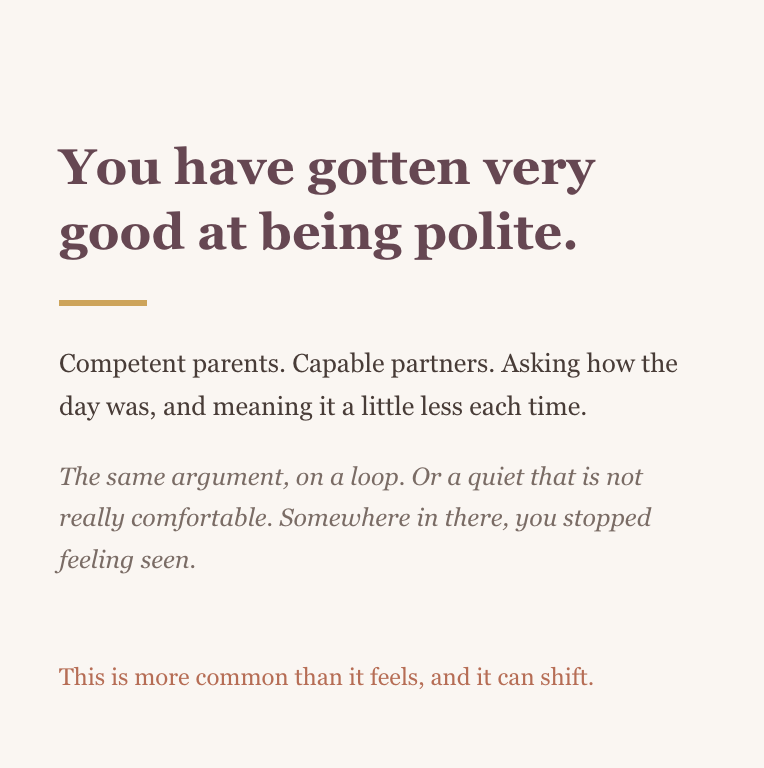
Perhaps it is not even conflict. Perhaps you are two people who have become very good at being polite. Who ask how the day was. Who are competent parents and capable partners. But who cannot quite remember the last time you felt truly seen by each other, or truly close.
Couples therapy is not about deciding who is right. It is about understanding the patterns that have developed between you, where they came from, and how to build something different. Most couples who seek therapy are not in crisis. They are two people who care about each other and want their relationship to work better than it currently does.
Research from the Gottman Institute shows that couples wait an average of six years from when problems begin before seeking professional help [1]. The earlier couples engage with therapy, the better the outcomes.
Couples therapy can be helpful at many different points in a relationship: when things have become significantly distressed, but also as a proactive investment in a relationship that is fundamentally sound.
Couples commonly seek therapy for:
Research published in the Journal of Marital and Family Therapy found that approximately 70 per cent of couples who engage with evidence-based therapy report significant improvement in relationship satisfaction [2].Couples therapy is one of the most well-supported psychological interventions available
At Chrysalis Psychology & Wellbeing, our couples therapy is evidence-based, respectful of both partners, and focused on practical change as well as deeper understanding.
Gottman Method Couples Therapy: Developed from decades of research on what distinguishes relationships that thrive from those that deteriorate, the Gottman Method builds specific friendship, conflict management, and meaning-making skills [1].
Emotionally Focused Therapy (EFT): EFT focuses on the emotional bond between partners, helping couples understand the attachment needs that drive their conflict cycles and build more secure, responsive connection [3].
Interpersonal Therapy (IPT): Where relationship difficulties centre on ongoing disputes, a difficult life transition, or growing disconnection from others, IPT works directly with these relationship patterns to ease the distress connected to them. Read more about IPT
Cognitive Behavioural Therapy (CBT): We build practical communication skills including assertiveness, active listening, and conflict de-escalation. Read more about CBT
Schema Therapy: Where deep-seated beliefs and early life patterns are driving relational difficulties, Schema Therapy addresses these at their roots. Read more about Schema Therapy
Couples therapy sessions involve both partners together, facilitated by your psychologist. The psychologist maintains a neutral, caring stance toward both partners: the goal is not to take sides but to help both people feel heard and to facilitate the change you are working toward together.
Sessions typically involve exploring how current difficulties developed, identifying the patterns that maintain them, and practising new ways of communicating and connecting. Between sessions, partners may practise specific skills together.
Your first session is an opportunity for both partners to share their perspective on what has been happening and what they are hoping will be different. The psychologist listens to both of you with equal respect, and begins building a picture of your relationship and your goals.
Couples therapy sessions are available face-to-face at our Battery Point rooms in Hobart, Tasmania, and via telehealth for couples anywhere in Australia. We accept Medicare Mental Health Treatment Plans (individual components), NDIS (self-managed and plan-managed), DVA, Open Arms, National Redress Scheme, work insurance, and private health insurance. Self-referral is also welcome.
→ How Do You Know When It Is Time to Talk to Your GP About Your Mental Health?
→ The Wounded Child, the Inner Critic, and the Healthy Adult: A Guide to Schema Modes
→ The Spill You Cannot Stop Replaying: Making Peace With Your Inner Critic
[1] Gottman, J.M., & Silver,N. (1999). The Seven Principles for Making Marriage Work. Harmony Books.
[2] Shadish, W.R., &Baldwin, S.A. (2003). Meta-analysis of MFT interventions. Journal of Marital and Family Therapy, 29(4), 547–570.
[3] Johnson, S.M. (2004). The Practice of Emotionally Focused Couple Therapy (2nd ed.). Brunner-Routledge.


.webp)
