
Contact Us
Contact Us
At Chrysalis Psychology & Wellbeing, our psychologists in Hobart provide evidence-based parenting support for families navigating a wide range of challenges. We also offer telehealth psychology across Australia. Please contact us for more information.
.svg)
You did not expect it to be easy. But you did not expect it to feel like this. The tantrums that leave you shaking. The teenager who looks at you like a stranger. The toddler who will not sleep, or eat, or stop. The school refusal that started three weeks ago and is not improving. Your own exhaustion, so deep it has moved past tired and into something else.
And underneath all of it, the voice that says: a better parent would know what to do.
Parenting is one of the most meaningful and one of the most demanding experiences a person can have. Research published in the Journal of Child Psychology and Psychiatry found that parenting stress is a significant predictor of mental health difficulties in both parents and children, and that parenting support interventions improve outcomes for the whole family [1].
Parenting challenges come in many forms. Some are about the child: managing difficult behaviour, supporting a child with anxiety or neurodevelopmental differences, or navigating a young person's mental health. Some are about the parent: managing your own mental health while parenting, recovering from difficult childhood experiences that are triggered by parenting, or finding yourself reacting in ways you do not want to.
Many parenting challenges are about the relationship between parent and child: patterns of interaction that have become unhelpful, communication that is not working, or a sense of disconnection that both parent and child are feeling but neither knows how to bridge.
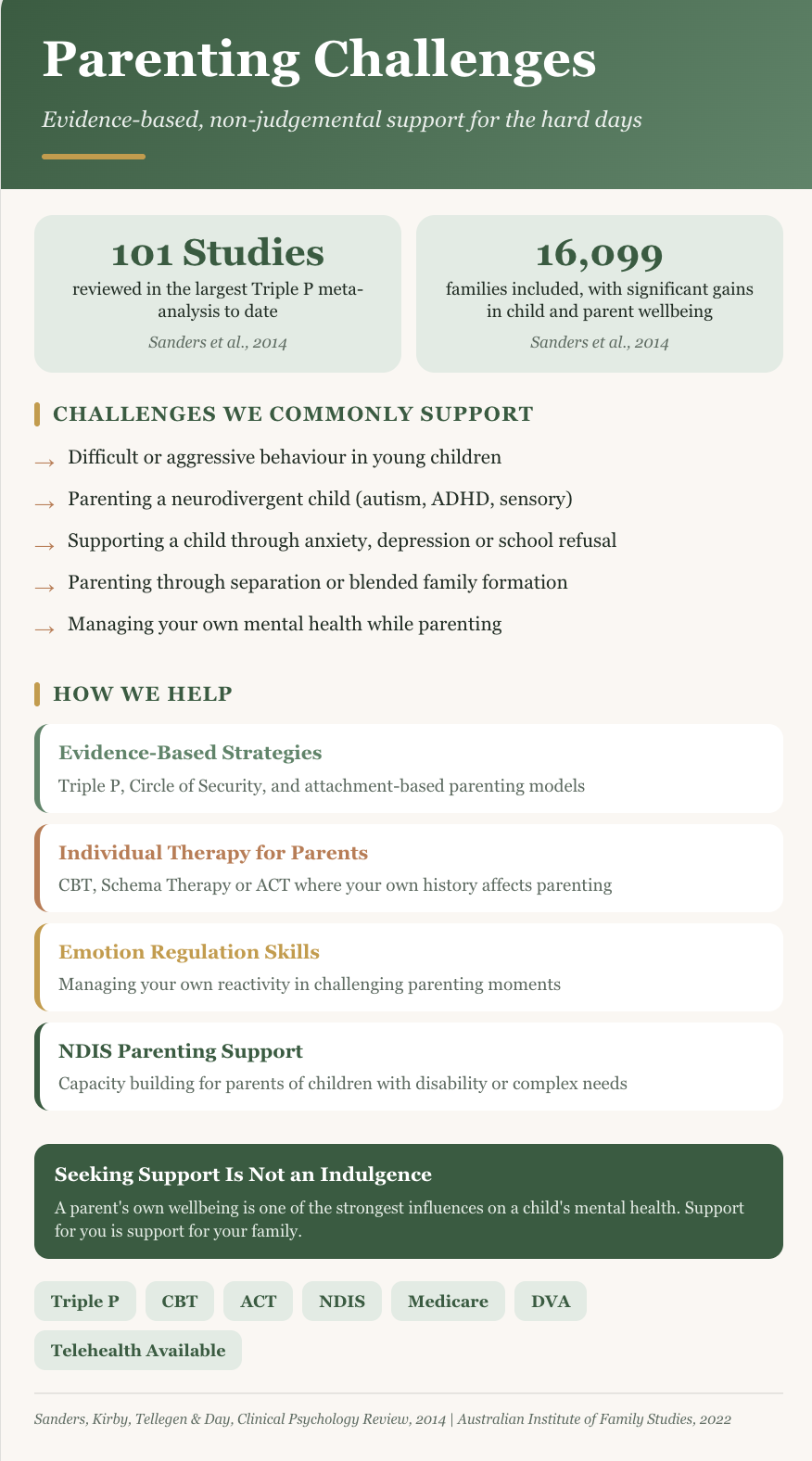
Parenting challenges we commonly support include:
Research from the Australian Institute of Family Studies confirms that access to parenting support is associated with significant improvements in child behaviour, parent wellbeing, and family relationships across a wide range of family types and circumstances [2]. This condition connects closely with behavioural issues and separation anxiety.
Parents are frequently the last people to seek support for themselves. The needs of children and the demands of daily life absorb available energy, and there is often little left for attending to your own wellbeing. Yet research consistently shows that a parent's mental health is one of the strongest influences on a child's mental health.
Parents who are struggling with depression, anxiety, unresolved trauma, or significant stress are more likely to find parenting harder, to experience conflict in the parenting relationship, and to have children who are also struggling. Seeking support for yourself as a parent is not an indulgence. It is one of the most effective things you can do for your child.
At Chrysalis Psychology & Wellbeing, our team of psychologists in Hobart work with parents individually to address depression, anxiety, and to build parenting skills and strengthen the parent-child relationship. Our telehealth psychology service is available for parents anywhere in Australia.
Our parenting support is practical, evidence-based, and non-judgemental. We understand that parents come to us already doing their best.
Your first session is a space to talk about what is happening in your family and what feels most challenging right now. We do not judge your parenting. We listen, understand the context, and work with you to identify what will make the most practical difference.
Sessions with our psychologists are available face-to-face at our Battery Point rooms in Hobart, Tasmania, and via telehealth for clients anywhere in Australia via individual therapy. We accept Medicare Mental Health Treatment Plans, NDIS (self-managed and plan-managed), DVA, Open Arms, National Redress Scheme, and private health insurance. Self-referral is also welcome.


.webp)
