
Contact Us
Contact Us
Phobias are among the most treatable of all anxiety-related conditions, and most people experience significant improvement with evidence-based psychological treatment. At Chrysalis Psychology & Wellbeing, our psychologists in Hobart provide treatment for phobias in children, adolescents, and adults. We also offer telehealth psychology across Australia. Please contact us for more information.
.svg)
You have arranged your entire life around it. You know which roads to take to avoid it. You have memorised which social situations might involve it. And when you cannot avoid it, the panic that hits is not metaphorical. It is physical, immediate, and overwhelming.
Maybe it is heights, or flying, or needles, or enclosed spaces. Maybe it is spiders, dogs, vomiting, or something you have never told anyone because you are not sure how it sounds. The fear does not feel like a choice. It feels like fact.
A phobia is an intense, persistent, and disproportionate fear of a specific object or situation that triggers an immediate anxiety response, even when the person understands at a rational level that the threat is not proportionate [1]. The Australian Bureau of Statistics' National Study of Mental Health and Wellbeing found that specific phobia is one of the most prevalent anxiety-related conditions in Australia, with international reviews placing lifetime prevalence at between roughly 7 and 12 per cent [2, 3].
Phobias develop through several pathways. Some are learned through a frightening personal experience. Some develop through observation, watching someone else respond with intense fear. Others seem to emerge without a clear trigger, often connected to evolutionary predispositions towards certain types of threat.
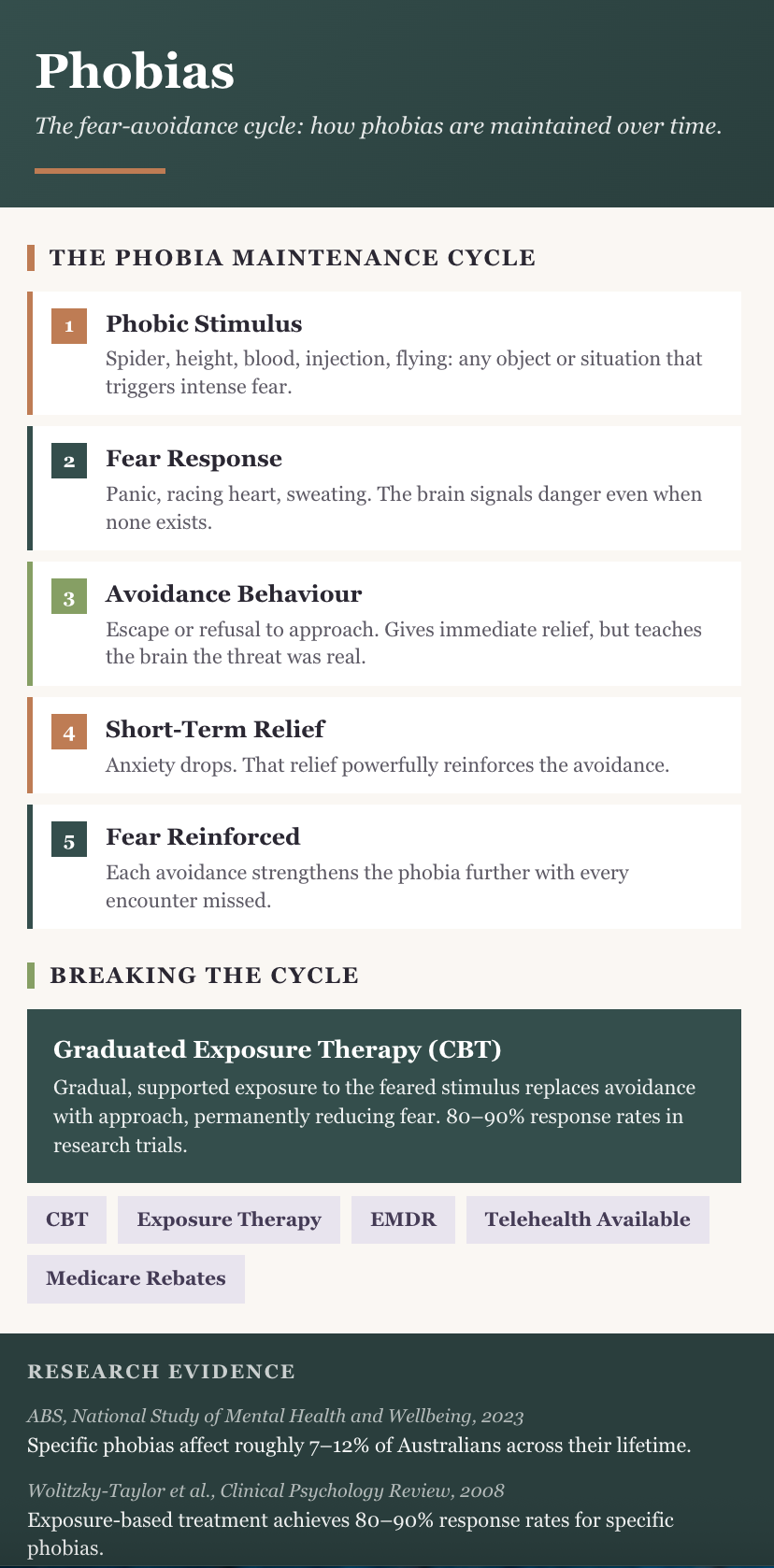
Whatever the origin, phobias are maintained by avoidance. Each time you avoid the feared object or situation, you experience short-term relief. This reinforces the belief that the object is truly dangerous and that you cannot cope with encountering it. Over time, the phobia can expand, affecting more and more situations and requiring increasingly elaborate avoidance strategies.
Common types of phobias include:
Phobias affect people of all ages, genders, and backgrounds, and they tend to worsen over time when left untreated as avoidance narrows the scope of daily life. A 2023 systematic review of exposure-based interventions confirmed that exposure therapy remains the leading evidence-based treatment across phobia subtypes, whether delivered in person, through structured imagery, or via newer technology-assisted formats [4].
Phobias often sit alongside other anxiety-related presentations, and it can help to also read about anxiety and social anxiety if your fear extends beyond a single specific trigger.
For adults, a phobia can impose a quiet but pervasive cost on daily life. Career opportunities may be avoided because they involve flying or certain medical procedures. Social situations may be refused because animals might be present. Travel may be restricted or avoided entirely. The cumulative effect on quality of life, confidence, and relationships can be significant even when individual acts of avoidance feel small.Many adults carry a phobia for years, managing it through avoidance and accepting a narrower life as the price. It is common to feel embarrassed or to minimise the impact of a phobia, but phobias are not a character weakness. They are a well-understood anxiety response that reliably responds to appropriate treatment.
At Chrysalis Psychology & Wellbeing, our team of psychologists help adults understand and overcome specific phobias using evidence-based approaches. Our telehealth psychology service is available for clients across Australia.
Phobias are common in children and young people. Some childhood fears, such as fear of the dark or loud noises, are developmentally normal and resolve without intervention. A phobia is distinguished by its intensity, persistence, and the degree to which it interferes with normal functioning.
A child with a phobia may refuse to attend school if a feared animal might be present. They may avoid medical appointments, become distressed in certain environments, or develop significant anticipatory anxiety about upcoming events. Reassurance alone rarely resolves a phobia and may inadvertently reinforce it over time.
With appropriate support, children and young people typically respond well to treatment and often see rapid improvement. At Chrysalis Psychology & Wellbeing, we provide developmentally adapted individual therapy for young people with specific phobias, and where separation from a parent or carer is the central fear, our separation anxiety page may also be relevant.
Phobia treatment is highly effectivewhen approached with care and structure. Our psychologists provideevidence-based treatment tailored to your specific phobia and lifecircumstances.
Cognitive Behavioural Therapy (CBT): CBT helps identify and challenge the thoughtsand predictions that maintain the phobia. This includes examining theprobability of feared outcomes and building a more accurate, balanced appraisalof the feared object or situation [5].
Exposure Therapy: Gradual, supportedexposure to the feared object or situation is the most effective approach toreducing phobia-related anxiety [4, 5]. This is done collaboratively and at apace you control. The goal is not to force distress but to build new learning thatthe feared stimulus is manageable.
EMDR for phobias with a trauma component: Where a phobia developed following a frightening event, EMDR may be used to process the underlyingmemory and reduce its emotional charge before exposure work begins.Our psychologists draw on CBT and exposure-based approaches, and EMDR depending on the phobia presentation andindividual needs, including where a phobia sits alongside PTSD or generalised anxiety disorder.
Your first session involves discussing the specific phobia, how it developed where known, how it affects your daily life, and what your goals are for treatment. We collaboratively build a treatment plan that progresses at a pace that feels manageable and safe.
Sessions with our psychologists are available face-to-face at ourBattery Point rooms in Hobart, Tasmania, and via telehealth for a client base anywhere in thecountry. Our psychologists work with Medicare Mental Health Treatment Plans,private health insurance, NDIS (self-managed and plan-managed), DVA, Open Arms,the National Redress Scheme, EAP, WorkCover, and MAIB.
A smaller life builtaround avoiding fear does not have to be permanent. Effective treatment isavailable, and most people experience meaningful change in a relatively shortperiod with the right support.
1] American Psychiatric Association. (2022). Diagnostic and Statistical Manual of Mental Disorders (5th ed., text revision). American Psychiatric Publishing.
[2] Australian Bureau of Statistics. (2023). National Study of Mental Health and Wellbeing, 2020–2022. https://www.abs.gov.au/statistics/health/mental-health/national-study-mental-health-and-wellbeing/latest-release
[3] Hasan, S., Alhaj, H., & Hassoulas, A. (2023). The efficacy and therapeutic alliance of augmented reality exposure therapy in treating adults with phobic disorders: Systematic review. JMIR, 25, e51318. https://doi.org/10.2196/51318
[4] Wolitzky-Taylor, K.B., Horowitz, J.D., Powers, M.B., & Telch, M.J. (2008). Psychological approaches in the treatment of specific phobias: A meta-analysis. Clinical Psychology Review, 28(6), 1021–1037.
[5] Australian Psychological Society. (2018). Evidence-based Psychological Interventions in the Treatment of Mental Disorders. https://psychology.org.au/for-the-public/psychology-topics/evidence-based-psychological-interventions


.webp)
