
Contact Us
Contact Us
At Chrysalis Psychology & Wellbeing, our psychologists in Hobart offer family therapy for families of all kinds and at all stages of life. We also offer telehealth psychology across Australia. Please contact us for more information.
.svg)
Some things are too hard to talk about at home. The stakes feel too high, the same conversations go the same way, and before long someone is angry or silent or has left the room. You love each other. But something has shifted, and you are not sure how to shift it back.
Family therapy provides a facilitated, neutral space where family members can say the things that are hard to say, hear each other more clearly than usual, and begin to build new ways of being together. It is not about assigning blame or deciding who is right. It is about understanding the patterns that have developed, and finding a way through them together.
Evidence consistently supports family therapy as effective for a wide range of family difficulties, including conflict, communication breakdown, adjustment to major life changes, and support for a family member experiencing mental health challenges [1].
Family therapy is a form of psychological treatment that works with the family as a unit, rather than treating one individual in isolation. It draws on systemic principles, recognising that the patterns, roles, and dynamics within a family influence every member. Changing the system changes outcomes for everyone in it.
Family therapy can involve the whole family, a subset of family members, or one individual working to understand and change their role within the family. Sessions are facilitated by a psychologist who maintains a neutral, respectful stance toward all participants and creates a safe environment for honest conversation.
Family therapy can support families navigating:
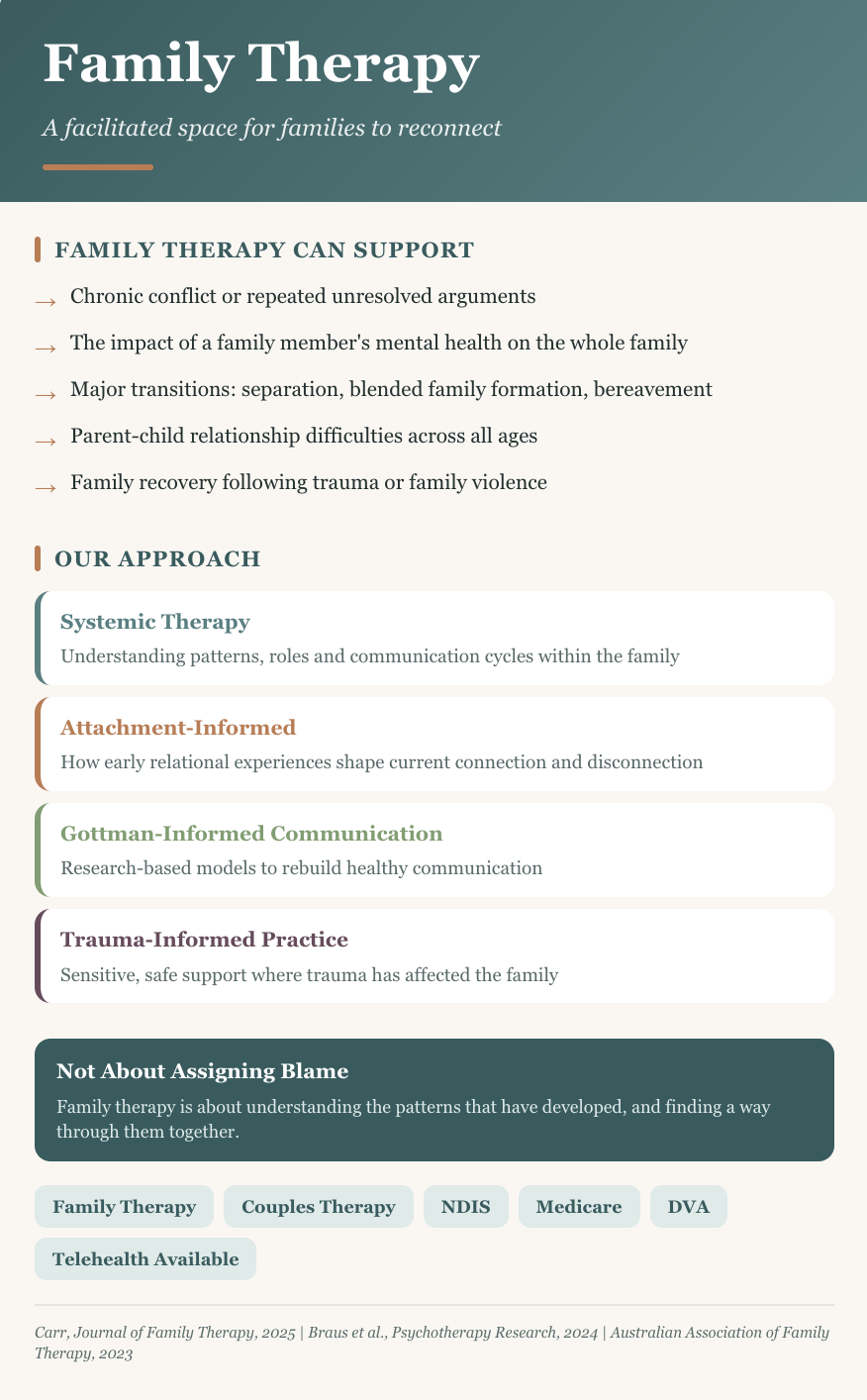
Family therapy is most helpful when the difficulties being experienced are relational rather than purely individual, when one person's individual therapy alone has not been sufficient, or when the whole family is affected and needs support together.
A 2025 evidence review published in the Journal of Family Therapy, marking 25 years of updates to the field's evidence base, found consistent support for systemic and family therapy approaches across childhood behavioural problems, adolescent mental health, depression, eating disorders, and relationship difficulties [2].
A 2024 multilevel meta-analysis further found a reliable, if modest, overall effect of systemic therapy across symptom and family-functioning outcomes [3]. The Australian Association of Family Therapy supports family therapy as an evidence-based approach for relational difficulties.
Family therapy is not appropriate where there is an ongoing risk of family violence in the room. In those situations, individual therapy and specialist family violence services are the recommended approach. Our team will discuss with you the most appropriate form of support for your specific circumstances.
At Chrysalis Psychology & Wellbeing, our family therapy approach is warm, collaborative, and grounded in evidence.
Our psychologists are experienced in working with diverse family structures including single-parent families, blended families, same-sex parent families, multigenerational households, and families from a range of cultural backgrounds.
Your first family therapy session is an opportunity for all participating family members to share their perspective on what has been happening, what they hope will be different, and what feels most important to them. The psychologist facilitates this with care, ensuring all voices are heard with equal respect.
Sessions may include all family members together, or may involve separate individual sessions alongside joint sessions, depending on what best suits your family's needs. Sessions with our psychologists are available face-to-face at our Battery Point rooms in Hobart, Tasmania, and via telehealth for clients anywhere in Australia.
We accept Medicare Mental Health Treatment Plans, NDIS (self-managed and plan-managed), DVA, Open Arms, National Redress Scheme, and private health insurance. Self-referral is also welcome.


.webp)
