
Contact Us
Contact Us
At Chrysalis Psychology & Wellbeing, our psychologists in Hobart support people experiencing body image concerns of all kinds. We also offer telehealth psychology across Australia. Please contact us for more information.
.svg)
You get dressed in the morning and feel okay. Then you catch a glimpse of yourself in a shop window and the day changes. The outfit that felt fine suddenly does not. You arrive at the event already thinking about your body rather than the people you are there to see.
Body image concerns exist on a wide spectrum. They can cause significant distress and affect quality of life, relationships, and wellbeing. Research from the Butterfly Foundation found that more than 30 per cent of Australians report feeling dissatisfied with their body, and that body dissatisfaction is one of the strongest predictors of disordered eating and low self-esteem [1].
Body image refers to how you perceive, think, and feel about your body. It is shaped by a complex mix of personal history, family messages, cultural standards, social comparison, and direct experiences with your body. Body image is not fixed: it fluctuates across circumstances, life stages, and emotional states.
Negative body image exists when your perception of your body is persistently unfavourable, when your body becomes a significant source of shame or preoccupation, or when concerns about appearance significantly affect your behaviour and daily functioning. At its most severe, negative body image can develop into Body Dysmorphic Disorder (BDD), a condition involving intense preoccupation with perceived flaws in appearance that others typically cannot observe [2].
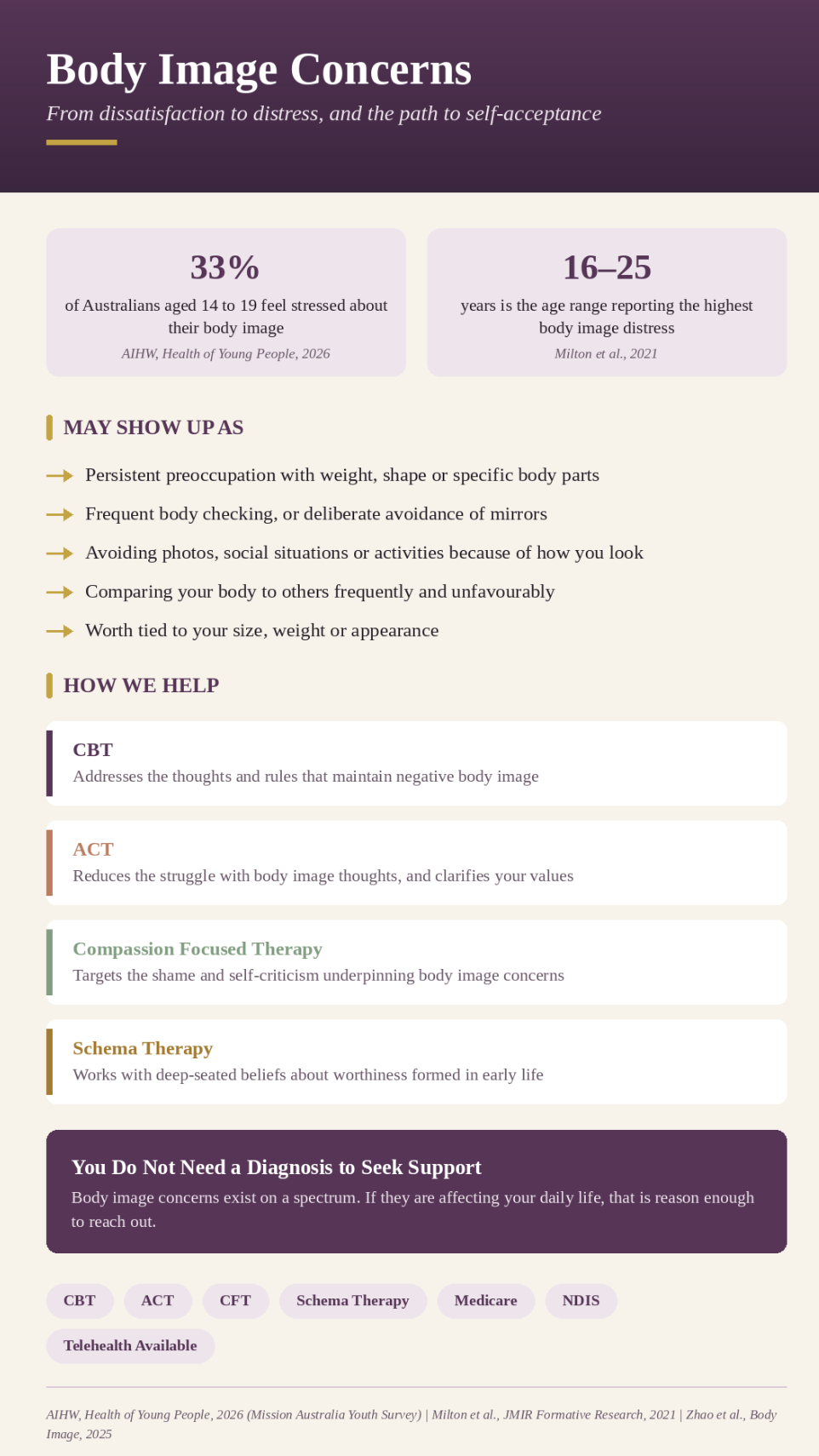
Body image concerns may show up as:
Research from the NEDC shows that social media use is significantly associated with body dissatisfaction, particularly among young people, with image-based platforms linked to increased social comparison and disordered eating risk [3]. However, body image concerns affect people across all age groups and are not limited to those who are heavy social media users.
Many adults carry body image concerns for years without identifying them as something that warrants support. It can feel like a personal failing rather than a psychological experience that responds to treatment. Body image concerns in adults are frequently intertwined with self-worth, perfectionism, and broader patterns of self-criticism.
Adults may find body image concerns intensify during life transitions including pregnancy, menopause, ageing, illness, injury, or significant weight changes. At Chrysalis Psychology & Wellbeing, our team of psychologists in Hobart offer non-judgemental, evidence-based support for adults working through body image concerns. Our telehealth psychology service is available for clients across Australia.
Body image concerns are among the most common mental health presentations in young Australians. The peak onset of eating disorders and significant body dissatisfaction typically falls between 12 and 25 years of age. Young people navigating puberty, social comparison, and social media are at particular risk [3].
Parents may notice a young person becoming preoccupied with food labelling, avoiding meals with the family, comparing their body to peers, or expressing persistent dissatisfaction with their appearance. Early support is important. At Chrysalis Psychology & Wellbeing, we provide developmentally appropriate individual therapy for young people experiencing body image concerns, alongside emotion regulation support.
Therapy for body image concerns is collaborative, strengths-based, and tailored to your specific experience.
Our psychologists will discuss with you which approaches best suit your specific presentation and goals.
Your first session is a space to talk about your experience with your body without judgement. There is no expectation about where you should be in your relationship with your body, or how quickly things should change. We work at a pace that feels right for you.
Sessions with our psychologists are available face-to-face at our Battery Point rooms in Hobart, Tasmania, and via telehealth for clients anywhere in Australia. We accept Medicare Mental Health Treatment Plans, NDIS (self-managed and plan-managed), DVA, Open Arms, National Redress Scheme, and private health insurance. Self-referral is also welcome.


.webp)
