
Contact Us
Contact Us
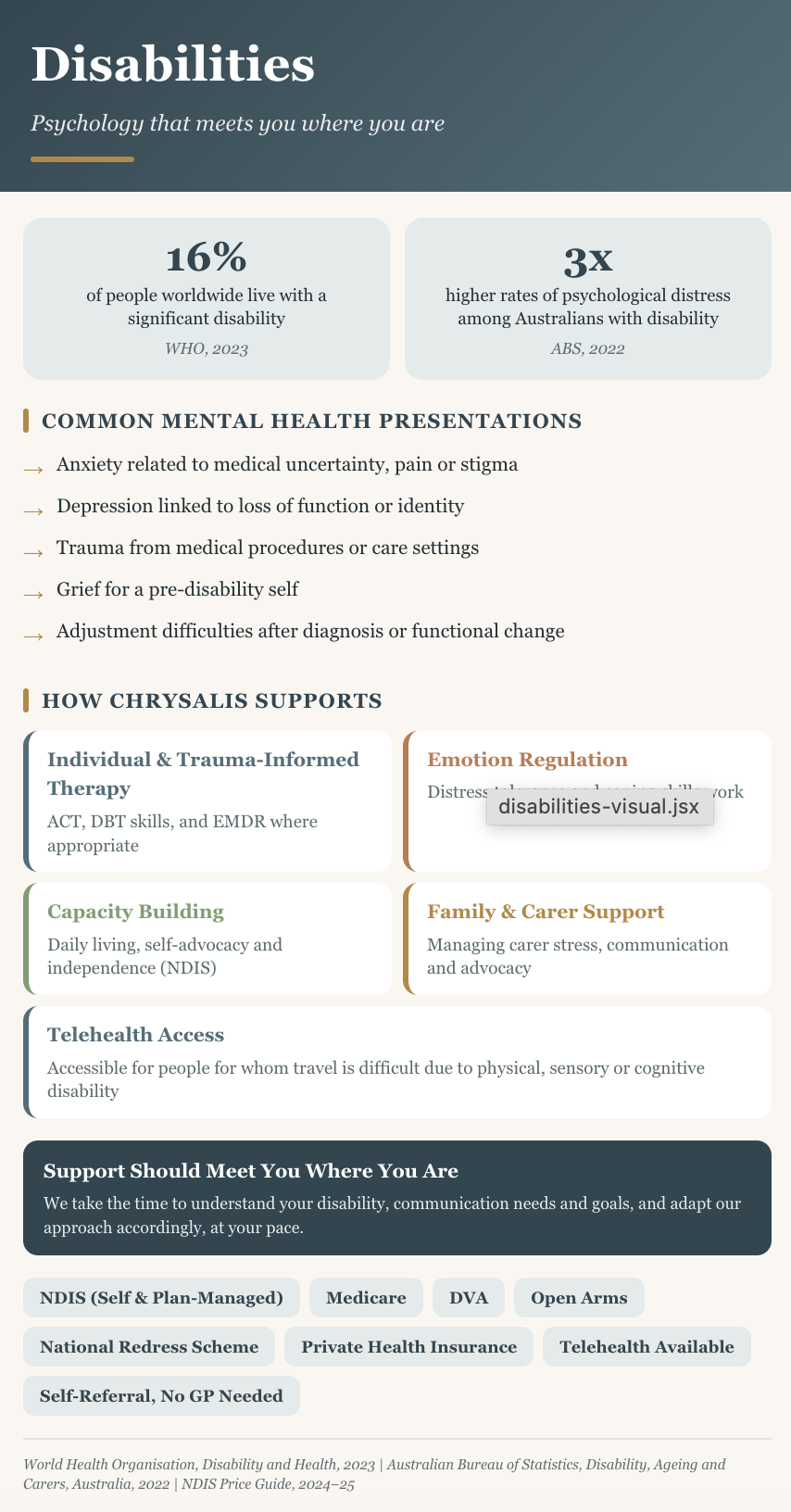
At Chrysalis Psychology & Wellbeing, our psychologists in Hobart provide evidence-based psychological support for people with disability, including those funded through the NDIS. We also offer telehealth psychology across Australia, which significantly increases accessibility for people for whom travel or in-person attendance is difficult. Please contact us for more information.
.svg)
Disability shapes how a person moves through the world. It affects daily functioning, relationships, opportunities, and how others respond to you. It can be a source of identity and community. It can also be a source of grief, frustration, stigma, and mental health difficulties that deserve proper support, delivered by someone who genuinely understands what they are listening to.
People with disability experience significantly higher rates of anxiety, depression, trauma, and other mental health conditions than the general population, driven by a combination of direct impacts of the disability itself, the ongoing experience of navigating a world not designed for disability, and frequently inadequate support systems[1]. Quality psychological support that is genuinely responsive to disability, accessible to people with a wide range of needs, and adapted to individual circumstances is both essential and under-provided.
The relationship between disability and mental health is bi directional and complex. Research from the Australian Bureau of Statistics shows that people with disability are approximately three times more likely to experience high or very high levels of psychological distress compared to people without disability [2].
Chronic fatigue and exhaustion are also common - often invisible -aspects of disability that profoundly affect mental health. See Blog: Why Am I Always Tired? A Psychologist’s Guide to Understanding Exhaustion
Despite this elevated need, many people with disability report significant difficulty accessing mental health care that is genuinely suited to them. The Australian Institute of Health and Welfare identifies cost, waiting times, and the physical accessibility of services as common barriers, while Australia's Disability Strategy notes that the greatest barrier people with disability report is often not physical or communication-related at all, but stigma, unconscious bias, and a lack of genuine understanding of disability among some health professionals [3). Finding a psychologist who takes the time to understand your disability, rather than expecting you to explain or justify it in every session, can make a meaningful difference to whether support actually feels helpful.
Individual therapy: Evidence-based individual therapy for the mental health presentations listed above, adapted to the communication needs, cognitive profile, and disability-related context of each person.
Acceptance and Commitment Therapy (ACT): ACT supports psychological flexibility and values-based living, and research suggests it may be particularly helpful for the ongoing distress that can accompany a chronic health condition or disability. See Blog: When You Are Exhausted by Your Own Thoughts
DBT Skills: DBT skills, including distress tolerance and emotion regulation, may help people with disability who experience intense emotional responses to their circumstances. See Blog: When Your Emotions Hit Like a Wave: How DBT Skills Help You Steady Yourself
Trauma-informed care: People with disability can face an increased risk of trauma, and our therapy, including EMDR where appropriate, is delivered with this context understood from the outset. See Blog: When Trauma Gets Stuck: How EMDR Therapy Helps Your Brain Process What Talk Therapy Alone Cannot
Emotion regulation skills: Structured skills work to support emotional regulation, distress tolerance, and coping across a range of disability presentations.
Social skills and communication: Structured support to build social and communication skills, including navigating social cues and community participation, tailored to each person's communication style.
Capacity building: Skills work for daily living, self-advocacy, and independence as part of NDIS Capacity Building support.
Family and carer support: Psychological support for families and carers of people with disability, including managing carer stress and burnout, and supporting effective communication and advocacy.
Telehealth access: Our telehealth service makes psychologyaccessible for people for whom travel is difficult due to physical, sensory, or cognitive disability.
Your first session is flexible and adapted to your needs. We take the time to understand your disability, your current circumstances, and your goals before building a plan. We communicate clearly, move at your pace, and will discuss any adjustments that would make our service more accessible for you.
Sessions are available face-to-face at our Battery Point rooms in Hobart, Tasmania, and via telehealth for clients anywhere in Australia. We accept NDIS (self-managed and plan-managed), Medicare Mental Health Treatment Plans, DVA, Open Arms, National Redress Scheme, work insurance, and private health insurance. Self-referral is welcome.
[1] World Health Organisation(2023). Disability and Health.https://www.who.int/news-room/fact-sheets/detail/disability-and-health
[2] Australian Bureau ofStatistics (2022). Disability, Ageing and Carers, Australia.https://www.abs.gov.au
[3] Australian Institute of Health and Welfare (2024). People with Disability in Australia: Access to Health Services. https://www.aihw.gov.au/reports/disability/people-with-disability-in-australia/contents/health/access-to-health-services
[4] Australian Institute of Health and Welfare (2026). Health of People with Disability, citing Australia's Disability Strategy 2021–2031. https://www.aihw.gov.au/reports/australias-health/health-of-people-with-disability


.webp)
