
Contact Us
Contact Us
At Chrysalis Psychology & Wellbeing, our school refusal psychologists in Hobart provide evidence-based assessment and treatment for children and young people. We also offer telehealth psychology across Australia. Please contact our team for more information.
.svg)
It starts with a stomach ache on Monday morning. Then it is every morning. Then there are tears at the school gate that do not stop. Then your child simply will not get into the car. You have tried everything you can think of: rewards, reassurance, firmness, gentleness. Nothing is working. The school is asking questions. You are running out of answers. And underneath it all, you can see that your child is not doing this to make your life difficult. They are genuinely, visibly distressed.
School refusal is not a behaviour problem. It is not defiance. It is not bad parenting. It is a child who is experiencing significant distress that is making attendance feel impossible, and who does not yet have the skills or support to manage that distress and get through the door.
Estimates suggest that between 1 and 5 per cent of school-age children experience school refusal at some point, and that it affects children across all ages, backgrounds, and academic ability levels [1]. Without appropriate support, school refusal tends to worsen over time, with significant consequences for educational outcomes, social development, and mental health.
School refusal is defined as difficulty attending school associated with emotional distress, where the child remains at home with the awareness and tacit agreement of parents [2]. This distinguishes it clearly from truancy, where a child is absent without the parent's knowledge and typically does not show the same level of emotional distress.
School refusal may look like:
Research published in the Journal of Anxiety Disorders found that anxiety disorders, particularly separation anxiety and social anxiety, are present in the majority of children presenting with school refusal [3]. ADHD, autism, and depression are also commonly associated.
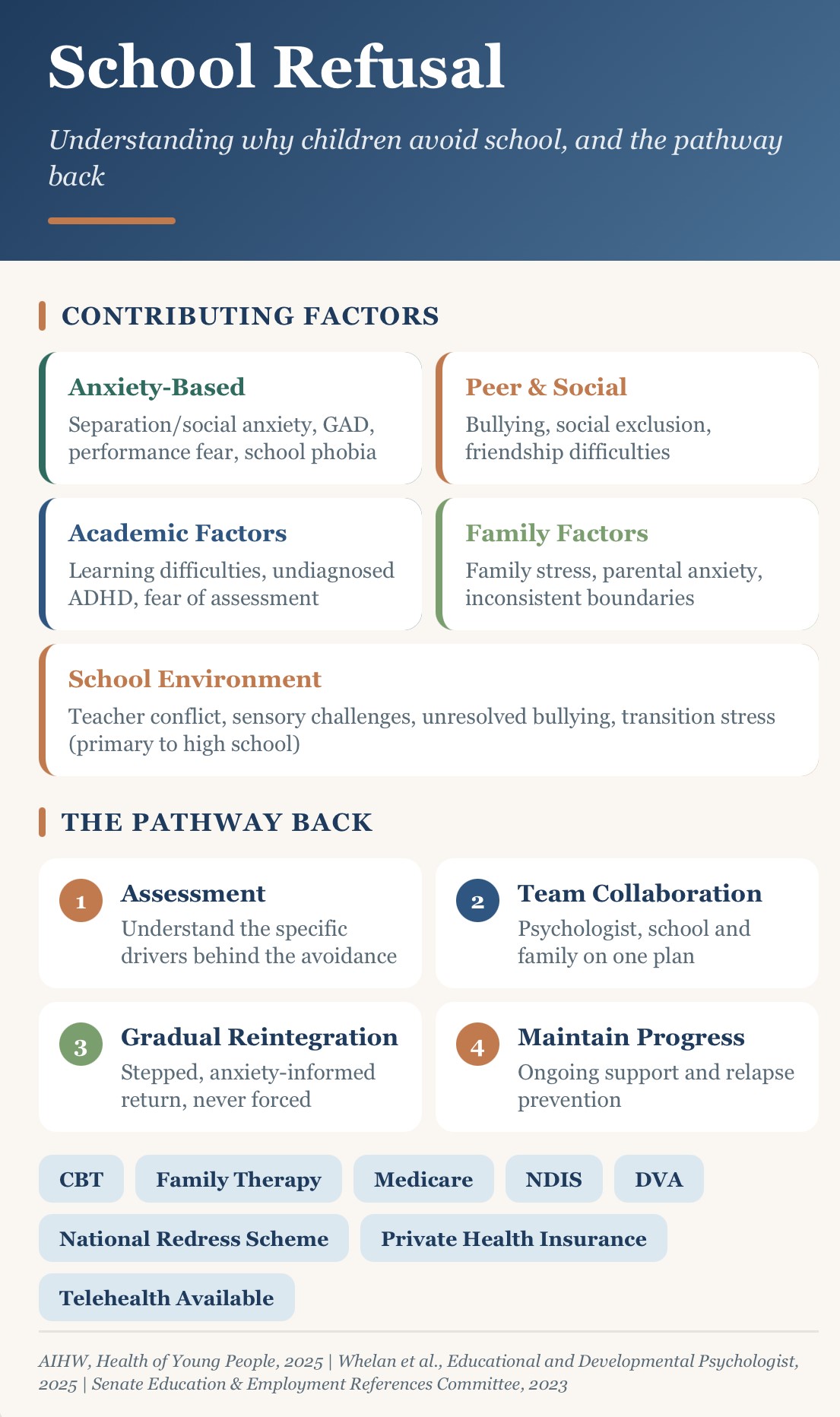
Anxiety-based refusal: The most common driver. The child is experiencing significant anxiety about some aspect of school, which may include separation from caregivers, social situations, academic performance, or a generalised sense of dread.
Depression: Some children refuse school as part of a withdrawal associated with depression, losing interest and motivation in activities including school.
Social difficulties: Bullying, social rejection, or difficulties with peer relationships can make the social environment of school feel unsafe or unbearable.
Neurodevelopmental factors: Children with autism, ADHD, or sensory processing differences may find the sensory, social, and regulatory demands of the school environment overwhelming. See Blog: Cognitive Testing in ADHD and Autism Assessments Hobart
Trauma: A specific traumatic event at school, or broader trauma affecting the child's sense of safety, can contribute to school avoidance.
Comprehensive assessment: We begin with a thorough assessment to understand the specific drivers of the school refusal in your child, including any underlying anxiety, mood, neurodevelopmental, or social factors.
CBT for anxiety-based school refusal: CBT is the most well-evidenced approach for anxiety-driven school refusal, involving gradual, supported exposure to the school environment alongside cognitive and skills work [4]. See Blog: What Is CBT, and Why Do So Many Psychologists Use It?
Family-based support: Parents are an important part of treatment. We work with families to understand school refusal, develop consistent responses at home, and support the return-to-school process.
School collaboration: With your consent, we can liaise with school counsellors, teachers, and administrators to coordinate a manageable return-to-school plan.
Your first session typically involves the parent or caregivers, allowing us to gather a full picture of the situation before meeting with the child directly. We work at a pace that feels manageable for your family and take care to build trust with the child before moving into exposure work.
Sessions are available face-to-face at our Battery Point rooms in Hobart, Tasmania, and via telehealth for families anywhere in Australia. We accept Medicare Mental Health Treatment Plans, NDIS (self-managed and plan-managed), DVA, Open Arms, National Redress Scheme, work insurance, and private health insurance. Self-referral is also welcome.
→ How Do You Know When It Is Time to Talk to Your GP About Your Mental Health?
→ Separation Anxiety and Drop-Offs: Supporting Children With Calm, Confidence, and Consistency
→ Cognitive Testing in ADHD and Autism Assessments Hobart
→ Returning to Work and School After the Festive Season
[1] Kearney, C.A. (2008). An interdisciplinary model of school absenteeism in youth. Educational Psychology Review, 20(3), 257–282.
[2] Berg, I. (2002). School avoidance, school phobia, and truancy. In Child and Adolescent Psychiatry (4th ed.). Blackwell.
[3] Egger, H.L., Costello, E.J., & Angold, A. (2003). School refusal and psychiatric disorders. Journal of the American Academy of Child & Adolescent Psychiatry, 42(7), 797–807.
[4] Australian Psychological Society (2018). Evidence-based Psychological Interventions. https://psychology.org.au


.webp)
