
Contact Us
Contact Us
At Chrysalis Psychology & Wellbeing, our psychologists in Hobart help people recover from work-related stress and burnout, rebuild sustainable working habits, and address the underlying patterns that created vulnerability. We also offer telehealth psychology across Australia. Please contact us for more information.
.svg)
You used to be good at this. You were reliable, motivated, the person others came to. Now you drag yourself to your desk and stare at tasks you once did automatically. The thought of one more email, one more meeting, one more person needing something from you sits in your chest like a stone.
Weekends do not reset you anymore. You lie awake replaying work scenarios, then arrive Monday already depleted. The version of you that cared is still there somewhere, but you cannot find it.
What you are describing is burnout, and it is not a personal failing. The World Health Organisation formally recognises burnout as an occupational phenomenon, defined by three dimensions: exhaustion, growing mental distance from one's job, and reduced professional efficacy [1]. A nationally representative Beyond Blue survey conducted in 2025 found that half of all Australian workers experienced burnout in the past year, with inappropriate workload, lack of management support, and inflexible working conditions identified as the primary drivers [2].
Work stress and burnout are related but distinct experiences. Work stress typically involves a mismatch between job demands and your resources or capacity. Burnout is the result of chronic, unrelenting work stress without adequate recovery, and it develops gradually, often in people who care deeply about their work and push themselves past sustainable limits.
Burnout is not the same as depression, though the two can co-occur and may require concurrent treatment. The core distinguishing feature of burnout is that it is specifically tied to the work context. Both experiences warrant professional support and respond well to evidence-based psychological treatment.
Work-related stress and burnout may show up as:
Research from Safe Work Australia shows that mental healthconditions, including work-related stress, are among the most costly categoriesof workers compensation claims in Australia, with median time off worksignificantly higher than for physical injuries [3]. If burnout has begun to affect your sleep, mood, or ability toconcentrate more broadly, it may also be worth reading about stress management, depression, and sleep problems, all of which can overlap withburnout.
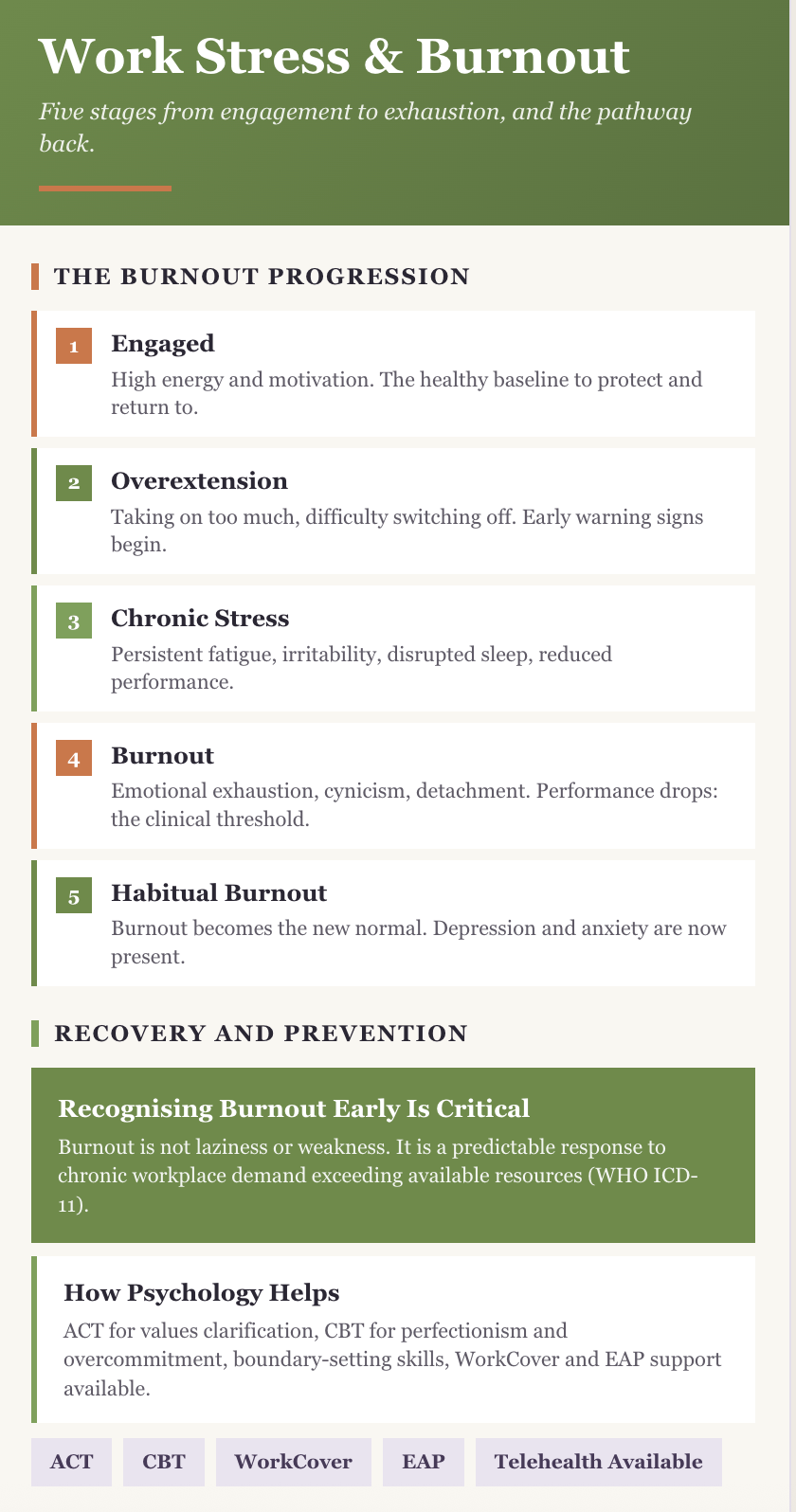
Burnout does not stay at work. It follows you home. It changes how you show up for the people you love, how much patience you have, and how willing you are to engage with life outside the office.
Many adults with burnout continue to function, managing their responsibilities while privately feeling empty, resentful, or on the edge of collapse. Others reach a point where continuing is no longer possible, which can trigger crisis, physical illness, or complete withdrawal from the workforce.
Burnout is more likely in workplaces with high demands, low autonomy, insufficient recognition, poor relationships with colleagues or supervisors, and values that conflict with your own. A widely cited framework for understanding these dynamics, the Job Demands-Resources model, links burnout directly to the balance between what a role demands and what resources and support are available to meet those demands [4]. Understanding which of these factors applies to your situation is an important part of recovery.
At Chrysalis Psychology & Wellbeing our team of psychologists in Hobart work with people experiencing burnout and work-related stress, including those supported through EAP, WorkCover, DVA, Open Arms, and other funding pathways. Our telehealth psychology service is available Australia-wide.
Therapy for burnout involves more than symptom reduction. It meansrebuilding a sustainable relationship with work, your values, and yourself.
Understanding the patterns behind burnout: We explore the beliefs, personality patterns, and workplacedynamics that contributed to your burnout, including perfectionism, difficultywith boundaries, or a deep but unsustainable investment in performance.
Rebuilding capacity: We support you torestore physical and emotional resources through evidence-based approaches tosleep, recovery, and regulation of the nervous system.
Addressing co-occurring conditions:Where burnout is accompanied by depression, anxiety, or trauma,we address these concurrently using CBT, ACT, Schema Therapy, and Compassion Focused Therapy (CFT) [5].
Navigating workplace decisions: We helpyou think clearly about next steps, whether that involves managing a return towork, negotiating changes to your role, or considering a different directionentirely.
WorkCover and EAP support: Ourpsychologists are experienced in working with WorkCover and EAP-funded clientsand understand the specific reporting and return-to-work requirements involved.
Your first session is a space to talk about what has been happening, when it started, and how it is affecting your life and your work. We take the time to understand the specific circumstances of your burnout before building a treatment plan.
[1] World Health Organisation. (2019). Burn-out an “occupational phenomenon”: International Classification of Diseases. https://www.who.int/news/item/28-05-2019-burn-out-an-occupational-phenomenon-international-classification-of-diseases
[2] Beyond Blue. (2025). 1 in 2 Australians facing workplace burnout [national community survey]. https://www.beyondblue.org.au/about/media/media-releases/1-in-2-Australians-Facing-Workplace-Burnout
[3] Safe Work Australia. (2023). Work-related Mental Health Conditions in Australia. https://www.safeworkaustralia.gov.au/resources-and-publications/statistical-reports/work-related-mental-health-conditions-australia
[4] Bakker, A.B., & de Vries, J.D. (2021). Job demands-resources theory and self-regulation: New explanations and remedies for job burnout. Anxiety, Stress and Coping, 34(1), 1–21.
[5] Australian Psychological Society. (2018). Evidence-based Psychological Interventions in the Treatment of Mental Disorders. https://psychology.org.au/for-the-public/psychology-topics/evidence-based-psychological-interventions


.webp)
