
Contact Us
Contact Us
As an OCD psychologist Hobart clients turn to for structured, evidence-based care, Chrysalis Psychology & Wellbeing provides treatment for OCD across the lifespan. We also offer telehealth psychology across Australia for those who cannot attend in person. Please contact us for more information.
.svg)
You know it does not make sense. You have locked the door. You watched yourself lock it. And yet, halfway down the street, the thought arrives again. What if you did not? What if something terrible happens because of it?
So you go back. You check. You feel better for about four minutes. And then the thought comes again.
This is OCD. Not a quirk. Not a preference for tidiness. A relentless cycle of intrusive thoughts and compulsive responses that can consume hours of each day, erode your confidence, and make even simple tasks feel impossible. The Australian Bureau of Statistics' 2020–2022 National Study of Mental Health and Wellbeing found that OCD affects a meaningful proportion of Australians across their lifetime, with onset often occurring in childhood or adolescence and years passing before people seek professional support [1].
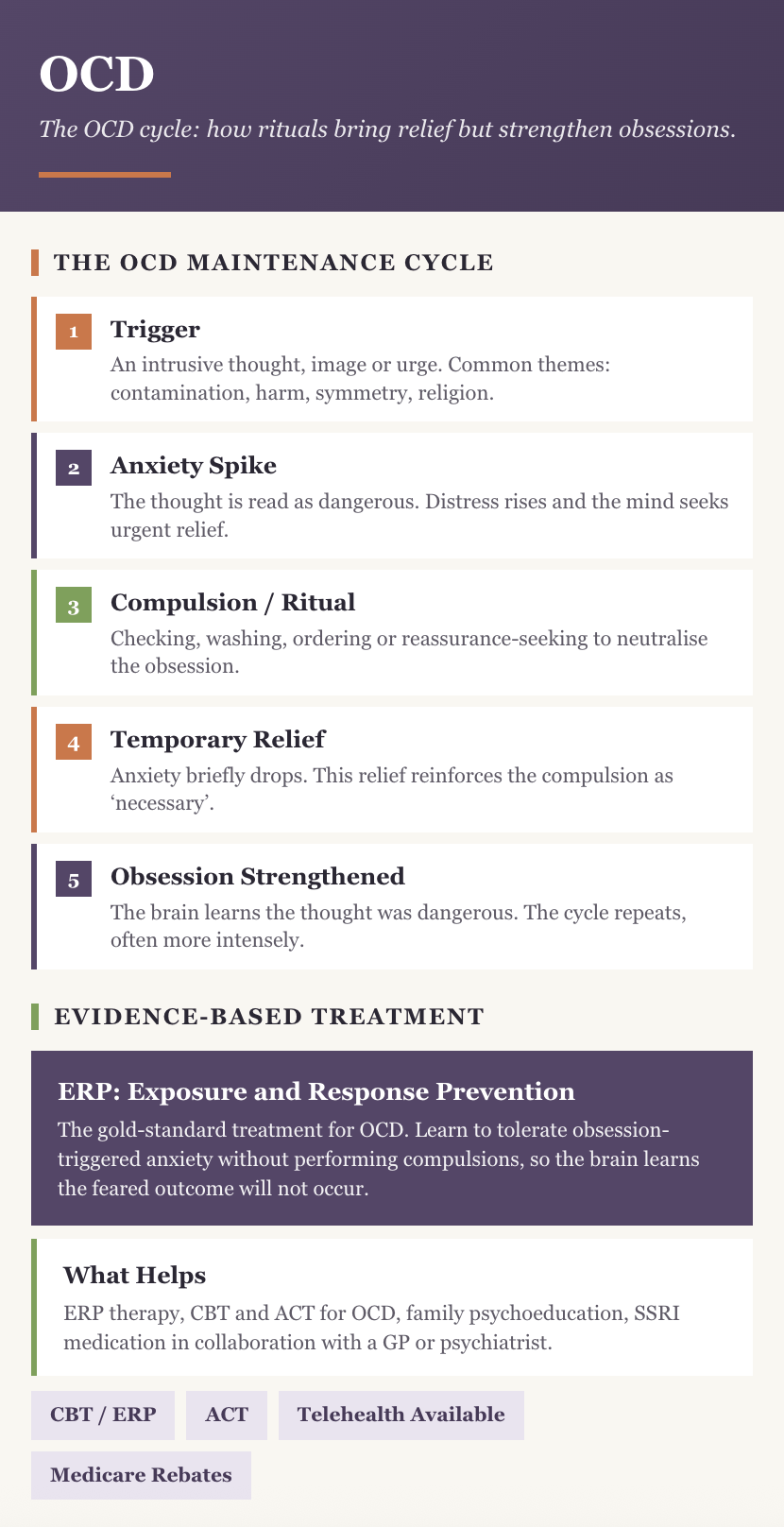
OCD stands for Obsessive Compulsive Disorder. It involves two core elements: obsessions and compulsions. Obsessions are intrusive, unwanted, and distressing thoughts, images, or urges that occur repeatedly and feel difficult to control. Compulsions are repetitive behaviours or mental acts performed to reduce the distress caused by the obsession.
Crucially, the compulsion does not resolve the obsession. It provides temporary relief, which reinforces the cycle and makes it harder to resist the next time [2]. Over time, compulsions can escalate, taking up more time and interfering more significantly with daily life, relationships, and work.
OCD may present as:
Research published in The Lancet estimates that OCD is among the top 20 causes of disability worldwide and is associated with significantly elevated rates of depression, anxiety, and suicidal ideation if left untreated [3]. Effective treatment is available, and research consistently shows that most people experience meaningful reduction in symptoms with the right support
For adults, OCD often shapes daily life in ways that are invisible to others. You may have developed routines and rituals that allow you to function, but at enormous personal cost. Significant amounts of time, often several hours each day, may go to managing obsessions and completing compulsions. Relationships can suffer when OCD demands that others participate in rituals or provide constant reassurance.
Adults with OCD frequently report shame and secrecy around their symptoms, often describing fears that others will think they are unstable or irrational. OCD is not a character flaw or a sign of weakness. It is a well-understood, treatable condition.
Chrysalis Psychology & Wellbeing works with adults using Exposure and Response Prevention (ERP), which is recognised internationally as the first-line psychological treatment for OCD [4]. A 2021 systematic review and meta-analysis of randomised controlled trials confirmed that CBT incorporating ERP produces significant and durable symptom reduction across age groups [4], and a 2023 study tracking adult ERP outcomes found that most patients show a steady trajectory of improvement across the course of treatment [5]. We also offer telehealth psychology for clients across Australia.
OCD in young people is more common than many parents realise. In children, OCD often looks different from adult presentations. A child might insist on rituals around bedtime or mealtimes, need repeated reassurance despite receiving it, have intrusive thoughts they are frightened to share, or require objects arranged in a precise way before they can feel settled.
Younger children may not understand that their thoughts or rituals are unusual. They may become intensely distressed when rituals are interrupted or cannot be completed. Teenagers often hide their OCD from family out of shame or fear of judgement, which can delay identification and support.
Early intervention matters. A 2025 meta-analysis published in Pediatrics, examining behavioural and pharmacological treatments for children and adolescents with OCD, found ERP significantly more effective than waitlist and control conditions, with remote or telehealth-delivered ERP producing comparable benefit to in-person sessions [6]. Without treatment, OCD in young people can interfere significantly with schooling, peer relationships, family functioning, and self-concept. At Chrysalis Psychology & Wellbeing, we provide developmentally appropriate individual therapy adapted to the child's age, language, and specific OCD presentation.
Therapy with us is evidence-based, collaborative, and tailored to your specific OCD presentation, delivered as a structured OCD treatment Hobart programme.
Exposure and Response Prevention (ERP): ERP is the most rigorously supported psychological treatment for OCD [4]. It involves gradual, supported exposure to obsessional triggers while practising refraining from compulsions. Over time, this process breaks the cycle and reduces the power that obsessions hold.
Cognitive approaches: Delivered through Cognitive Behavioural Therapy (CBT), we help you examine and challenge the beliefs that fuel OCD, including overestimation of threat, inflated responsibility, and intolerance of uncertainty.
Acceptance and Commitment Therapy (ACT): ACT may be used alongside ERP to help you relate differently to intrusive thoughts, reducing the struggle to eliminate or control them and building greater psychological flexibility [7].
Psychoeducation and family involvement: For children and adolescents, we work with families to understand OCD, reduce inadvertent accommodation of rituals, and support recovery at home. Our psychologists draw on ERP, CBT, and ACT, selecting the combination most suited to your individual needs and the severity of your OCD.
Your first session focuses on understanding your OCD, including the specific thoughts, triggers, and rituals involved, and how they are affecting your daily life. We assess the nature and severity of your OCD and begin building a clear, collaborative treatment plan together.
Sessions with our psychologists are available face-to-face at our Battery Point rooms in Hobart, Tasmania, and via telehealth for a telehealth OCD psychologist Australia client base anywhere in the country. Our psychologists work with Medicare Mental Health Treatment Plans, private health insurance, NDIS (self-managed and plan-managed), DVA, Open Arms, the National Redress Scheme, EAP, WorkCover, and MAIB.
[1] Australian Bureau of Statistics. (2023). National Study of Mental Health and Wellbeing, 2020–2022. https://www.abs.gov.au/statistics/health/mental-health/national-study-mental-health-and-wellbeing/latest-release
[2] Salkovskis, P.M. (1985). Obsessional-compulsive problems: A cognitive-behavioural analysis. Behaviour Research and Therapy, 23(5), 571–583.
[3] Vos, T., Allen, C., Arora, M., et al. (2016). Global, regional, and national incidence, prevalence, and years lived with disability for 310 diseases and injuries, 1990–2015. The Lancet, 388(10053), 1545–1602.
[4] Reid, J.E., Laws, K.R., Drummond, L., Vismara, M., Grancini, B., Mpavaenda, D., & Fineberg, N.A. (2021). Cognitive behavioural therapy with exposure and response prevention in the treatment of obsessive-compulsive disorder: A systematic review and meta-analysis of randomised controlled trials. Comprehensive Psychiatry, 106, 152223.
[5] Kim, H., Wheaton, M.G., Foa, E.B., & Simpson, H.B. (2023). Identifying trajectories of symptom change in adults with obsessive compulsive disorder receiving exposure and response prevention therapy. Journal of Anxiety Disorders, 96, 102711.
[6] American Academy of Pediatrics. (2025). Treatment of obsessive-compulsive disorder in children and youth: A meta-analysis. Pediatrics, 155(3), e2024068992.
[7] Twohig, M.P., & Levin, M.E. (2017). Acceptance and Commitment Therapy as a treatment for anxiety and depression. Psychiatric Clinics of North America, 40(4), 751–770.


.webp)
