
Contact Us
Contact Us
At Chrysalis Psychology & Wellbeing, we provide affirming, non-judgmental psychological support for people navigating questions of gender identity, sexuality, and neurodivergent identity. We also offer telehealth psychology across Australia. Please contact us for more information.
.svg)
Maybe you have known for a long time. Maybe it arrived as a realisation recently and everything is still settling. Maybe you are not sure yet, and the uncertainty itself is what is hard. You are trying to understand something about your self in a world that does not always make space for that process.
Identity questions involving gender, sexuality, or neurodivergence are not pathologies.They are not problems to be fixed. But navigating them, particularly in environments that are not always affirming, can bring very real challenges: anxiety, depression, loneliness, and a grief for the version of yourself you thought you were supposed to be.
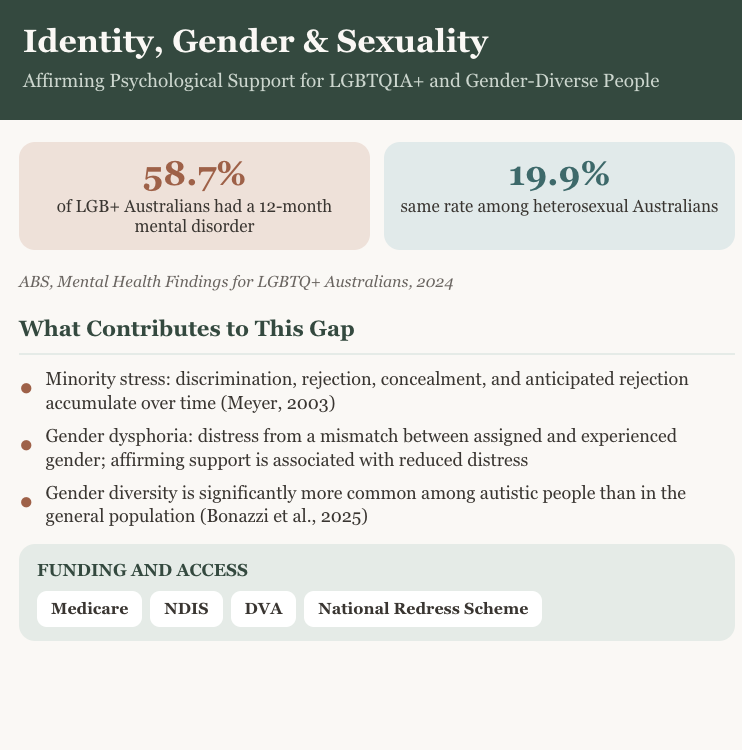
Research consistently shows that LGBTQIA+ individuals and neurodivergent people face significantly elevated rates of depression, anxiety, and suicidal ideation compared to the general population, driven largely by experiences of discrimination, rejection, and the absence of affirming spaces [1].
Gender identity refers to a person's internal, deeply held sense of their own gender. For many transgender, non-binary, and gender-diverse people, there is a significant misalignment between their gender identity and the gender they we reassigned at birth, which may be experienced as gender dysphoria: distress arising from this misalignment.
Gender diversity is not a disorder. The World Health Organisation removed gender incongruence from the list of mental disorders in ICD-11, instead recognising it as a condition related to sexual health [2]. However, the distress that can arise from living in a body, or a world, that does not align with one's gender identity is real and may benefit significantly from psychological support.
We provide gender-affirming psychological support including:
Sexual identity encompasses sexual orientation and the process of understanding and integrating one's own sexuality. For many LGBTQIA+ individuals, this process unfolds in environments that are not always safe or affirming, and may involve experiences of rejection, shame, or the need to conceal a core aspect of self.
Research from the Writing Themselves In study of LGBTQIA+ young Australians found that 41 percent of respondents had experienced depression or anxiety, and that family rejection and lack of affirming support were the strongest predictors of poor mental health outcomes [3]. Affirming psychological support that validates LGBTQIA+ identity is associated with significantly better mental health outcomes.
We do not practise conversion therapy or any approach that aims to change, suppress, or pathologise a person's sexual orientation or gender identity. Our practice is fully LGBTQIA+ affirming.
For many autistic people, those with ADHD, and others who are neurodivergent, identity is also a central theme in therapy. Coming to understand one self as neurodivergent, whether through a recent diagnosis or a lifelong sense of difference, can involve both relief and grief: relief at having an explanation for experiences that have long felt confusing, and grief for the years spent trying to fit a world that was not built for the way you think.
Neurodivergent identity work may involve processing a late diagnosis, navigating masking and the exhaustion it creates, building self-acceptance alongside practical coping skills, and finding community and connection with others who share similar experiences.
Navigating gender, sexuality, or neurodivergent identity in environments that are not always affirming can significantly elevate the risk of anxiety, depression, trauma, and suicidal ideation. This is not because of the identity itself, but because of minority stress: the chronic psychological burden of living in a society where your identity is marginalised, misunderstood, or actively rejected [4].
Effective psychological support addresses both the identity-specific aspects of a person's experience and any co-occurring mental health difficulties that have arisen as a result.
Our approach to identity support is affirming, individualised, and grounded in the best available evidence.
Affirming individual therapy: We provide individual therapy that meets you where you are in your identity journey, without agenda, without pathologising, and with genuine respect for your experience.
Acceptance and Commitment Therapy (ACT): ACT supports you to build a life that is aligned with your values and identity, reducing the impact of shame, avoidance, and internalised stigma.
Trauma-informed care: For people who have experienced rejection, discrimination, or trauma related to their identity, we provide trauma-informed therapy including EMDR where appropriate.
Compassion Focused Therapy (CFT): CFT addresses the shame and self-criticism that can develop when a core aspect of identity has been met with rejection or non-acceptance.
Your first session is a confidential, affirming space. We do not assume your goals or tell you where your identity journey should lead. We listen, understand your specific experience, and work with you according to what matters most to you.
Sessions are available face-to-face at our Battery Point rooms in Hobart, Tasmania, and via telehealth for clients anywhere in Australia. We accept Medicare Mental Health Treatment Plans, NDIS (self-managed and plan-managed), DVA, and private health insurance.
When Should You Talk to Your GP About Mental Health
[1] Roxas, M., & Stoneman, Z. (2020). Identity and mental health outcomes for LGBTQIA+ youth.Journal of Adolescence, 82, 76–85.
[2] World Health Organisation (2019). ICD-11: Gender Incongruence.https://icd.who.int/browse11/l-m/en
[3] Hillier, L. et al.(2010). Writing Themselves In 3: The third national study on the sexual health and wellbeing of same sex attracted and gender questioning young people. Australian Research Centre in Sex, Health and Society, La Trobe University.
[4] Meyer, I.H. (2003). Prejudice, social stress, and mental health in lesbian, gay, and bisexual populations. Psychological Bulletin, 129(5), 674–697.


.webp)
