
Contact Us
Contact Us
At Chrysalis Psychology & Wellbeing, our psychologists in Hobart provide evidence-based support for low self-worth and self-criticism. We also offer telehealth psychology across Australia. Please contact us for more information.
.svg)
It is with you when you wake up. When you make a mistake at work. When someone does not text back. When you look in the mirror. When you say something in a group and immediately wonder whether you sounded stupid. The voice that reminds you of every shortcoming, every failure, every way in which you do not quite measure up.
For some people, this voice arrived early. It sounds like someone from your childhood. For others, it developed gradually, shaped by experiences of criticism, rejection, or environments where love and approval felt conditional on performance. Either way, it has become so familiar that it can be hard to notice it as something separate from the truth.
Low self-worth and chronic self-criticism are not personality traits. They are learned patterns, shaped by experience, that can be understood and changed. Research from Professor Paul Gilbert demonstrates that high self-criticism activates the threat system in the brain, contributing to chronic stress, anxiety, and depression, and that self-compassion-based approaches lead to meaningful improvements in wellbeing and mental health outcomes [1].
Self-worth refers to the overall value or regard a person has for themselves as a person, distinct from confidence in specific skills or areas. Low self-worth involves a pervasive belief that you are fundamentally inadequate, unlovable, a burden, or less deserving than others, regardless of evidence to the contrary.
Low self-worth and self-criticism may show up as:
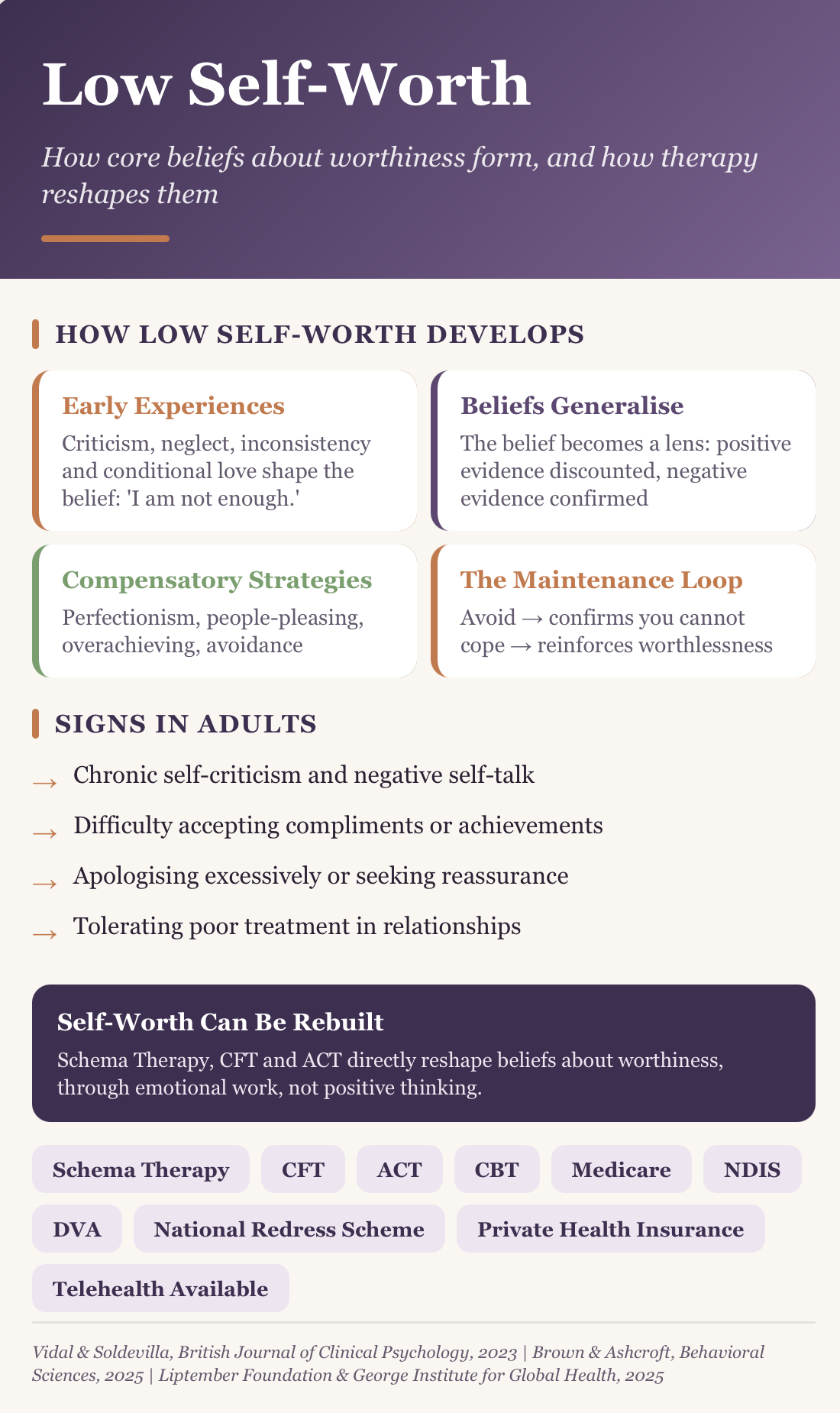
Low self-worth typically has roots in early experiences. Criticism, neglect, abuse, inconsistent care, or environments where love and approval felt conditional on performance can all contribute to the development of a negative core self-concept. These early experiences become internalised as beliefs: I am not good enough. I am not loveable. I am a burden.
Schema Therapy, developed by Dr Jeffrey Young, identifies these deep-seated negative beliefs as early maladaptive schemas, and provides a structured, evidence-based approach to understanding and changing them at their roots [2]. Understanding where your self-worth patterns came from is a significant step toward change.
Compassion Focused Therapy (CFT): CFT, developed by Professor Paul Gilbert, directly targets the self-critical mind and builds the capacity for self-compassion: treating yourself with the same warmth and care you would extend to someone you love. Research supports CFT as highly effective for shame-based self-criticism [1].
Schema Therapy: Schema Therapy addresses the deep core beliefs and early life experiences that underpin low self-worth, working at the level of the emotional patterns that maintain them.
Cognitive Behavioural Therapy (CBT): CBT helps identify and challenge the specific thought patterns involved in self-criticism, building more balanced, realistic, and supportive ways of relating to yourself.
DBT Skills: For people whose self-criticism is bound up with intense emotional experiences, DBT skills build emotional regulation and distress tolerance alongside self-compassion work.
Acceptance and Commitment Therapy (ACT): ACT supports you to notice the self-critical voice without being controlled by it, and to invest in a life that reflects your values rather than your fears.
Your first session is a warm, non-judgemental space to talk about how you experience yourself and how that is affecting your life. We work gently and with genuine care to understand your specific patterns and history before building a plan.
Sessions are available face-to-face at our Battery Point rooms in Hobart, Tasmania, and via telehealth for clients anywhere in Australia. We accept Medicare Mental Health Treatment Plans, NDIS (self-managed and plan-managed), DVA, Open Arms, National Redress Scheme, work insurance, and private health insurance. Self-referral is welcome.
→ How Do You Know When It Is Time to Talk to Your GP About Your Mental Health?
→ The Spill You Cannot Stop Replaying: Making Peace With Your Inner Critic
→ The Wounded Child, the Inner Critic, and the Healthy Adult: A Guide to Schema Modes
→ What Is CBT, and Why Do So Many Psychologists Use It?
→ When You Are Exhausted by Your Own Thoughts
[1] Gilbert, P. (2010). Compassion Focused Therapy: Distinctive Features. Routledge.
[2] Young, J.E., Klosko, J.S., & Weishaar, M.E. (2003). Schema Therapy: A Practitioner's Guide. Guilford Press.
[3] Neff, K.D., & Germer, C.K. (2013). A pilot study and randomized controlled trial of the Mindful Self-Compassion program. Journal of Clinical Psychology, 69(1), 28–44.


.webp)
