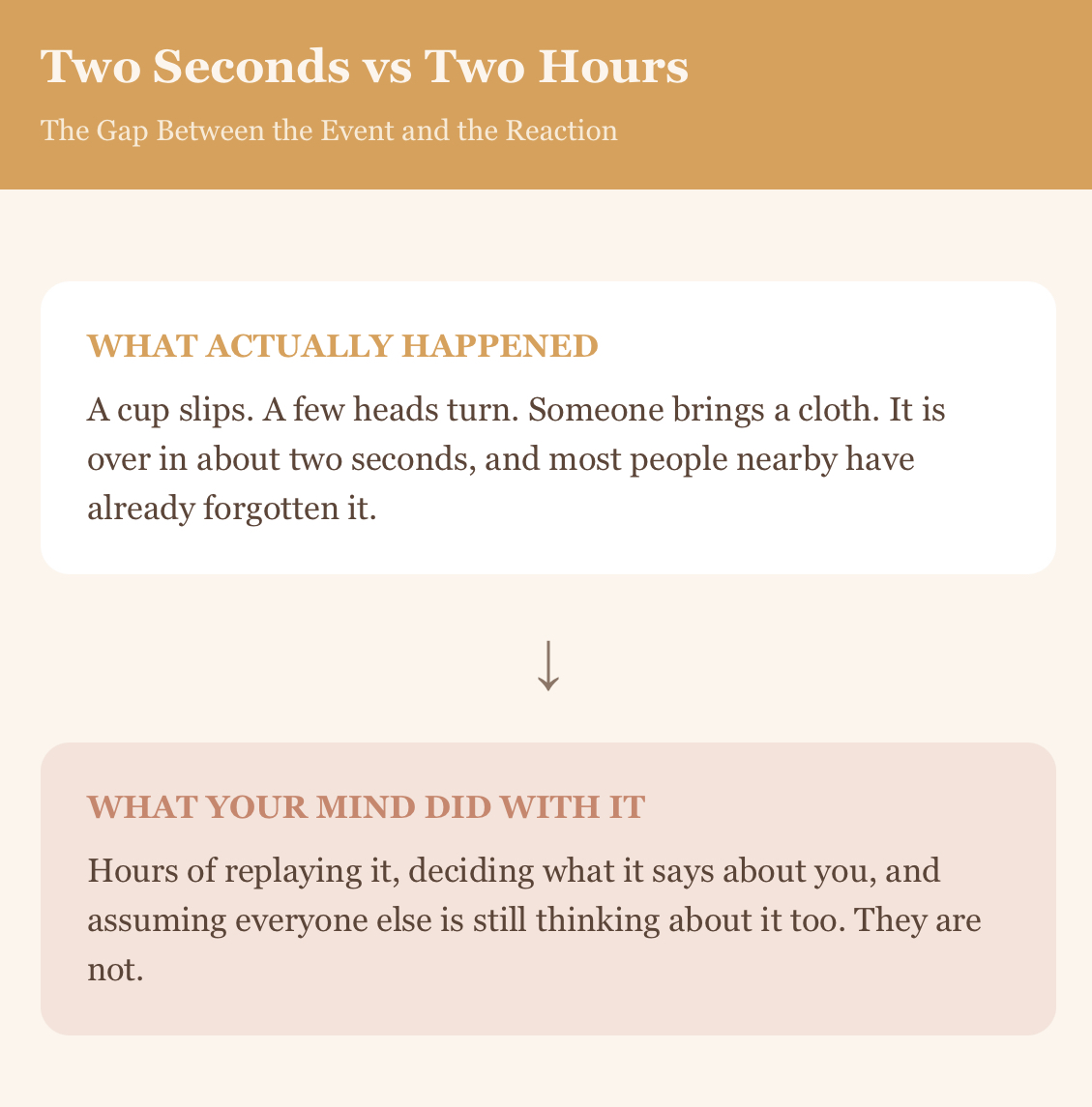
The cup slips from your hand in a crowded cafe. It is over in less than two seconds: a small clatter, a few heads turning, a barista appearing with a cloth before you have even finished apologising. Nobody else remembers it by the time they reach the counter. You remember it for the rest of the day.
By the time you are walking home, the moment has grown teeth. You are not thinking about the cup anymore. You are thinking about how clumsy you are, how you always manage to make a scene, how everyone in that cafe probably noticed and judged you the way you are now judging yourself. The original event lasted two seconds. The commentary that followed has lasted for hours, and it is far harsher than anything an actual stranger said to you.
If this pattern is familiar, you are not alone, and you are not simply being dramatic. Psychologists increasingly recognise this kind of disproportionate self-directed criticism as a distinct pattern in its own right, one with a name, a shape, and a good deal of research behind it.
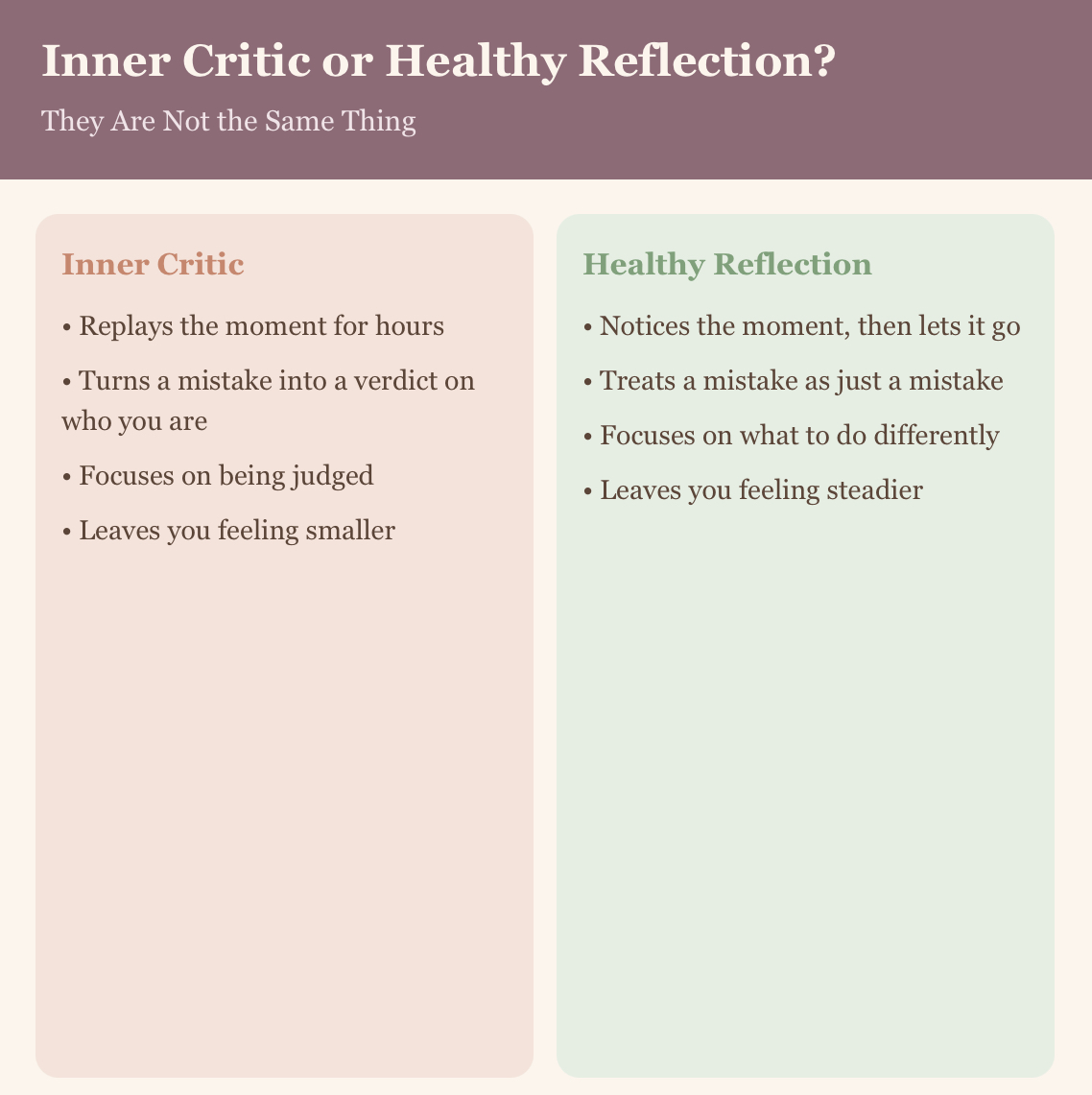
In psychology, this pattern is often described as the inner critic: an internal voice, sometimes barely noticed because it is so constant, that responds to ordinary mistakes and setbacks with a severity you would never direct at another person. It is not the same as healthy reflection or accountability. Reflection helps you learn from a moment and move on. The inner critic tends to keep the moment alive far longer than it deserves, often framing it as evidence of a deeper flaw rather than a small, forgettable event.


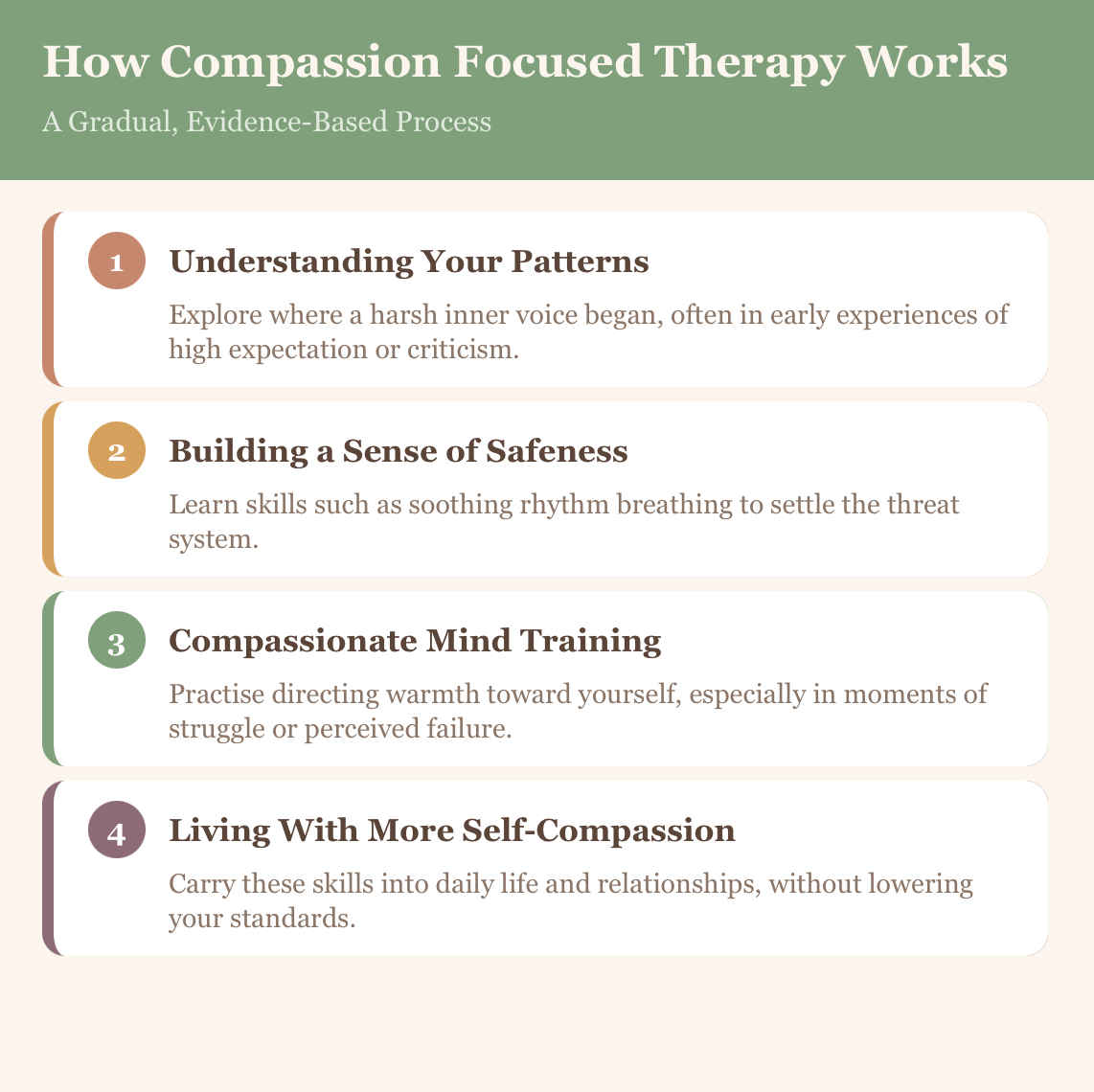
Compassion Focused Therapy (CFT), developed by British psychologist Paul Gilbert, was built specifically to work with this pattern. Rather than trying to argue with the content of self-critical thoughts, the approach focuses on the emotional system that produces them, and on strengthening the capacity to respond to yourself with the same warmth you would offer someone you cared about.
Self-criticism is increasingly understood as a factor that cuts across many different difficulties, rather than belonging to one diagnosis alone. In 2020 to 2022, an estimated 21.5 per cent of Australians aged 16 to 85 experienced a 12-month mental disorder, with anxiety the most commonly reported presentation (Australian Bureau of Statistics, 2023). Chronic self-criticism and shame are frequently present alongside these experiences, whether or not they are the primary reason someone seeks support.
A 2025 systematic review examined 21 international studies on CFT and found consistent improvements in self-compassion and reductions in self-criticism among clinical populations, along with reductions in external shame in the smaller number of studies that measured this outcome (Brown and Ashcroft, 2025). A large 2024 series of meta-analyses similarly reported that CFT was associated with reductions in negative mental health outcomes and improvements in positive outcomes such as wellbeing, across a substantial body of published research (Petrocchi et al., 2024). Researchers have been careful to note that the field would benefit from more high-quality randomised controlled trials, and that not every study reviewed was of strong methodological quality (Vidal and Soldevilla, 2023), but the overall direction of the evidence is consistent.
You do not need a formal diagnosis to benefit from noticing your own inner critic more clearly. A useful starting point is simply naming it when it appears, even silently, as a way of creating a small gap between yourself and the voice. Some people find it helpful to ask whether they would say the same thing to a close friend in the same situation, and if not, to notice the gap between the two responses without needing to close it immediately.
Slower, physical practices can also help settle the nervous system before self-critical thoughts are addressed directly. Gilbert's model places particular emphasis on soothing rhythm breathing, a slower and more even breathing pattern that can help shift the body out of a threat state before any cognitive work begins. This is not a replacement for professional support where self-criticism is severe, longstanding, or connected to a significant history of shame or trauma, but it can be a reasonable place to begin noticing the pattern.
If the inner critic has been a near-constant presence for a long time, particularly if it is connected to anxiety, depression, or a difficult period in your past, it may help to work through this with a psychologist who can tailor Compassion Focused Therapy or a related approach to your specific situation.
You do not have to keep carrying a voice this harsh on your own. Chrysalis Psychology & Wellbeing offers Compassion Focused Therapy (CFT) for adults navigating shame, self-criticism, and the effects of a persistent inner critic, face to face in Battery Point, Hobart, or via telehealth psychology across Australia. Contact our reception team on (03) 6263 6319 to arrange an appointment, or visit our individual therapy page to learn more about the approaches our clinical team uses.

1. Australian Bureau of Statistics. (2023). National study of mental health and wellbeing, 2020 to 2022. Canberra: ABS.
2. Brown, N., and Ashcroft, K. (2025). The effectiveness of compassion focused therapy for the three flows of compassion, self-criticism, and shame in clinical populations: A systematic review. Behavioural Sciences, 15(8), 1031.
3. Gilbert, P. (2014). The origins and nature of compassion focused therapy. British Journal of Clinical Psychology, 53(1), 6 to 41.
4. Petrocchi, N., Ottaviani, C., Cheli, S., Matos, M., Baldi, B., Basran, J. K., and Gilbert, P. (2024). The impact of compassion-focused therapy on positive and negative mental health outcomes: Results of a series of meta-analyses. Clinical Psychology: Science and Practice, 31(2), 230 to 247.
5. Vidal, J., and Soldevilla, J. M. (2023). Effect of compassion-focused therapy on self-criticism and self-soothing: A meta-analysis. British Journal of Clinical Psychology, 62(1), 70 to 81.