What ACT Can Help With
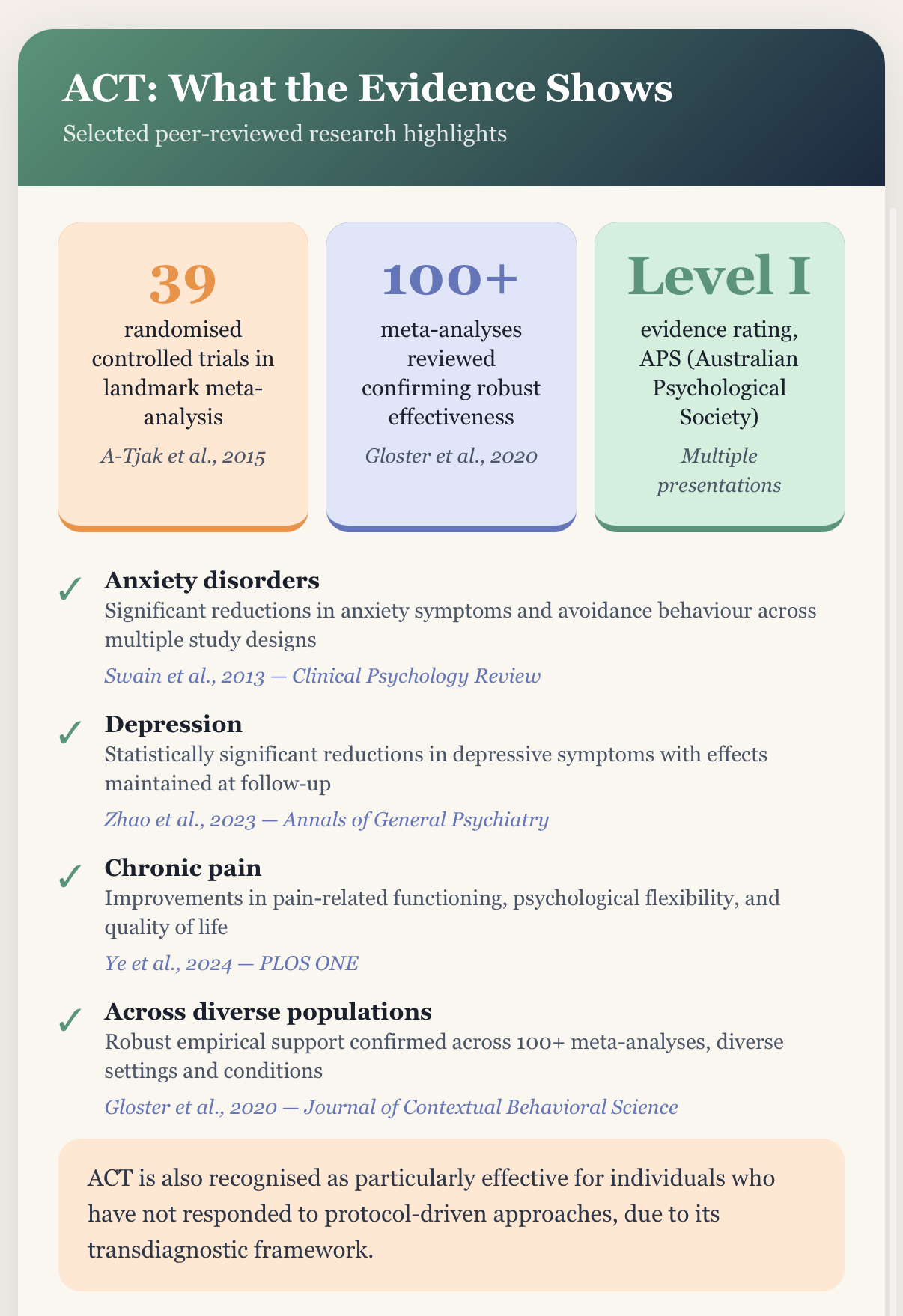
Research supports the use of ACT across a wide range of clinical presentations. At Chrysalis Psychology & Wellbeing, ACT may be offered as a primary approach or integrated with other evidence-based therapies such as CBT, EMDR, DBT, or Schema Therapy, depending on individual circumstances and clinical presentation. ACT has well-established evidence for:
- Anxiety and Generalised Anxiety Disorder
- Stress management and burnout recovery
- Relationship Difficulties
- Chronic pain and health-related psychological adjustment
What to Expect in ACT Therapy
ACT sessions are collaborative, practical, and experiential. Rather than spending significant time analysing the past, the focus is on building real-world skills and moving toward a life shaped by your values. Your psychologist will draw on exercises, metaphors, and mindfulness-based practices tailored to your specific situation.
You do not need to have things figured out before you arrive. The process itself is where the work happens. Many people find that something shifts not because painful thoughts have disappeared, but because those thoughts have lost their power to steer.
At Chrysalis Psychology & Wellbeing, ACT is delivered through individual psychology sessions in Battery Point, Hobart and via telehealth psychology across Australia. No GP referral is required - you can self-refer at any time.
Taking the Next Step
If something here has resonated, support is available. At Chrysalis Psychology & Wellbeing in Battery Point, Hobart, our psychologists provide ACT-informed therapy for children, adolescents, adults, and families.
Sessions can be accessed through a Mental Health Treatment Plan (Medicare, up to 10 rebated sessions per year), NDIS, DVA, Open Arms, National Redress Scheme, EAP, private health insurance, or self-referral. To enquire or book, contact us on (03) 6263 6319 or visit chrysalispsychwell.com.au/contact-us.
Related Reading
https://www.chrysalispsychwell.com.au/services/acceptance-and-commitment-therapy-act
References
All references are peer-reviewed international publications. Please review dates of access where relevant. References are formatted in APA 7th edition.
- A-Tjak, J.G.L., Davis, M.L., Morina, N., Powers, M.B., Smits, J.A.J., & Emmelkamp, P.M.G. (2015). A meta-analysis of the efficacy of acceptance and commitment therapy for clinically relevant mental and physical health problems. Psychotherapy and Psychosomatics, 84(1), 30–36. https://doi.org/10.1159/000365764
- Gloster, A.T., Walder, N., Levin, M.E., Twohig, M.P., & Karekla, M. (2020). The empirical status of acceptance and commitment therapy: A review of meta-analyses. Journal of Contextual Behavioral Science, 18, 181–192. https://doi.org/10.1016/j.jcbs.2020.09.009
- Hayes, S.C., Strosahl, K.D., & Wilson, K.G. (2012). Acceptance and commitment therapy: The process and practice of mindful change (2nd ed.). Guilford Press.
- Jiang, X., Sun, J., Song, R., Wang, Y., Li, J., & Shi, R. (2024). Acceptance and commitment therapy reduces psychological distress in patients with cancer: A systematic review and meta-analysis of randomized controlled trials. Frontiers in Psychology, 14, 1253266. https://doi.org/10.3389/fpsyg.2023.1253266
- Kashdan, T.B., & Rottenberg, J. (2010). Psychological flexibility as a fundamental aspect of health. Clinical Psychology Review, 30(7), 865–878. https://doi.org/10.1016/j.cpr.2010.03.001
- Lopez-Pinar, C., Lara-Merin, L., & Macias, J. (2025). Process of change and efficacy of acceptance and commitment therapy (ACT) for anxiety and depression symptoms in adolescents: A meta-analysis of randomized controlled trials. Journal of Affective Disorders, 368, 633-644. https://doi.org/10.1016/j.jad.2024.09.076
- Ma, T.W., Yuen, A.S.K., & Yang, Z. (2024). The efficacy of acceptance and commitment therapy for chronic pain: An overview of systematic reviews with meta-analysis of randomized clinical trials. The Journal of Pain, 25(5), 1187-1203. https://doi.org/10.1016/j.jpain.2023.09.013
- Ruiz, F.J. (2012). Acceptance and commitment therapy versus traditional cognitive behavioral therapy: A systematic review and meta-analysis of current empirical evidence. International Journal of Psychology and Psychological Therapy, 12(3), 333–357.
- Swain, J., Hancock, K., Hainsworth, C., & Bowman, J. (2013). Acceptance and commitment therapy in the treatment of anxiety: A systematic review. Clinical Psychology Review, 33(8), 965–978. https://doi.org/10.1016/j.cpr.2013.07.002
- Ye, L., Li, Y., Deng, Q., Zhao, X., Zhong, L., & Yang, L. (2024). Acceptance and commitment therapy for patients with chronic pain: A systematic review and meta-analysis on psychological outcomes and quality of life. PLOS ONE, 19(6), e0301226. https://doi.org/10.1371/journal.pone.0301226
- Zhao, B., Wang, Q., Wang, L., Chen, J., Yin, T., Zhang, J., Cheng, X., & Hou, R. (2023). Effect of acceptance and commitment therapy for depressive disorders: a meta-analysis. Annals of General Psychiatry, 22, 34. https://doi.org/10.1186/s12991-023-00462-1




.webp)
