
Book Now
Book Now
.svg)
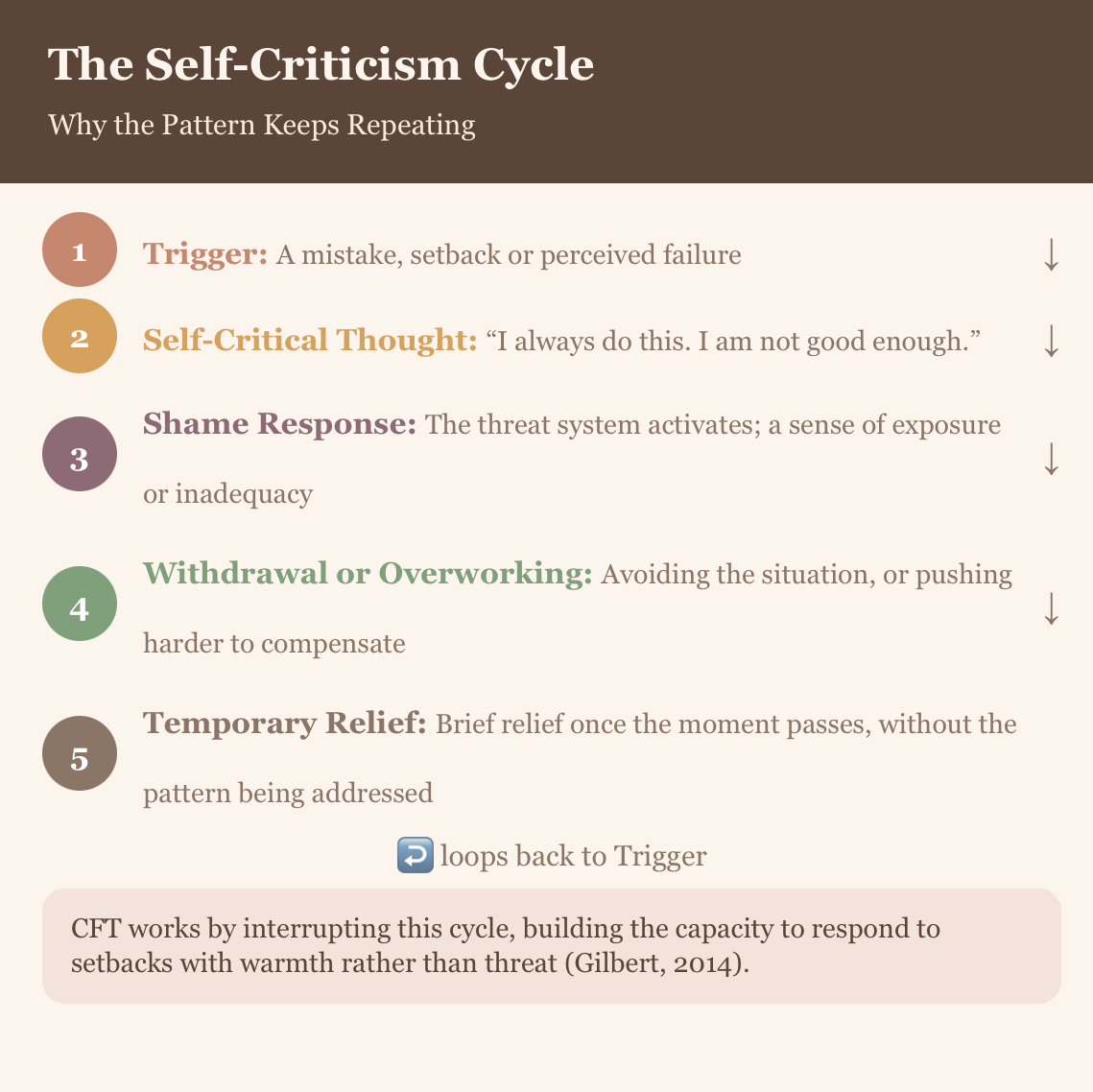
After the meeting, the feedback was mostly positive. One colleague mentioned that a single slide could have been clearer, and that is the only part you can remember by the time you get home. You turn it over while making dinner, while trying to fall asleep, and again at five the next morning. A friend in the same position would tell you it was one small comment inside an otherwise strong presentation. You would tell a friend that. You do not tell yourself that.
For many people, this kind of internal harshness is so familiar that it no longer feels like a choice. It feels like an accurate account of who they are. Compassion Focused Therapy was developed for exactly this experience: a persistent, critical inner voice that can follow a person through work, relationships and everyday life, regardless of how much they achieve or how hard they try.
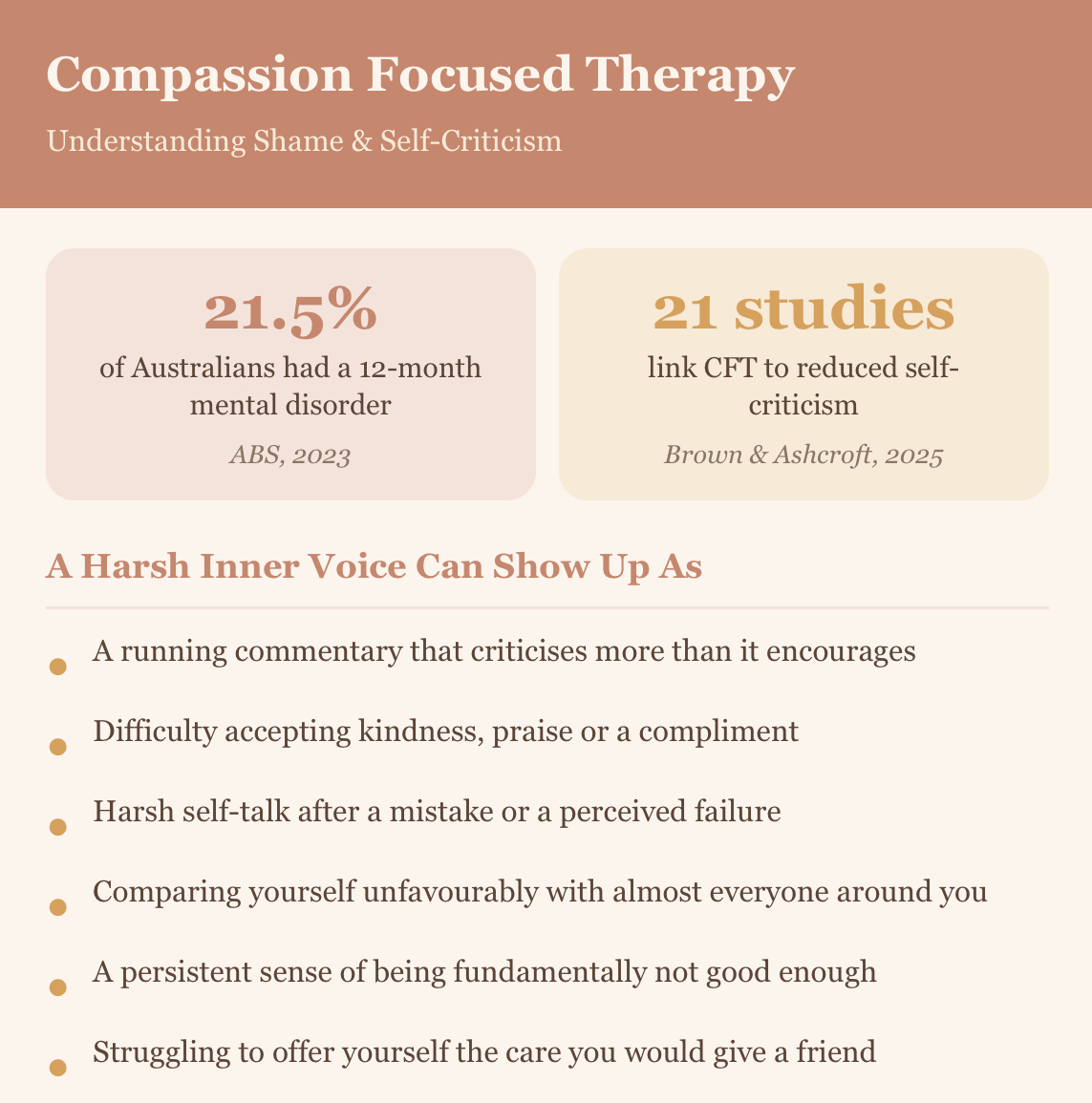
Compassion Focused Therapy, often referred to as CFT, is a structured, evidence-based approach developed by British clinical psychologist Paul Gilbert for people who experience high levels of shame and self-criticism (Gilbert, 2014). Unlike approaches that focus primarily on changing the accuracy of a thought, CFT works directly with the emotional systems that sit underneath self-critical patterns.
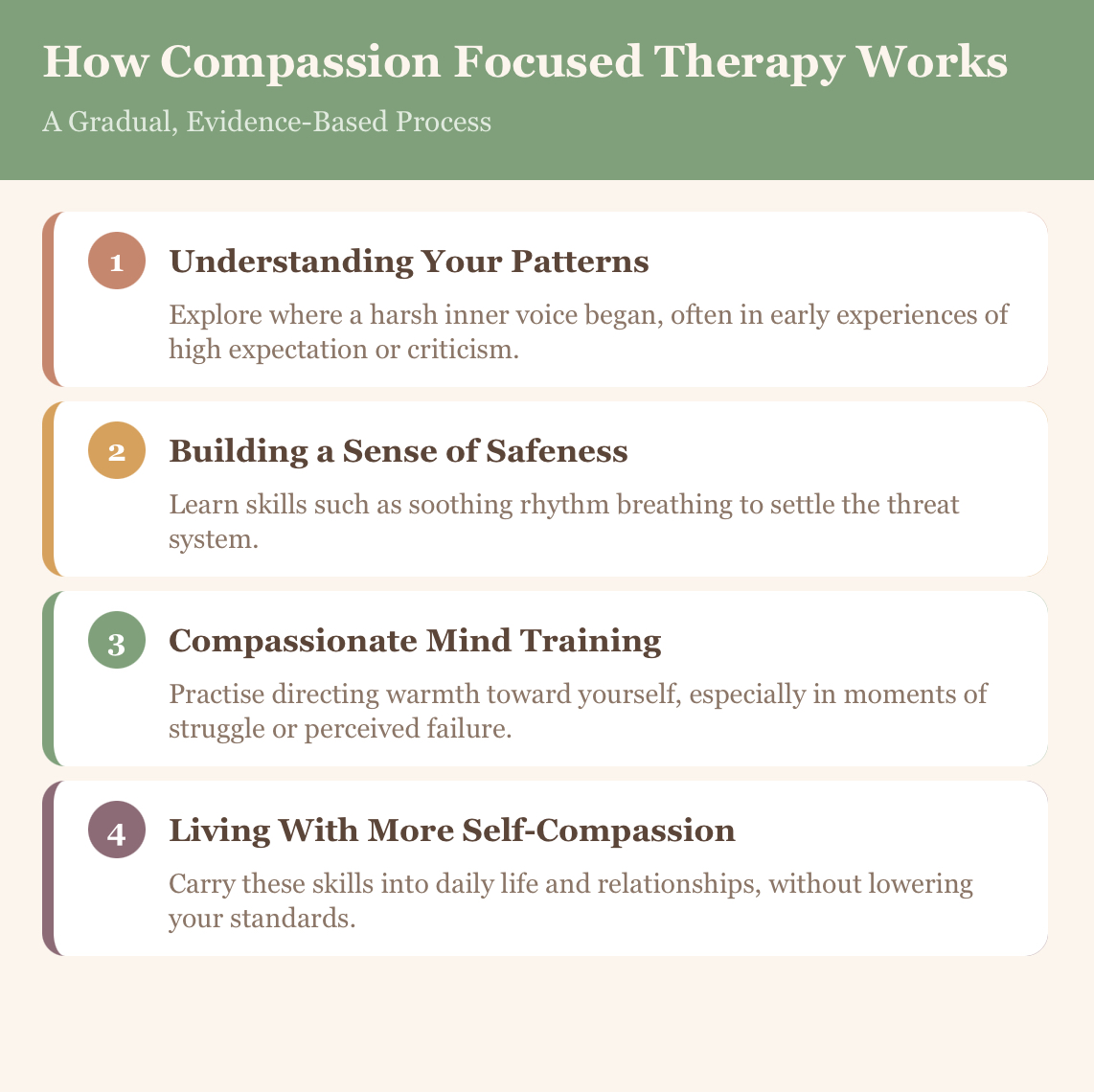
Gilbert's model describes three interacting emotion regulation systems: a threat system that scans for danger and criticism, a drive system that pursues achievement and reward, and a soothing system that provides a sense of safeness and calm (Gilbert, 2014). Many people who seek compassion focused therapy in Hobart and elsewhere have a threat and drive system that is highly active, alongside a soothing system that is underdeveloped or difficult to access. CFT aims to strengthen this soothing system directly, using structured practices sometimes described as compassionate mind training.
The approach also describes compassion as something that can move in three directions: compassion you feel for others, compassion you feel coming from others toward you, and compassion you are able to direct toward yourself. Research reviewing this model has found the strongest and most consistent evidence for the third of these, the ability to direct compassion toward yourself, with more limited evidence currently available for the other two directions (Brown and Ashcroft, 2025). This is one of the reasons CFT places such deliberate emphasis on self-compassion as a specific, trainable skill, rather than treating it as a simple by-product of feeling supported by others.
Shame and harsh self-criticism often develop early, sometimes in response to high family expectations, critical caregivers, bullying, or experiences of trauma, though they can also develop later in life through demanding workplaces or difficult relationships. Whatever its origin, a harsh inner voice does not always announce itself clearly. For many people, it has simply become the background of everyday thinking. Common signs include:
These patterns often sit alongside, rather than instead of, other difficulties such as anxiety, depression, or the lasting effects of trauma, which is one reason CFT is frequently used as part of a broader, integrated treatment plan rather than in isolation.
In 2020 to 2022, an estimated 21.5 per cent of Australians aged 16 to 85 experienced a 12-month mental disorder, with anxiety the most commonly reported presentation (Australian Bureau of Statistics, 2023). Self-criticism and shame are increasingly understood as transdiagnostic factors that cut across many of these presentations, rather than being specific to a single diagnosis.
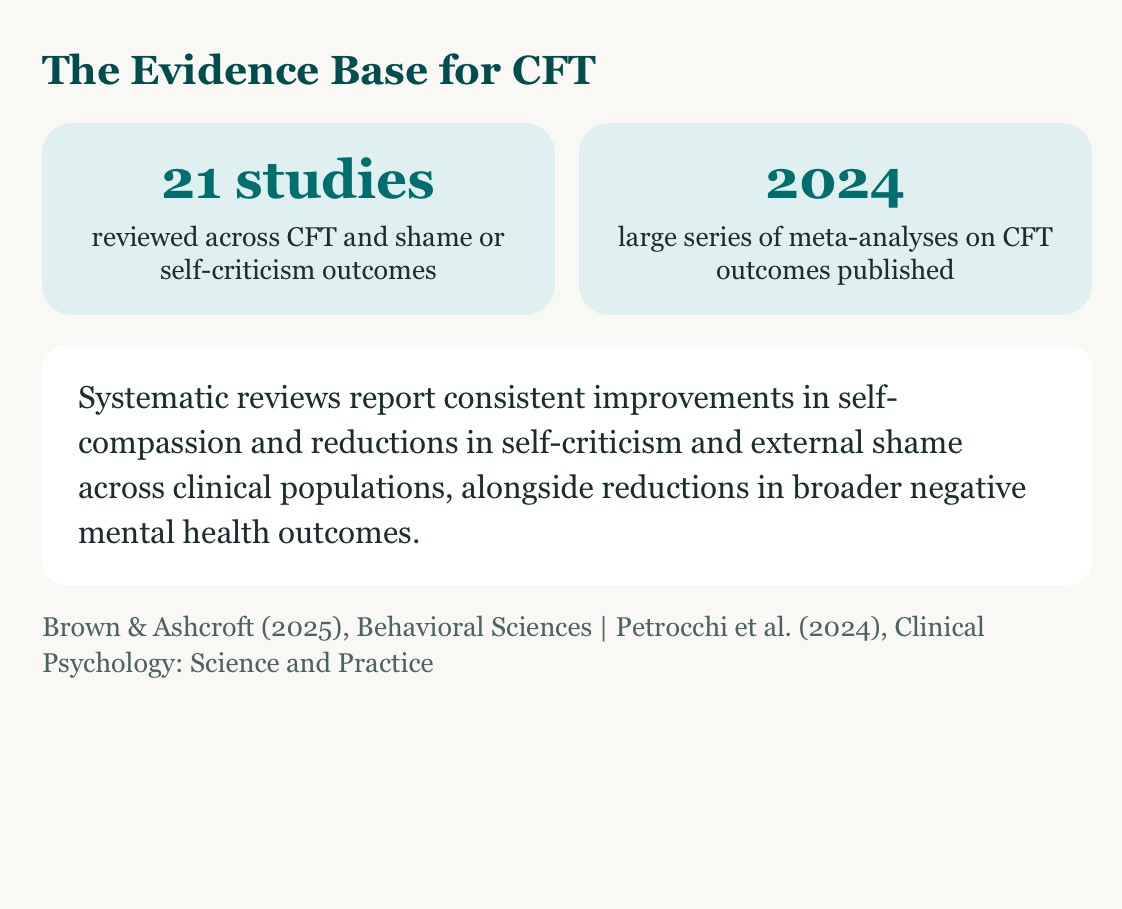
A 2025 systematic review of 21 international studies found that Compassion Focused Therapy was consistently associated with improvements in self-compassion and reductions in self-criticism among clinical populations, along with reductions in external shame in the smaller number of studies that measured it (Brown and Ashcroft, 2025). A related meta-analysis reported that CFT reduced self-criticism and increased participants' capacity for self-soothing, although the authors noted that more high-quality randomised controlled trials are needed to strengthen confidence in these findings, as roughly half of the studies reviewed were of lower methodological quality (Vidal and Soldevilla, 2023).
A large 2024 series of meta-analyses examined the impact of CFT across a wide range of positive and negative mental health outcomes, reporting reductions in negative outcomes such as depression and anxiety symptoms alongside improvements in positive outcomes such as wellbeing and compassion for self and others (Petrocchi et al., 2024). Taken together, this research suggests that CFT may help people who have not found the same benefit from approaches that focus primarily on the accuracy of a thought rather than the emotional tone that accompanies it, while also suggesting that, as with most psychological treatments, individual results vary and further high-quality research continues to strengthen the evidence base.
At Chrysalis Psychology & Wellbeing, our clinical team offers Compassion Focused Therapy as either a primary approach within individual therapy or as part of an integrated treatment plan. CFT is often used alongside other therapeutic approaches available at our practice, including Cognitive Behavioural Therapy, Acceptance and Commitment Therapy, and Schema Therapy, particularly where a client's presentation includes a strong internalised critical voice similar to what Schema Therapy describes as the Punitive Parent mode.
Sessions typically begin with psychoeducation about the three emotion regulation systems, followed by structured practices such as soothing rhythm breathing, compassionate imagery and, where appropriate, compassionate letter writing. Your psychologist will tailor the pace and content of therapy to your presentation, drawing on your broader treatment goals, whether these relate to anxiety, depression, self-esteem and confidence building, relationship difficulties, or the lasting effects of trauma.
Because shame and self-criticism so often affect how people relate to those around them, CFT can also be a useful foundation for work on relationship difficulties, particularly where a harsh inner voice makes it difficult to accept support, tolerate conflict, or feel worthy of care from a partner or family member. Similarly, where self-esteem and confidence have been shaped by years of internal criticism, CFT can offer a different way of building self-worth, one grounded in warmth rather than achievement alone.
Your first session will focus on understanding your current difficulties and how self-criticism or shame shows up in your life, alongside your broader history and goals for therapy. Compassion Focused Therapy can feel unfamiliar at first, particularly for people who are unused to directing warmth toward themselves, and your psychologist will move at a pace that feels manageable. Some clients notice this unfamiliarity quite strongly in early sessions, which is a common and expected part of the process rather than a sign that the approach is not working. Sessions are available face to face at our Battery Point rooms or via secure telehealth psychology across Australia, for clients who prefer to attend from home or cannot travel to Hobart.
Compassion Focused Therapy at Chrysalis Psychology & Wellbeing can be accessed through a Medicare Mental Health Treatment Plan which provides a rebate for up to ten sessions per calendar year. Our practice accepts both self-managed and plan-managed NDIS funding. We also accept DVA and Open Arms referrals, the National Redress Scheme, WorkCover and MAIB claims, and private health insurance where applicable. Self-referral is welcome.
Is Compassion Focused Therapy the same as being told to think positively?
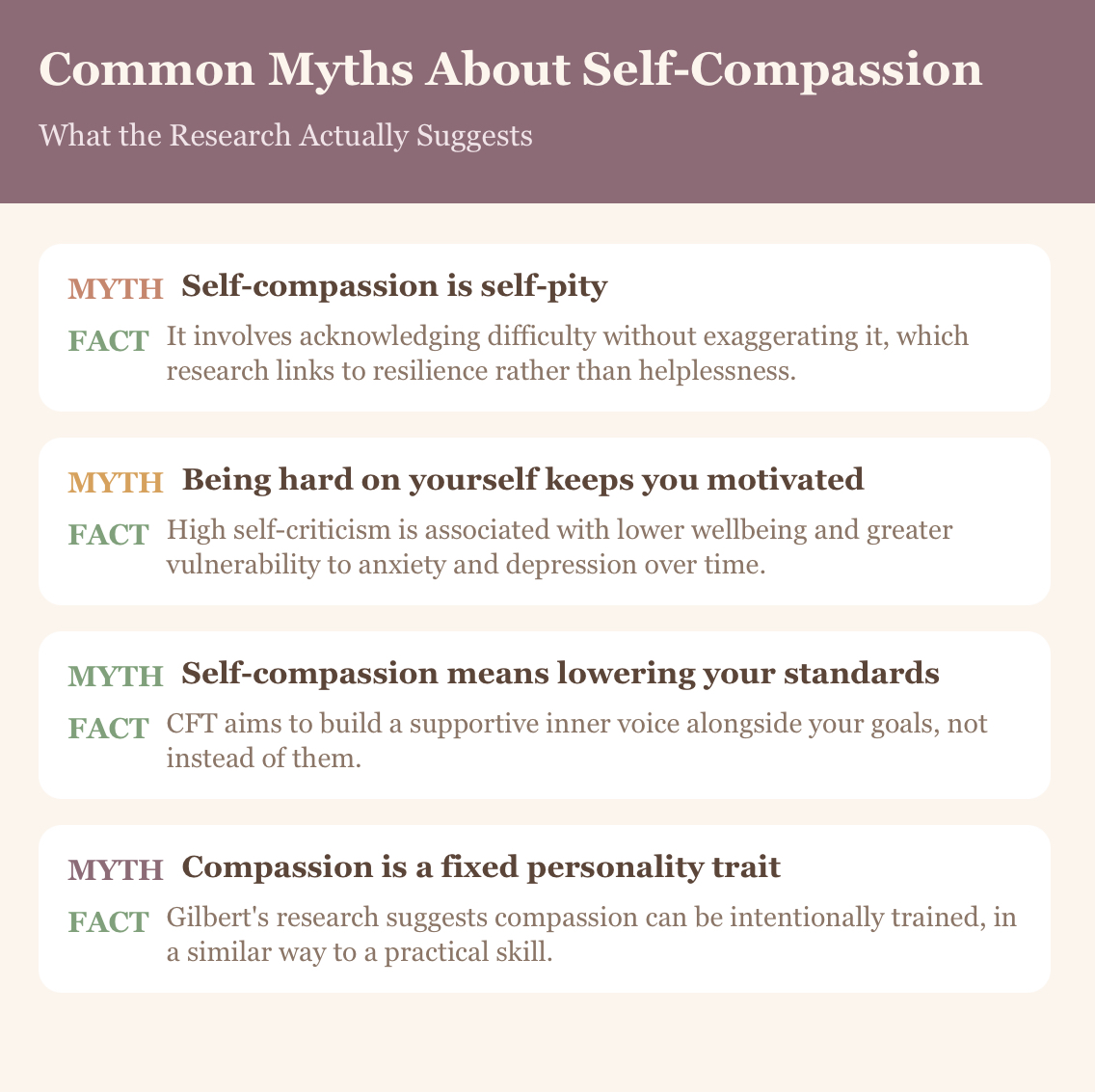
No. CFT does not ask you to ignore genuine difficulties or replace honest self-assessment with forced positivity. It focuses on changing the emotional tone of your relationship with yourself, particularly during moments of struggle or failure, rather than insisting on positive thinking.
Will Compassion Focused Therapy make me less motivated or less driven?
Research suggests the opposite tends to be true. High levels of self-criticism are associated with lower wellbeing and greater vulnerability to anxiety and depression over time, whereas self-compassion is not the same as lowering your standards (Gilbert, 2014).
How many sessions does Compassion Focused Therapy usually involve? The number of sessions varies depending on your presentation and goals. Some people integrate CFT techniques into a small number of sessions alongside another primary approach, while others use CFT as the main focus of therapy over a longer period.
What is the difference between Compassion Focused Therapy and Schema Therapy?
Both approaches can address a harsh internal voice. Schema Therapy maps a broader range of childhood-linked patterns known as modes, while CFT focuses specifically on building the capacity for safeness and self-compassion. Depending on your presentation, your psychologist may draw on both within the same course of therapy.
Can I access Compassion Focused Therapy via telehealth?
Yes. Our clinical team offers Compassion Focused Therapy via secure telehealth psychology across Australia, in addition to face-to-face sessions at our Battery Point rooms in Hobart. If a harsh inner voice has been part of your life for a long time, you do not have to keep managing it alone. You are welcome to learn more about our clinical team, review our current fees, or get in touch via our contact page. Alternatively, call our reception team directly on (03) 6263 6319 to arrange an appointment.
You do not need a diagnosis to start. You do not need to be in crisis. You just need to be ready to take one step.
Whether you are in Hobart, regional Tasmania, or anywhere else in Australia, support is available. Our psychologists are ready to help.
At Chrysalis Psychology & Wellbeing, our psychologists are trained in CFT and ready to help.
Phone: (03) 6263 6319
Email: info@chrysalispsychwell.com.au
Website: www.chrysalispsychwell.com.au
Knopwood House, Level 2, 38 Montpelier Retreat, Battery Point, Tasmania, 7004
Face-to-face in Battery Point, Hobart. Telehealth across Australia.
1. Australian Bureau of Statistics. (2023). National study of mental health and wellbeing, 2020 to 2022. Canberra: ABS.
2. Brown, N., and Ashcroft, K. (2025). The effectiveness of compassion focused therapy for the three flows of compassion, self-criticism, and shame in clinical populations: A systematic review. Behavioural Sciences, 15(8), 1031.
3. Gilbert, P. (2014). The origins and nature of compassion focused therapy. British Journal of Clinical Psychology, 53(1), 6 to 41.
4. Petrocchi, N., Ottaviani, C., Cheli, S., Matos, M., Baldi, B., Basran, J. K., and Gilbert, P. (2024). The impact of compassion-focused therapy on positive and negative mental health outcomes: Results of a series of meta-analyses. Clinical Psychology: Science and Practice, 31(2), 230 to 247.
5. Vidal, J., and Soldevilla, J. M. (2023). Effect of compassion-focused therapy on self-criticism and self-soothing: A meta-analysis. British Journal of Clinical Psychology, 62(1), 70 to 81.


.webp)
