
Contact Us
Contact Us
.svg)
You are staring at a text message, trying to decide whether to reply. Part of you wants to say yes, keen to see people and not miss out. Another part is already dreading it, tallying the cost of showing up and performing a version of yourself that will be exhausting to maintain. A third part is irritated at the first two for taking so long to decide. You put the phone down without responding, caught between voices that all sound like you, and none of which feel like the whole of you.
This kind of internal multiplicity, several distinct and sometimes conflicting voices, is not a sign that something has gone wrong. Internal Family Systems therapy was developed around exactly this experience, offering a structured way to understand the different parts of yourself and how they came to take on the roles they play.
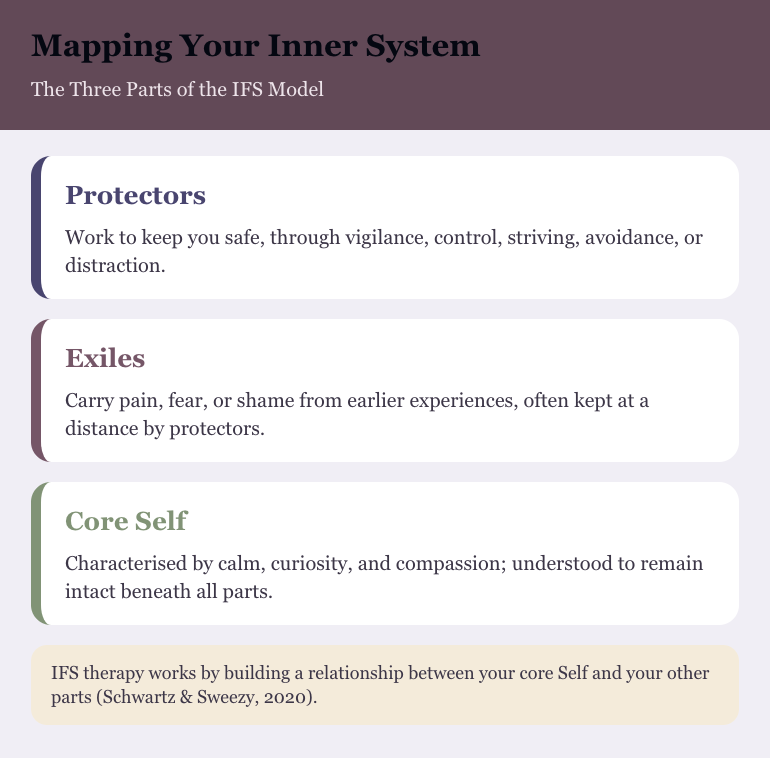
Internal Family Systems, often shortened to IFS, is a therapeutic model developed by American family therapist Richard Schwartz, who noticed that many of his clients described their inner experience in terms of distinct parts, each with its own feelings, beliefs, and role, rather than a single, unified way of thinking or feeling (Schwartz and Sweezy, 2020). Rather than treating this inner multiplicity as a problem, IFS treats it as the ordinary architecture of the mind.
The model describes several broad categories of parts. Protector parts work to keep you safe, sometimes through vigilance, control, or striving, and sometimes through avoidance, numbing, or distraction. Exile parts carry pain, fear, or shame, often connected to earlier or difficult experiences, and are frequently kept at a distance by protector parts working to prevent that pain from resurfacing. Underneath these parts, IFS describes a core Self, characterised by qualities such as curiosity, calm, and compassion, which is understood to remain intact even when parts are in conflict.
For many people who look into internal family systems therapy in Hobart, the appeal lies in this non-pathologising framework. Rather than being told a reaction is irrational or excessive, IFS offers a way of understanding why a particular part might have developed that reaction in the first place, and what it has been trying to protect.
The patterns IFS addresses are common, even though the language of parts is not always how people first describe their experience. Common signs include:
These patterns often accompany, rather than replace, other difficulties such as trauma, low self-esteem and confidence, or relationship difficulties, and IFS is frequently used as one part of a broader, integrated treatment plan. For some people, this pattern of parts has been present since childhood; for others, it becomes more pronounced during a period of significant stress, transition, or loss.
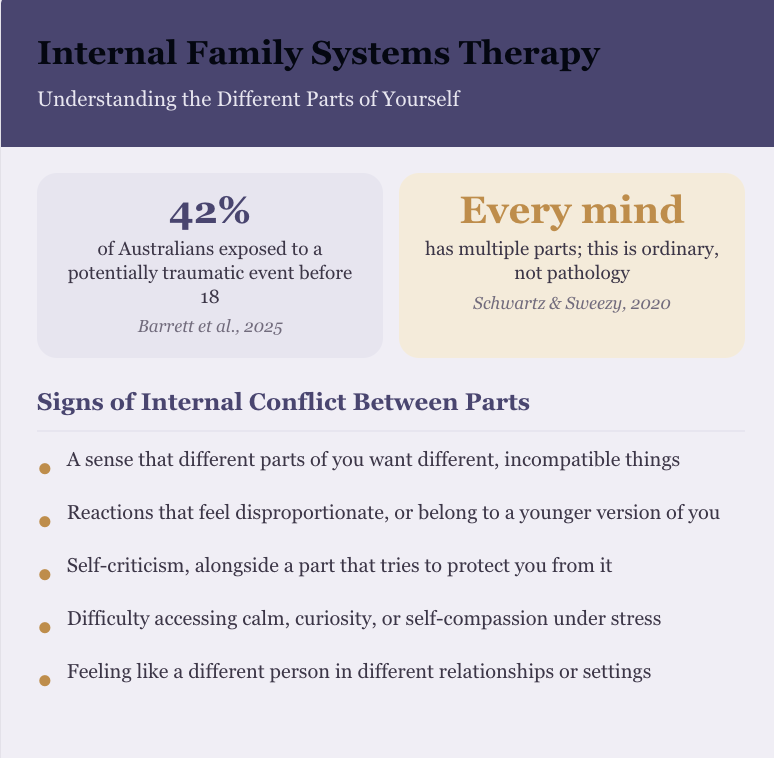

Recent Australian research highlights how common early experiences of adversity are, and how significantly they can shape adult mental health. A 2025 nationally representative study found that up to 42 per cent of Australians had been exposed to a potentially traumatic event before the age of 18, with childhood exposure associated with significantly higher odds of experiencing a lifetime mental disorder in adulthood (Barrett et al., 2025). This kind of early adversity is central to the IFS model, which understands many protector and exile parts as having formed in response to difficult experiences, often in childhood.
As a relatively newer therapeutic model, IFS currently has a smaller research base than longer-established approaches such as cognitive behavioural therapy. A 2025 scoping review of the peer-reviewed literature identified 27 studies investigating IFS, the majority of which were case studies, with only two randomised controlled trials completed to date (Buys, 2025). The review described the existing evidence as promising, particularly for depression, chronic pain, and post-traumatic stress disorder, while noting that the research base remains limited in scope and would benefit from further high-quality trials.
Early trial evidence includes a pilot randomised controlled trial that tested IFS as a treatment for depression among female college students, with promising results reported by the study authors (Haddock et al., 2016). Given the developing nature of this evidence base, your psychologist will discuss with you how IFS fits alongside other, more extensively researched approaches as part of your overall treatment plan, rather than presenting it as a stand-alone, first-line treatment.

At Chrysalis Psychology & Wellbeing, our clinical team offers Internal Family Systems therapy as part of an integrated approach to individual therapy, often alongside more extensively researched approaches such as Schema Therapy, Compassion Focused Therapy, Eye Movement Desensitisation Therapy, or Cognitive Behavioural Therapy, depending on your presentation and goals. IFS shares meaningful common ground with Schema Therapy in particular, since both approaches understand present-day patterns as having developed in response to earlier, often childhood, experiences.
Sessions typically involve psychoeducation about the IFS model, followed by structured exploration of your own parts, including protector parts and, where appropriate and at a pace that feels manageable, the more vulnerable exile parts they work to protect. Your psychologist will tailor the pace and depth of this work to your presentation, particularly where your primary concern relates to trauma, the lasting effects of PTSD, self-esteem and confidence, or relationship difficulties. Because self-esteem and confidence are often shaped by a harsh or self-critical protector part, IFS can also offer a different entry point into this work, one grounded in curiosity about the part rather than an effort to argue with or silence it. Similarly, where relationship difficulties are connected to strong, fast reactions that feel bigger than the present moment warrants, understanding the part driving that reaction can open up new options for responding differently.
IFS therapy is typically delivered at a pace set by you, since working with more vulnerable exile parts can bring up significant emotion, and your psychologist will not move faster than feels safe and manageable. Many people begin by building a working relationship with their protector parts, understanding what these parts are trying to achieve, before any work with more vulnerable material begins. Sessions are available face to face at our Battery Point rooms or via secure telehealth psychology across Australia. A typical course of therapy is not fixed in length. Some clients draw on IFS techniques within a small number of sessions alongside another primary approach, while others use it as a more central focus over a longer period, depending on what feels most useful.
IFS therapy at Chrysalis Psychology & Wellbeing can be accessed through a Medicare Mental Health Treatment Plan, arranged with your GP, which provides a rebate for up to ten sessions per calendar year. Our practice works with self-managed and plan-managed NDIS participants. We also accept DVA and Open Arms referrals, the National Redress Scheme, WorkCover and MAIB claims, and private health insurance where applicable. Self-referral is welcome.
Is Internal Family Systems therapy well-researched?
IFS is a relatively newer therapeutic model, and its research base, while promising, particularly for depression, chronic pain, and post-traumatic stress disorder, remains smaller than longer-established approaches (Buys, 2025). Your psychologist will discuss where IFS fits within your broader treatment plan.
What does it mean to have parts?
IFS uses the language of parts to describe distinct feelings, beliefs, and patterns of behaviour that can feel almost like separate voices within you. This is understood as a normal feature of the mind, not a sign of pathology or disorder.
Is IFS the same as Dissociative Identity Disorder?
No. IFS uses the concept of parts as a way of understanding ordinary internal multiplicity, which is different from a dissociative disorder. If you have concerns about dissociation, please discuss this directly with your psychologist.
How does IFS relate to Schema Therapy?
Both approaches understand present-day patterns as connected to earlier experiences, often in childhood. Schema Therapy maps these patterns as schemas and modes, while IFS describes them as parts. Your psychologist may draw on both within the same course of therapy.
Can I access IFS therapy via telehealth?
Yes. Our clinical team offers Internal Family Systems therapy via secure telehealth psychology across Australia, in addition to face-to-face sessions at our Battery Point rooms in Hobart.
If different parts of yourself have been pulling you in different directions for some time, you do not have to work it out alone. You are welcome to learn more about our clinical team, review our current fees, or get in touch via our contact page. Alternatively, call our reception team directly on (03) 6263 6319 to arrange an appointment.


.webp)
