
Book Now
Book Now
.svg)
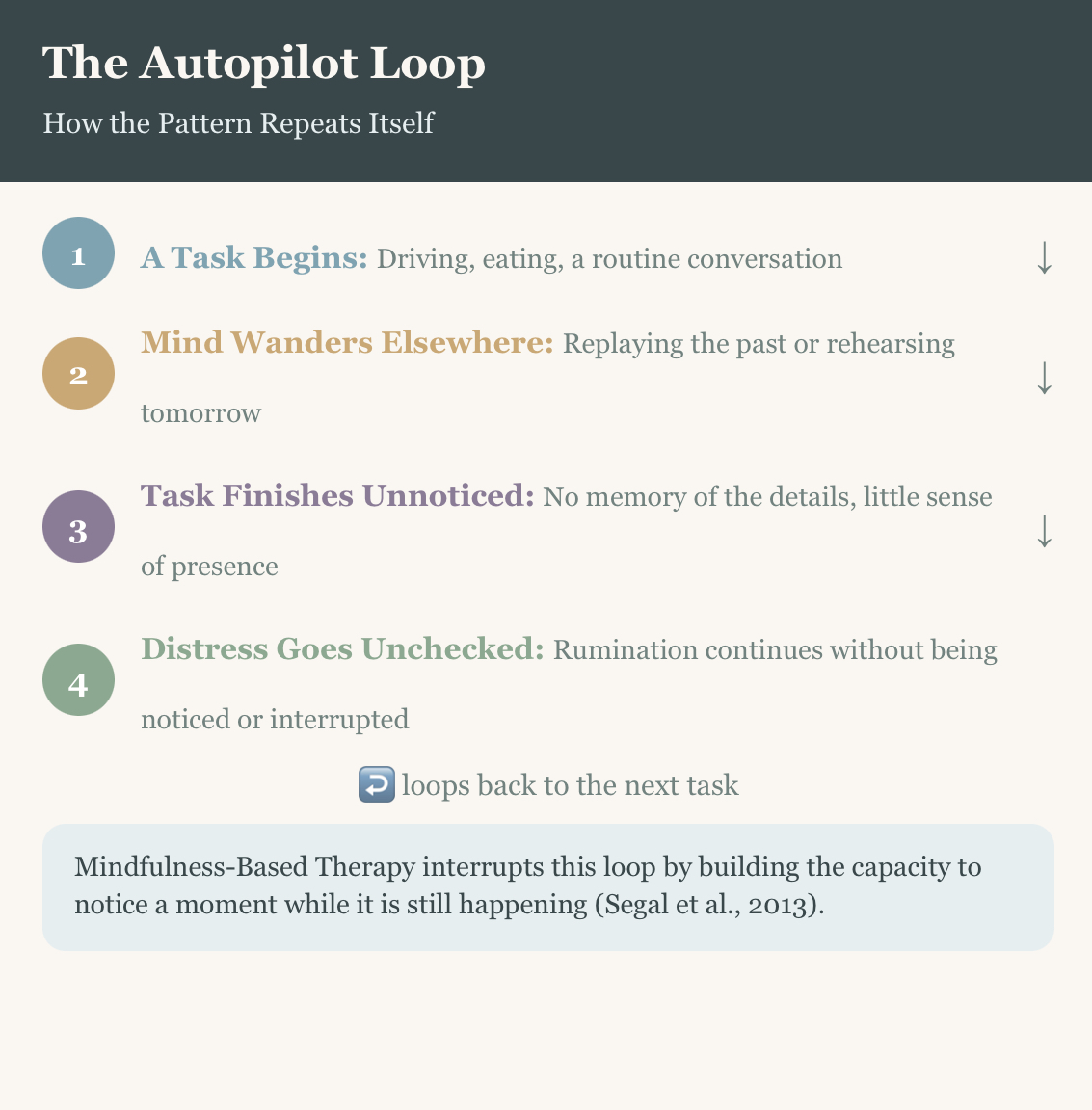
You sit down to eat and somewhere between the first bite and the last, you stop noticing the food entirely. Your fork moves, the plate empties, but your attention has been somewhere else, replaying a conversation from earlier, planning tomorrow, holding a low hum of worry about something that has not happened yet. When you finish, you could not describe what the meal tasted like.
This kind of absence, where the body carries on with a task while the mind is elsewhere entirely, is remarkably common, and it is not a personal failing. Mindfulness-Based Therapy was developed to help people notice this pattern and gently return their attention to the present moment, without judgment or self-criticism.
Mindfulness-Based Therapy is an umbrella term for a group of structured, evidence-based approaches that teach people to bring deliberate, non-judgmental attention to the present moment. The most researched clinical form is Mindfulness-Based Cognitive Therapy, often shortened to MBCT, developed by psychologists Zindel Segal, Mark Williams, and John Teasdale, which combines mindfulness meditation practices with principles drawn from cognitive therapy (Segal et al., 2013). MBCT builds on Mindfulness-Based Stress Reduction, an earlier program developed by Jon Kabat-Zinn to help people manage the psychological impact of chronic stress and illness.
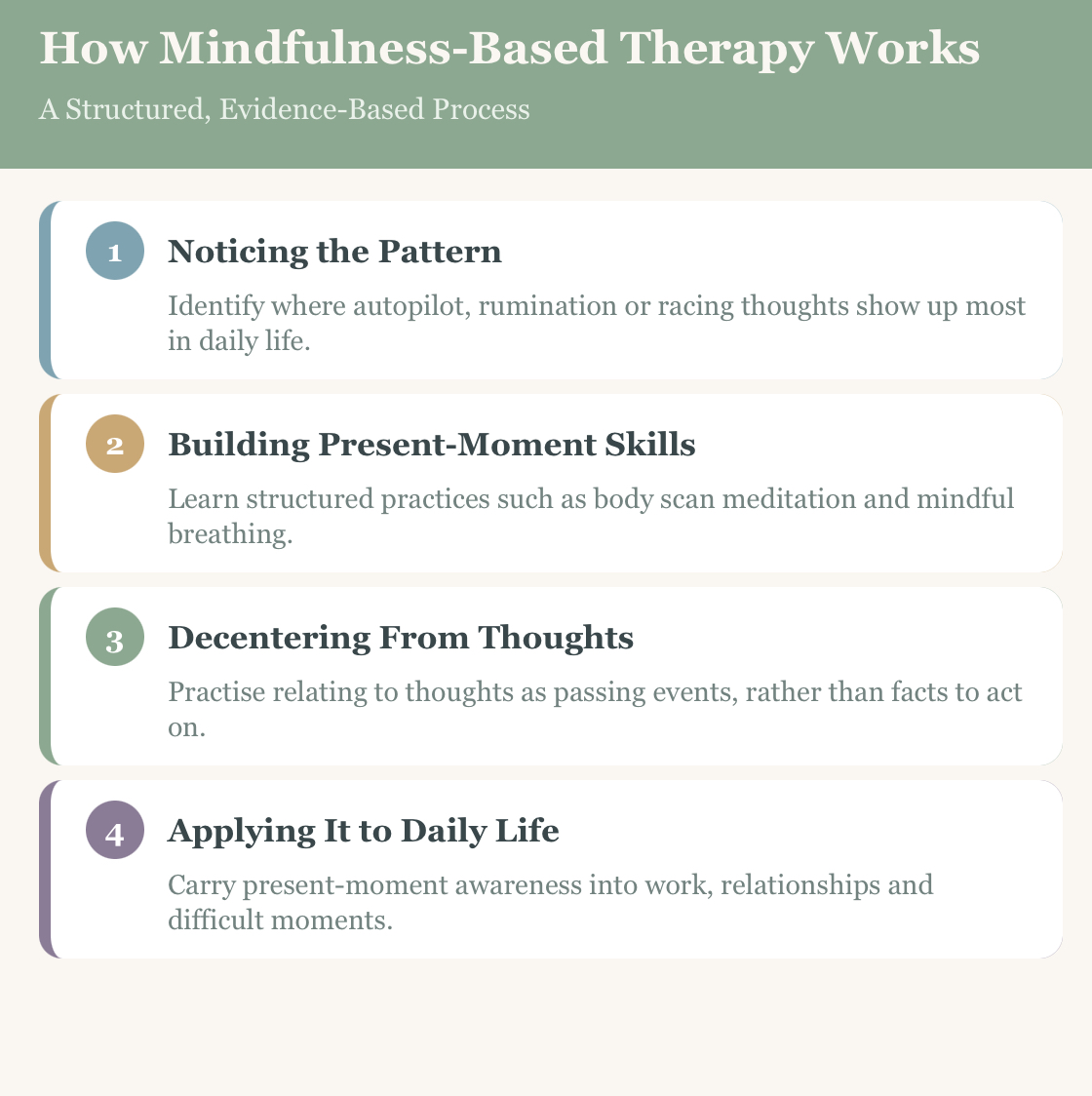
Central to this process is a skill sometimes called ‘decentering’, the ability to notice a thought as a mental event passing through awareness, rather than an accurate statement of fact that must be acted on or argued with (Segal et al., 2013). Many people who seek mindfulness-based therapy in Hobart describe feeling caught up in their thoughts, as though a worry or a self-critical judgement is simply true because it is present. Mindfulness practice offers a different relationship with these moments, creating enough space to choose a response rather than reacting automatically.
Rather than trying to eliminate difficult thoughts or feelings, mindfulness-based approaches teach people to notice thoughts, emotions and body sensations as they arise, and to relate to them with curiosity rather than automatic reaction. For many people who seek mindfulness based therapy, the appeal lies in learning a set of practical, portable skills rather than relying solely on insight or analysis.
Mindfulness difficulties do not always look dramatic. For many people, the pattern is quiet and easy to miss until it is named. Common signs include:
These patterns often accompany, rather than replace, other difficulties such as anxiety, depression, stress management, or the lasting effects of trauma, which is one reason mindfulness skills are so frequently taught alongside other therapeutic approaches rather than in isolation. For some clients, these patterns are lifelong; for others, they emerge during a particularly demanding period of work, caregiving, or personal change.
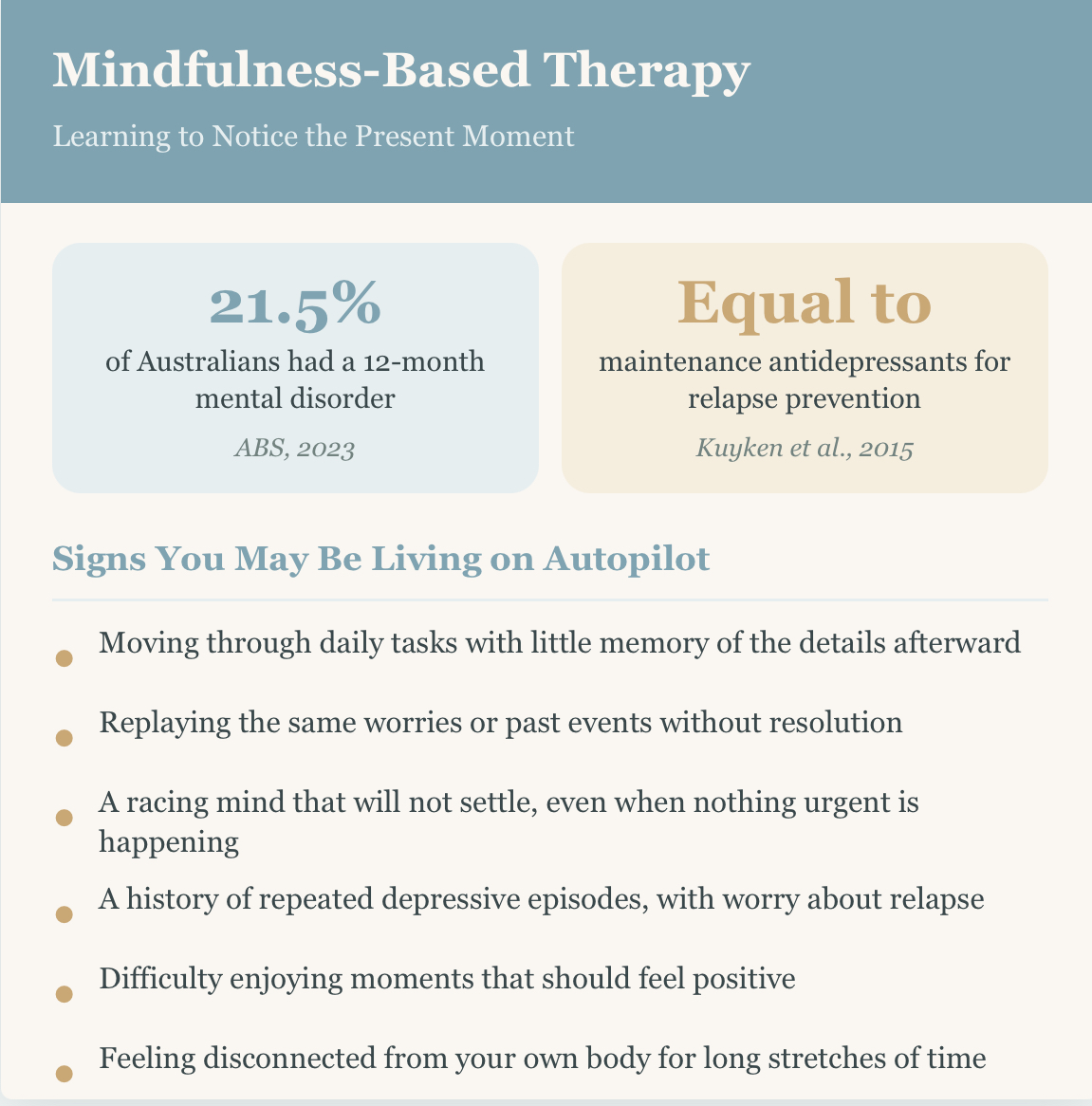
In 2020 to 2022, an estimated 21.5 per cent of Australians aged 16 to 85 experienced a 12-month mental disorder, with anxiety and depressive disorders among the most commonly reported presentations (Australian Bureau of Statistics, 2023). Recurrent depression in particular carries a high risk of relapse, which has made relapse prevention a significant focus of psychological research over the past two decades.
Mindfulness-Based Cognitive Therapy was originally developed and tested as a relapse prevention approach for people with a history of recurrent depression. In a large randomised controlled trial, MBCT was found to be as effective as maintenance antidepressant medication in preventing depressive relapse or recurrence, with comparable cost-effectiveness (Kuyken et al., 2015).
More recent evidence has extended these findings. A 2025 systematic review and meta-analysis found that Mindfulness-Based Cognitive Therapy produced durable improvements in both anxiety and depressive symptoms, with benefits maintained over follow-up periods (Nandarathana and Ranjan, 2025). A separate 2025 meta-analysis examining Mindfulness-Based Cognitive Therapy delivered via telehealth found that this format also produced significant reductions in anxiety and depression symptoms among adults, supporting its use as an accessible option for people who cannot attend in person (Wang et al., 2025).
This integration matters because rumination, the tendency to replay the same distressing thoughts on a loop, is closely linked to both anxiety and depression. By building the capacity to notice a ruminative pattern early and gently redirect attention, mindfulness-based approaches aim to interrupt this cycle before it deepens into a more significant depressive episode.
At Chrysalis Psychology & Wellbeing, our clinical team draws on Mindfulness-Based Therapy as either a stand-alone approach within individual therapy or in combination with other therapies. Mindfulness skills form a core component of Dialectical Behaviour Therapy, and are often integrated alongside Cognitive Behavioural Therapy and Acceptance and Commitment Therapy, particularly where present-moment awareness supports a client's broader treatment goals. For clients working through shame or self-criticism, mindfulness practices are also frequently woven into Compassion Focused Therapy, since both approaches share an emphasis on relating to internal experience with curiosity rather than judgment.
Sessions typically introduce structured mindfulness practices, including body scan meditation, mindful breathing and gentle movement, alongside psychoeducation about the relationship between thoughts, mood and relapse. Between sessions, most clients are asked to complete brief daily practices, since mindfulness skills strengthen with consistent, gentle repetition rather than occasional, lengthy sessions. Your psychologist will tailor the pace and structure of therapy to your presentation, whether your primary concern relates to anxiety, depression, stress management, sleep problems, or the lasting effects of trauma.
Mindfulness-Based Therapy can be delivered individually or, where suitable, within a small group format, and often follows a structured sequence over several weeks, with practices to continue between sessions. Many people find the approach unfamiliar at first, particularly if sitting with present-moment experience feels uncomfortable, and your psychologist will help you build this capacity gradually. A typical course of Mindfulness-Based Cognitive Therapy involves an introductory phase followed by regular practice, though your psychologist will adjust the structure, length and pacing of therapy to fit your individual circumstances rather than following a rigid template. Sessions are available face-to-face at our Battery Point rooms or via secure telehealth psychology across Australia.
Mindfulness-Based Therapy at Chrysalis Psychology & Wellbeing can be accessed through a Medicare Mental Health Treatment Plan which provides a rebate for up to ten sessions per calendar year. We also accept NDIS (self-managed and plan managed), DVA and Open Arms referrals, the National Redress Scheme, WorkCover and MAIB claims, and private health insurance where applicable. Self-referral is also welcome.
Is Mindfulness-Based Therapy the same as meditation?
Not exactly. Meditation is one tool used within Mindfulness-Based Therapy, but the approach also includes structured psychoeducation and cognitive strategies. It is a clinical treatment delivered by a trained psychologist, rather than a general wellness practice alone.
Do I need experience with meditation before starting?
No prior experience is needed. Mindfulness-Based Therapy is taught from the beginning, and your psychologist will guide you through each practice at a pace that suits you.
Is Mindfulness-Based Therapy suitable for someone who feels restless or finds it hard to sit still?
Yes, although your psychologist may begin with shorter or more movement-based practices. Mindfulness does not require lengthy, silent sitting, and can be adapted to suit your concentration, physical comfort, and prior experience.
Is Mindfulness-Based Therapy only used for depression?
Mindfulness-Based Cognitive Therapy was originally developed for depression relapse prevention, but research suggests mindfulness-based approaches may also help with anxiety, stress, and difficulty regulating emotions (Nandarathana and Ranjan, 2025).
How is Mindfulness-Based Therapy different from Acceptance and Commitment Therapy?
Both approaches share an emphasis on present-moment awareness. Acceptance and Commitment Therapy places additional focus on clarifying your personal values and committing to actions aligned with them, while Mindfulness-Based Therapy centres more specifically on structured mindfulness practice and its relationship to mood and relapse.
Can I access Mindfulness-Based Therapy via telehealth?
Yes. Our clinical team offers Mindfulness-Based Therapy via secure telehealth psychology across Australia, in addition to face-to-face sessions at our Battery Point rooms in Hobart. If you would like support to feel more present in your own life, you do not have to work it out alone. You are welcome to learn more about our clinical team, review our current fees, or get in touch via our contact page. Alternatively, call our reception team directly on (03) 6263 6319 to arrange an appointment.
You do not need a diagnosis to start. You do not need to be in crisis. You just need to be ready to take one step.
Whether you are in Hobart, regional Tasmania, or anywhere else in Australia, support is available. Our psychologists are ready to help.
At Chrysalis Psychology & Wellbeing, our psychologists are trained in MBT and ready to help.
Phone: (03) 6263 6319
Email: info@chrysalispsychwell.com.au
Website: www.chrysalispsychwell.com.au
Knopwood House, Level 2, 38 Montpelier Retreat, Battery Point, Tasmania, 7004
Face-to-face in Battery Point, Hobart. Telehealth across Australia.


.webp)
