
Contact Us
Contact Us
At Chrysalis Psychology & Wellbeing, we offer Eye Movement Desensitisation and Reprocessing (EMDR) therapy as part of our evidence-based approach to treating trauma, PTSD, anxiety, phobias, and other stress-related conditions.
.svg)
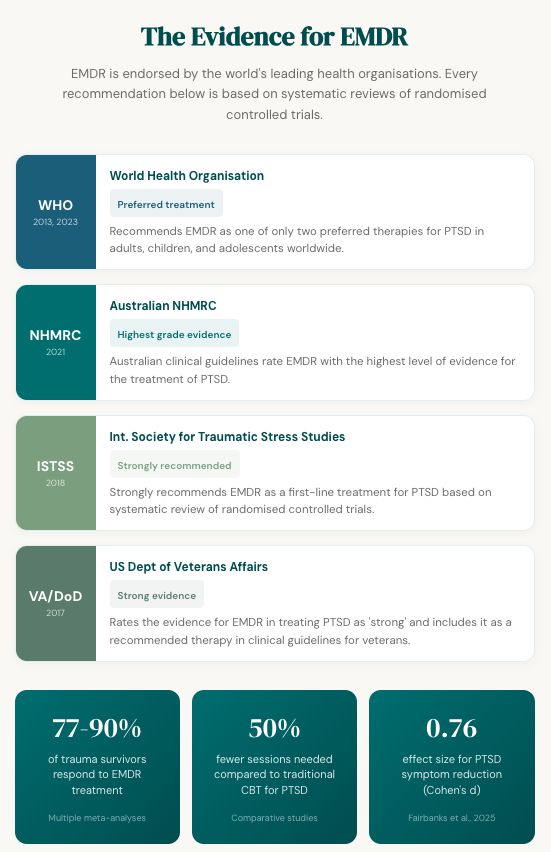
EMDR is available face-to-face at our Battery Point practice in Hobart and via secure telehealth for clients anywhere in Australia. EMDR is recommended by the World Health Organisation as one of two preferred therapies for the treatment of PTSD in adults, adolescents, and children (WHO, 2013; WHO, 2023).
EMDR is a structured, evidence-based therapy that helps people process and recover from distressing memories and experiences. It was developed by Dr Francine Shapiro in 1987 and has since become one of the most extensively researched treatments for trauma worldwide. During EMDR, your psychologist guides you through the distressing memory while you engage in bilateral stimulation, most commonly by following the psychologist’s hand movements with your eyes, or through gentle tapping or auditory tones. This process helps your brain reprocess the memory so that it no longer carries the same intensity, distress, or sense of being “stuck.” EMDR does not require you to talk through the traumatic event in extensive detail. This is one of the reasons many people find it more accessible than traditional talk-based trauma therapies.
.png)
EMDR is most widely recognised for its effectiveness in treating trauma and PTSD. However, research also supports its use for a range of other conditions, including:
EMDR therapy at Chrysalis Psychology & Wellbeing follows a structured, eight-phase approach:
EMDR therapy moves at a pace that feels safe for you. Your psychologist will never push you beyond what you are ready for.
We understand that not everyone can attend our Battery Point practice in person. That is why we offer EMDR therapy via secure telehealth for clients located anywhere in Australia, including regional and rural areas, other capital cities, and anywhere with a reliable internet connection.
EMDR has been successfully adapted for telehealth delivery. When working online, your psychologist may use alternative forms of bilateral stimulation that are suitable for the telehealth format, such as:
Research supports the effectiveness of EMDR delivered via telehealth, and many clients find it comfortable and convenient. Your psychologist will discuss the best approach for your situation during your initial session.
All you need is a private, quiet space, a device with a camera and microphone (computer, tablet, or phone), and a stable internet connection. If you are using auditory bilateral stimulation, headphones may be required.
EMDR is suitable for adults, adolescents, and children. It may be particularly helpful if:
EMDR therapy is available at our Battery Point practice in Hobart and via secure telehealth across Australia. You can access EMDR through:
Whether you are in Hobart, regional Tasmania, or anywhere else in Australia, we are here to support you.
Phone: (03) 6263 6319
Email: info@chrysalispsychwell.com.au
Website: www.chrysalispsychwell.com.au
“When Trauma Gets Stuck: How EMDR Therapy Helps Your Brain Process What Talk Therapy Alone Cannot” - Read our blog post.
Australian Guidelines for the Prevention and Treatment of Acute Stress Disorder, Posttraumatic Stress Disorder and Complex PTSD (2021). Phoenix Australia, Centre of Posttraumatic Mental Health.
International Society for Traumatic Stress Studies (2018). Posttraumatic Stress Disorder Prevention and Treatment Guidelines.
Shapiro, F. (2018). Eye Movement Desensitization and Reprocessing (EMDR) Therapy: Basic Principles, Protocols, and Procedures (3rd ed.). Guilford Press.
US Department of Veterans Affairs & Department of Defense (2017). VA/DoD Clinical Practice Guideline for the Management of Posttraumatic Stress Disorder and Acute Stress Disorder.
World Health Organisation (2013). Guidelines for the Management of Conditions Specifically Related to Stress. Geneva: WHO.
World Health Organisation (2023). Mental Health Gap Action Programme (mhGAP) Guideline for Mental, Neurological and Substance Use Disorders (3rd ed.). Geneva: WHO.


.webp)
