When 'Fine' Is a Full-Time Job: Understanding High-Functioning Anxiety

When 'Fine' Is a Full-Time Job: Understanding High-Functioning Anxiety

You send the email, close the laptop, and smile when a colleague compliments your work. You cook dinner, help with the homework, return three phone calls, and remember the milk on the way home. Nobody would guess that your heart has been racing since you first opened your eyes. That your shoulders have been sitting up near your ears since before breakfast. That you rehearsed a short, ordinary conversation three times before you managed to have it.

To the outside world, you are fine. Reliable. Capable. The person who holds everything together when everyone else falls apart.

But fine is not a feeling. It isa performance. And performances are exhausting.

The Anxiety That Wears a Suit

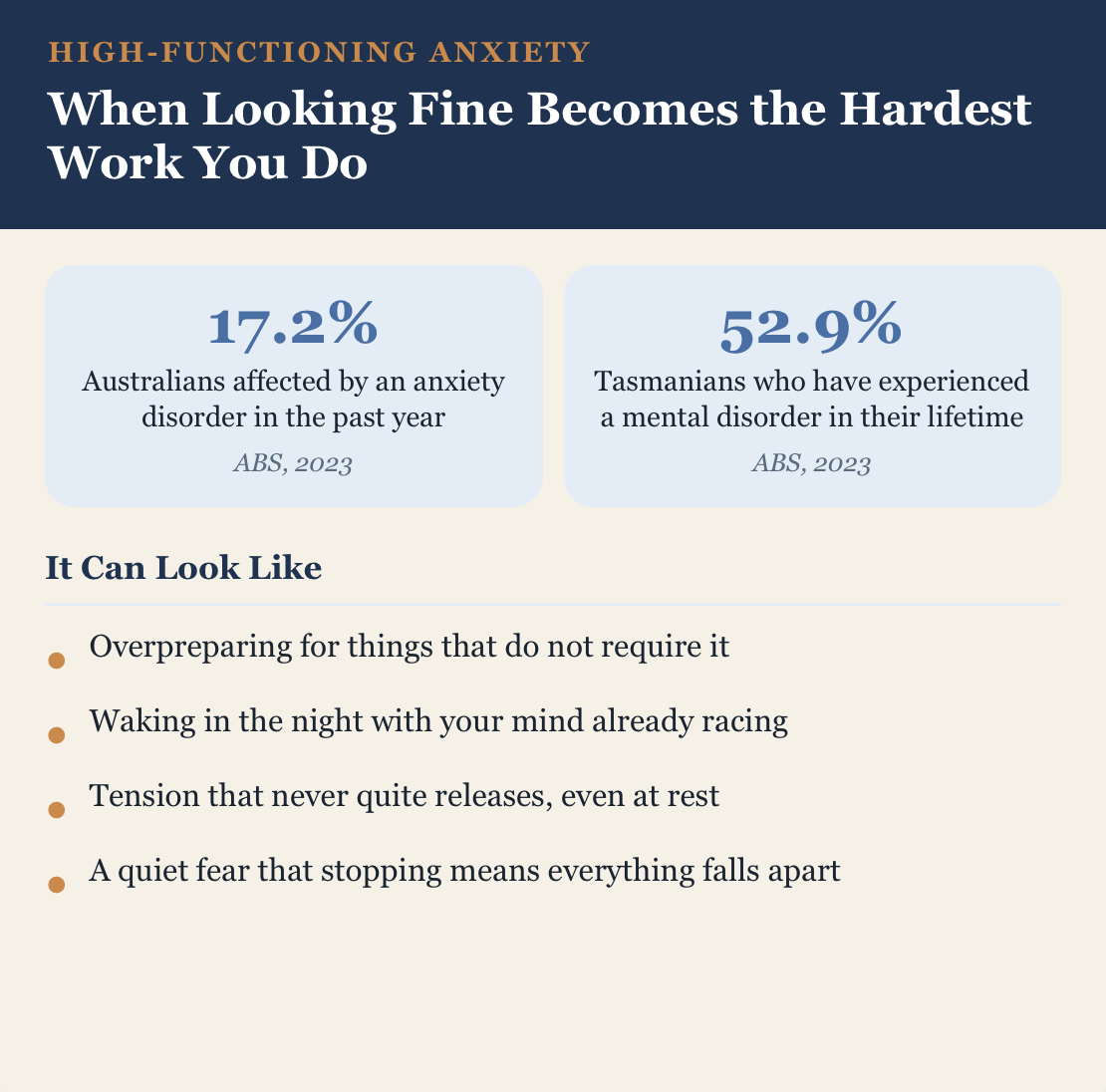
There is a name for this, even though it will not appear in a diagnostic manual. High-functioning anxiety describes the experience of carrying all the internal weight of anxiety, theracing thoughts, the catastrophic what-ifs, the persistent sense that something is about to go wrong, while presenting an exterior that looks, to everyone else, like success. You meet deadlines. You show up early. You remember birthdays. You are the one people count on.

And because you are functioning, because you are achieving, because you are not falling apart in ways anyone else can see, nobody offers you help.

What the Research Shows

The scale of this is larger than most people expect. The Australian Bureau of Statistics' National Study of Mental Health and Wellbeing (2020 to 2022) found that 21.5 per cent ofAustralians aged 16 to 85 had experienced a mental disorder in the 12 months before being surveyed, with anxiety disorders the most common group at 17.2 percent (Australian Bureau of Statistics, 2023). In Tasmania, the figures are more pronounced again. Over half of Tasmanians, 52.9 per cent, have experienced a mental disorder in their lifetime, compared with 42.9 per cent nationally, and nearly one in five Tasmanians, around 88,700 people, had a mental disorder in the 12 months before being surveyed (Australian Bureau of Statistics, 2023; Primary Health Tasmania, 2025).

High-functioning anxiety is also easy to miss precisely because it does not look like suffering. It looks like ambition, conscientiousness, and having your life together. Access to care can compound the problem. The RANZCP Tasmania Branch has highlighted that the state has considerably fewer specialised mental health beds per capita than the national median of 24.5 per 100,000 people, and that demand for psychiatric and psychological care in Tasmania continues to outpace supply (RANZCP TasmaniaBranch, 2026). For someone who is still functioning, still achieving, that gap rarely feels urgent enough to close, even when the cost of waiting is real.

Perfectionism is one of the central drivers of high-functioning anxiety, and it is also one of the most researched. A systematic review and meta-analysis of fifteen randomised controlled trials found that Cognitive Behavioural Therapy for perfectionism, delivered through CBT, produced moderate to large reductions in perfectionistic thinking, alongside improvements in anxiety, depression, and related symptoms (Galloway et al., 2022). An earlier meta-analysis reached a similar conclusion and found that face-to-face and internet-delivered formats produced comparable results, which is relevant for anyone weighing up whether telehealth may genuinely help (Suh et al., 2019).

When 'Fine' Is a Full-Time Job: Understanding High-Functioning Anxiety

The Body Keeps Its Own Records

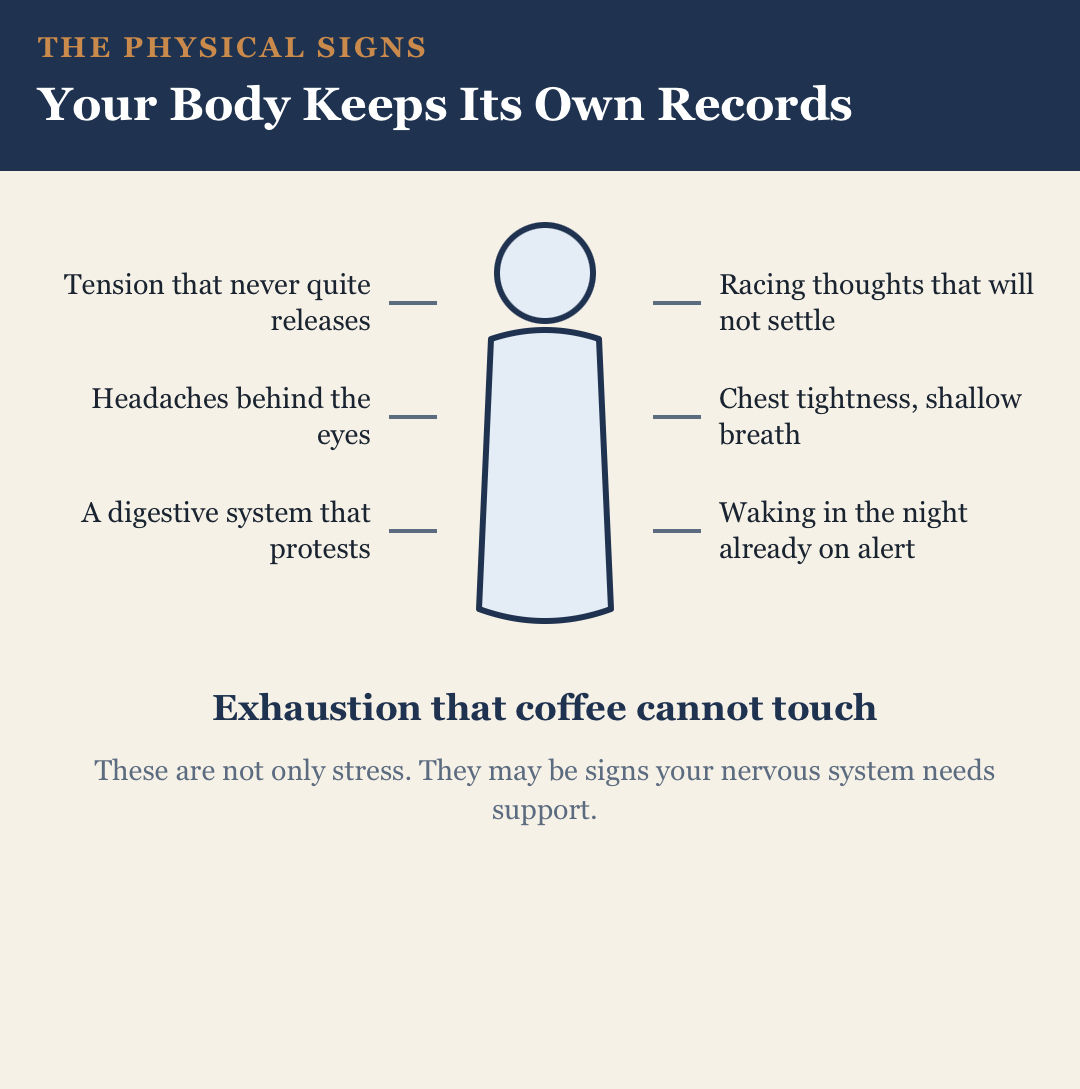
Your body does not know how successful you look on paper. It keeps its own records, and the records that matter most rarely arrive at a convenient time. Tension that never fully releases: tight shoulders, a clenched jaw, a headache that lives behind the eyes. Sleep that does not restore, where falling asleep exhausted gives way to waking in the middle of the night with your mind already running through tomorrow. A digestive system that protests before something stressful, or exhaustion that no amount of coffee seems to touch, because the tiredness underneath is not physical. It is the accumulated cost of staying on alert for a long time.

There is a particular cruelty to this pattern. It often waits until everything has gone quiet to make itself known. You can hold it together through the meeting, the dinner, the bed time routine, and then, in the hours when the house is silent, a mind that has been braced all day finally has room to spin. Cortisol naturally begins climbing well before waking as part of the body's ordinary rhythm. Recent research using continuous overnight hormone monitoring confirmed that this rise is already well underway long before a person consciously stirs, rather than being triggered by the act of waking itself (Klaas et al., 2025). For a nervous system that has spent the day on alert, that rising tide can be easy to misread as danger, even when nothing has actually changed. What can feel like an ambush in the quiet hours is often the tail end of a rhythm that was already in motion.

What Can Help

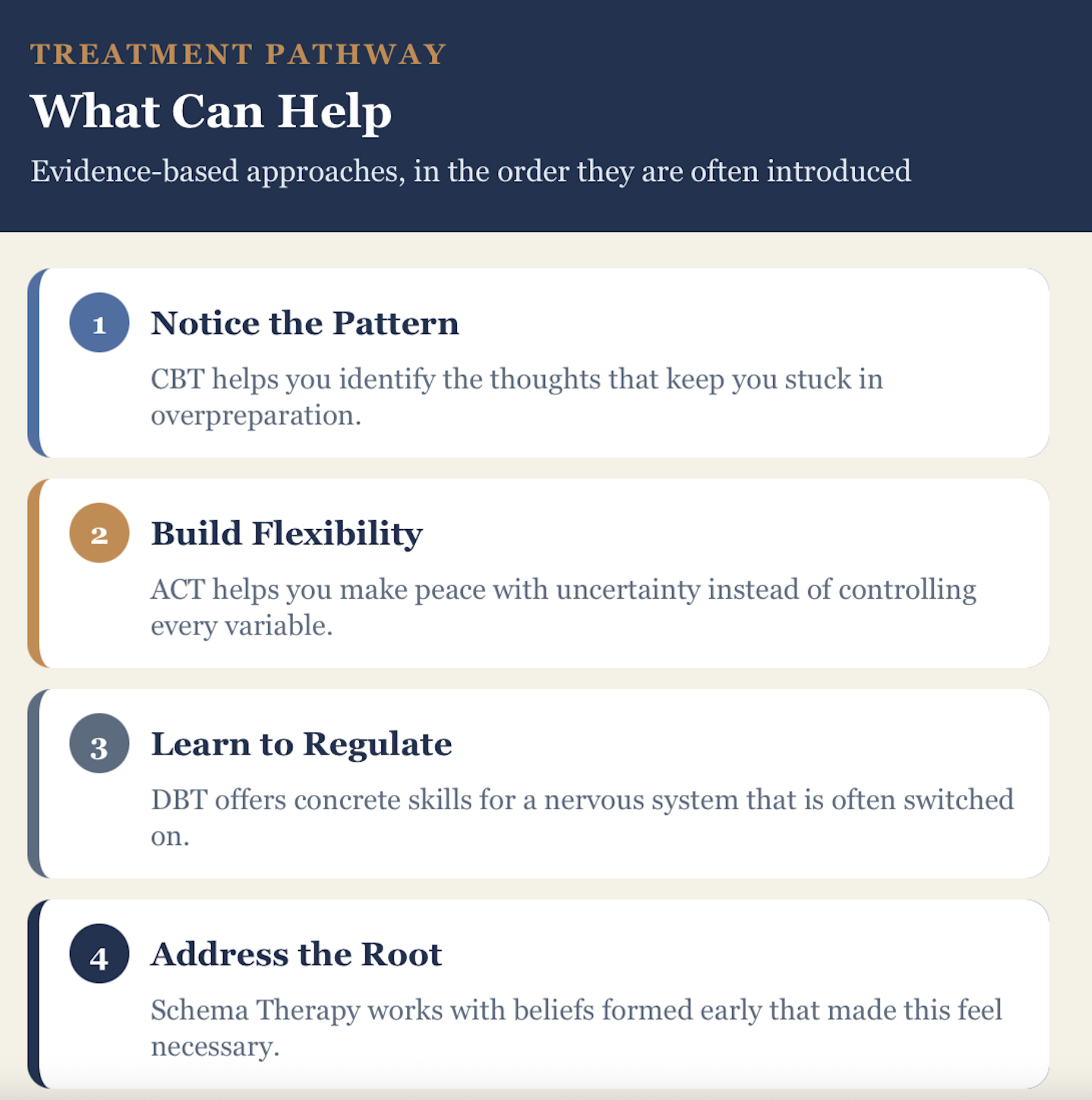
High-functioning anxiety may respond well to evidence-based psychological support. Cognitive Behavioural Therapy (CBT) can help you notice the thought patterns that keep you stuck in over preparation and catastrophic thinking, and gently test the belief that your worth depends on your output. Acceptance and Commitment Therapy (ACT) takes a different route toward a similar goal: rather than trying to control every variable, it builds the psychological flexibility to keep moving even when things feel uncertain. A randomised controlled trial comparing self-help ACT with self-help CBT for perfectionism found that both approaches produced meaningful improvement, suggesting there may be more than one credible path forward depending on what suits you (Bowers et al., 2025).

Dialectical Behaviour Therapy(DBT) offers concrete skills for regulating emotion and tolerating distress, useful for the moments when your nervous system is activated but your calendar has other plans. For some people, Schema Therapy goes further still, working with the underlying beliefs, often formed early in life, that made high-functioning anxiety feel like the only safe way to operate. Our psychologists draw on all of these approaches as part of our Individual Therapy sessions, adapted to what fits your circumstances.

None of this requires you toreach a breaking point first. You do not need to miss a deadline, or wait for something to visibly crack, before it is reasonable to ask for support. You are allowed to seek help simply because you are tired of being tired, and curious about what life might feel like without a constant hum of worry running underneath everything you do.

When 'Fine' Is a Full-Time Job: Understanding High-Functioning Anxiety

The Permission You Have Been Waiting For

There is a version of you that is still reliable, still capable, still kind, but not at the cost of your own wellbeing. That version is not a fantasy. It is the person who already exists underneath the anxiety, and with the right support, it may be possible to meet them.

If you are in Hobart or anywhere else in Tasmania and recognise yourself in this article, the team at ChrysalisPsychology & Wellbeing would welcome your enquiry. We offer face-to-face sessions in Battery Point and telehealth across Australia. You do not need to have the right words. You only need to show up. Call (03) 6263 6319 to arrange an appointment time.

Related Reading

References

  • Australian Bureau of Statistics (2023). National Study of Mental Health and Wellbeing, 2020–2022. ABS Catalogue No. 4326.0.
  • Bowers, E. M., Levin, M. E., Ong, C. W., & Twohig, M. P. (2025). A randomized controlled trial of self-help acceptance and commitment therapy and cognitive behavioral therapy for perfectionism. Behaviour Research and Therapy, 192, 104806.
  • Galloway, R., Watson, H., Greene, D., Shafran, R.,& Egan, S. J. (2022). The efficacy of randomised controlled trials of cognitive behaviour therapy for perfectionism: a systematic review and meta-analysis. Cognitive Behaviour Therapy, 51(2), 170–184.
  • Klaas, S., Upton, T. J., Zavala, E., Lawton, M.,Bensing, S., Berinder, K., Botusan, I., Grytaas, M., Methlie, P., Øksnes, M.,Russell, G., Vassiliadi, D. A., & Lightman, S. L. (2025). Awakening not associated with an increased rate of cortisol secretion. Proceedings of theRoyal Society B, 292(2038).
  • Primary Health Tasmania (2025). Data Profile: Mental Health.
  • RANZCP Tasmania Branch (2026). Better Mental Health Outcomes for Tasmanians: Pre-Budget Submission 2026–27.
  • Suh, H., Sohn, H., Kim, T., & Lee, D. G. (2019). A review and meta-analysis of perfectionism interventions: comparing face-to-face with online modalities. Journal of Counseling Psychology, 66(4), 473–486.