The Commute You Do Not Remember: Learning to Notice Your Life Again

The Commute You Do Not Remember: Learning to Notice Your Life Again

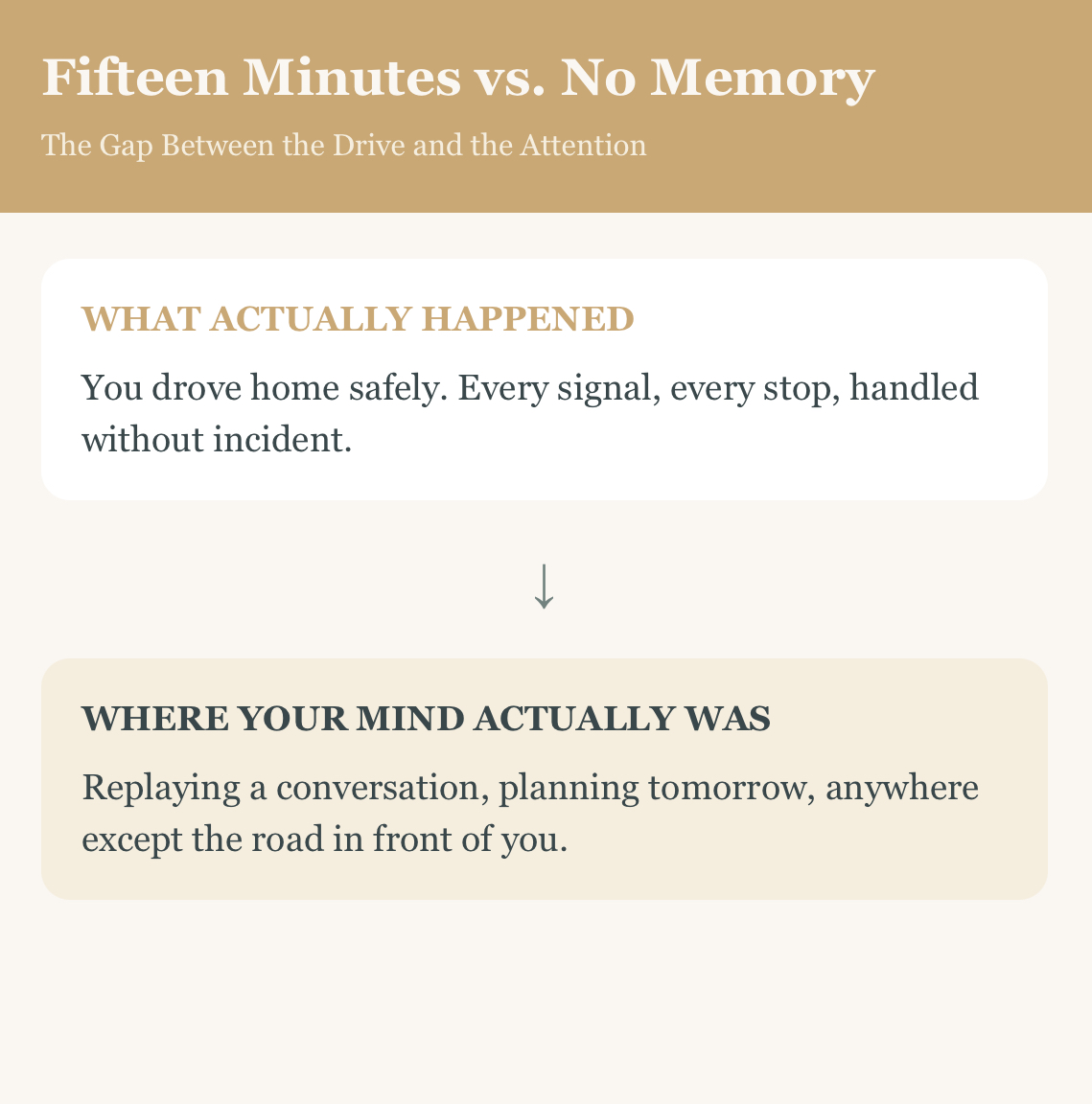
You pull into the driveway and switch off the engine, and for a moment you cannot account for the last fifteen minutes. You know you signalled at the right corners and stopped at the lights, because you are home safely, but you could not describe a single thing you saw along the way. Your body drove the car. Your mind was somewhere else entirely, replaying a conversation from earlier or drafting tomorrow's to-do list.

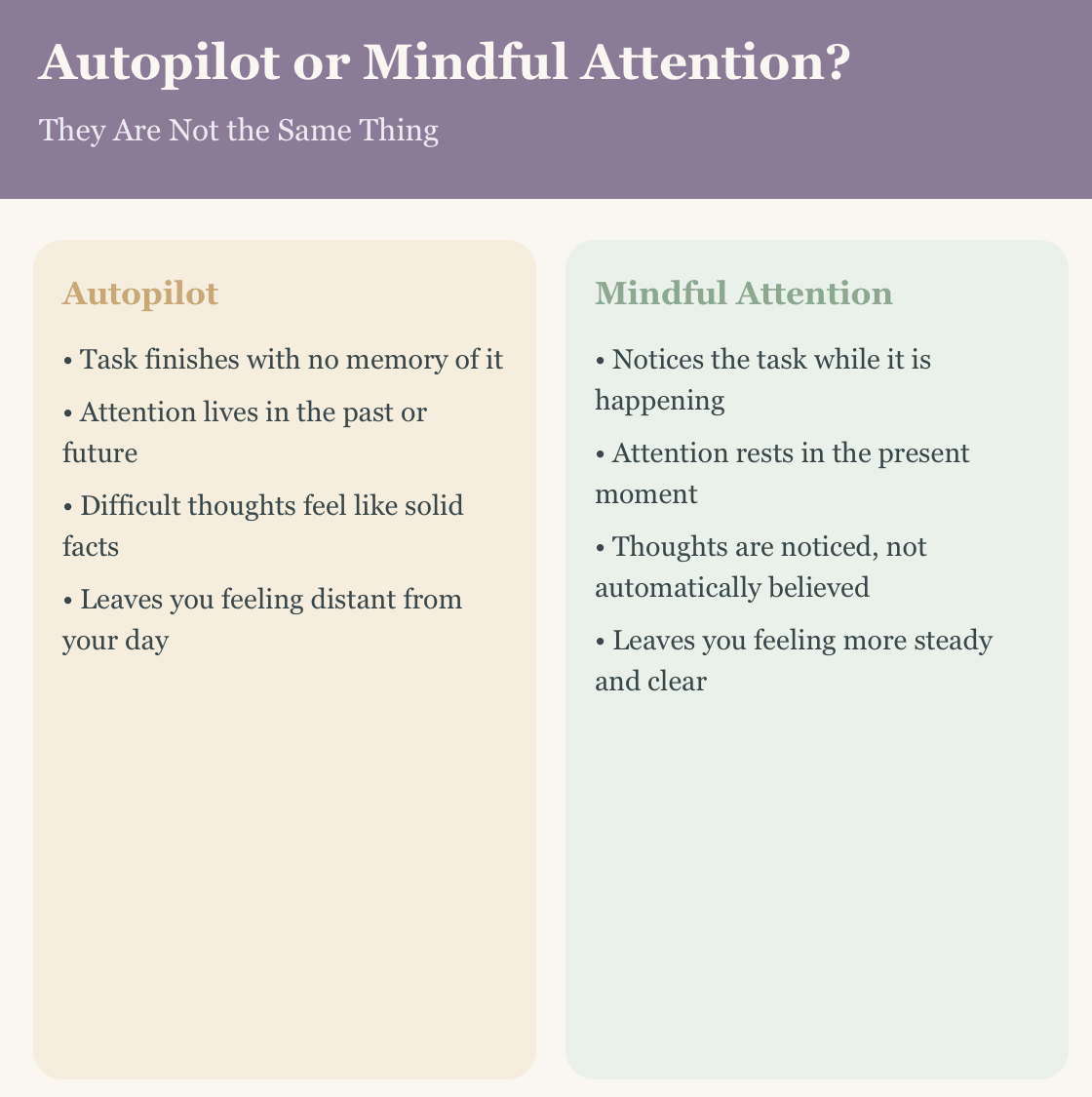
This is not a rare lapse. Most people can recall entire mornings, meals, or conversations they moved through without really being present for any of it. Modern life rewards this kind of split attention, and for a while it can feel efficient, getting through the motions while the mind works on the next thing. But over time, spending most of your day somewhere other than where you actually are can leave you feeling strangely distant from your own life, and less able to catch difficult thoughts before they take hold.

It is worth noting that this kind of split attention is not a modern character flaw. Human minds are built to plan, predict and problem-solve, which often means living a few steps ahead of, or several steps behind, the present moment. Mindfulness-based approaches do not ask you to switch this off permanently. They ask you to notice when it has taken over completely, and to build the capacity to step back into the present on purpose.

There is a name for the skill this situation is missing, and a growing body of research behind teaching it deliberately.

Psychologists call this quality of attention mindfulness, a deliberate, non-judgmental awareness of the present moment. Mindfulness-Based Therapy, and its most researched clinical form, Mindfulness-Based Cognitive Therapy, teaches this as a set of structured, learnable skills, rather than treating it as a personality trait some people simply have and others do not. The approach combines mindfulness meditation practices with elements of cognitive therapy, and was originally developed by psychologists Zindel Segal, Mark Williams and John Teasdale to help people who had experienced repeated episodes of depression stay well for longer (Segal et al., 2013).


The stakes for this kind of relapse prevention are significant. Depression tends to recur, and each episode raises the likelihood of another, which makes finding a sustainable, long-term approach particularly important. In a large randomised controlled trial, Mindfulness-Based Cognitive Therapy was found to be as effective as ongoing antidepressant medication in preventing depressive relapse, at comparable cost (Kuyken et al., 2015).

More recent research has extended these findings beyond depression alone. A 2025 systematic review and meta-analysis found durable improvements in both anxiety and depressive symptoms following Mindfulness-Based Cognitive Therapy, with benefits maintained over follow-up periods (Nandarathana and Ranjan, 2025). A separate 2025 meta-analysis examined the approach delivered via telehealth specifically, finding meaningful reductions in anxiety and depression among adults who completed the program online, a promising finding for anyone unable to attend a clinic in person (Wang et al., 2025). This matters because the relationship between rumination and low mood tends to feed itself. A difficult thought arrives, attention narrows around it, and the more it is turned over, the more convincing and permanent it can start to feel. Mindfulness-based approaches interrupt this loop early, before a passing thought has the chance to harden into a fixed belief about yourself or your circumstances.

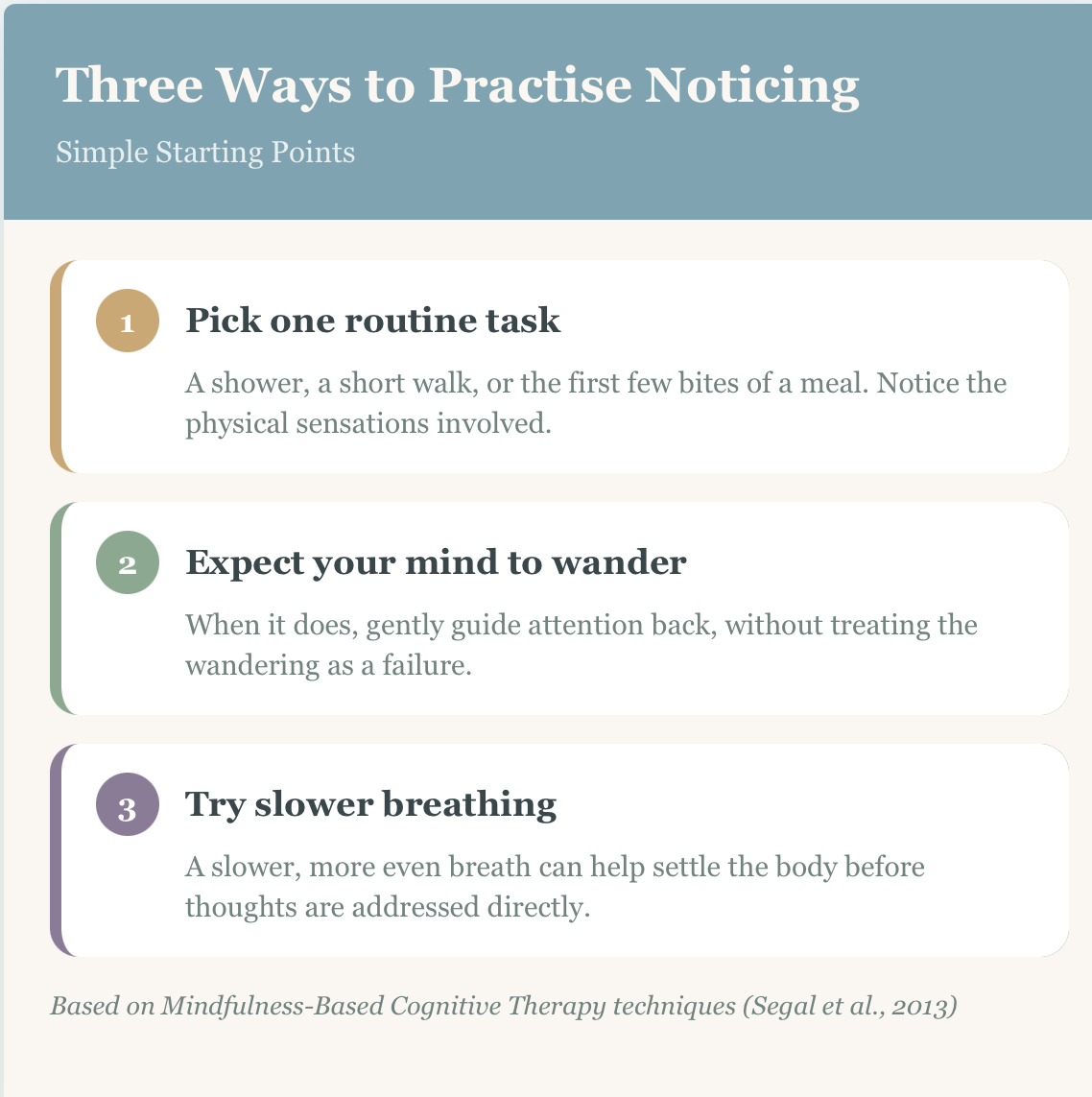
You do not need a formal course to begin noticing your own autopilot moments. A simple starting point is to pick one routine activity each day, a shower, a short walk, the first few minutes of a meal, and deliberately notice the physical sensations involved, without trying to change or judge them. When your attention wanders, which it will, gently guide it back rather than treating the wandering itself as a failure.

Slower, structured practices such as body scan meditation or mindful breathing can also help build this capacity over time, though they generally work best when introduced gradually and with guidance, particularly for anyone whose mind tends to fill with distressing content when it slows down. This is not a replacement for professional support where low mood, anxiety or rumination are significant or ongoing, but it can be a reasonable place to start noticing the pattern.

If autopilot living has become a near-constant experience, particularly alongside a history of depression, anxiety or difficulty switching off, it may help to work through Mindfulness-Based Therapy with a psychologist who can structure the practice around your specific situation.

You do not have to keep moving through your own life on autopilot. Chrysalis Psychology & Wellbeing offers Mindfulness-Based Therapy for adults navigating rumination, stress and the risk of depressive relapse, face to face in Battery Point, Hobart, or via telehealth psychology across Australia. Call our reception team on (03) 6263 6319 to arrange an appointment, or visit our individual therapy page to learn more about the approaches our clinical team uses.

Related Reading  

References

  • Australian Bureau of Statistics. (2023). National study of mental health and wellbeing, 2020 to 2022. Canberra: ABS.
  • Kuyken, W., Hayes, R., Barrett, B., et al. (2015). Effectiveness and cost-effectiveness of mindfulness-based cognitive therapy compared with maintenance antidepressant treatment in the prevention of depressive relapse or recurrence (PREVENT): A randomised controlled trial. The Lancet, 386(9988), 63 to 73.
  • Nandarathana, N., and Ranjan, J. K. (2025). The efficacy and durability of mindfulness-based cognitive therapy in the treatment of anxiety and depressive disorders: A systematic review and meta-analysis. Indian Journal of Psychological Medicine, 47(3), 214 to 222.
  • Segal, Z. V., Williams, J. M. G., and Teasdale, J. D. (2013). Mindfulness-based cognitive therapy for depression (2nd ed.). Guilford Press.
  • Wang, S., Wu, M., Wei, J., Xia, W., Luo, Z., and Tian, L. (2025). Effectiveness of mindfulness-based cognitive therapy via e-health on anxiety and depression in adults: A meta-analysis. General Hospital Psychiatry, 96, 211.