You want to send the email. You have drafted it three times. One part of you is certain it needs to be sent, that the situation cannot continue as it is. Another part is already listing reasons to wait, to soften the wording, to sleep on it one more night. By the time you close the laptop without sending anything, you feel less like someone who made a decision and more like someone who sat through an argument between two people who both happened to be you.
This experience, of feeling pulled between distinct, sometimes opposing parts of yourself, is far more common than the relative quiet with which most people carry it. Everyone has moments where one part of them wants something that another part is actively working against, whether that is rest against productivity, honesty against harmony, or connection against self-protection. Others notice it in relationships, feeling like a different person with one family member than they are with a partner or a close friend, without quite being able to explain the shift.
Psychologists have a specific way of understanding this multiplicity, and it does not treat it as a flaw to be corrected.
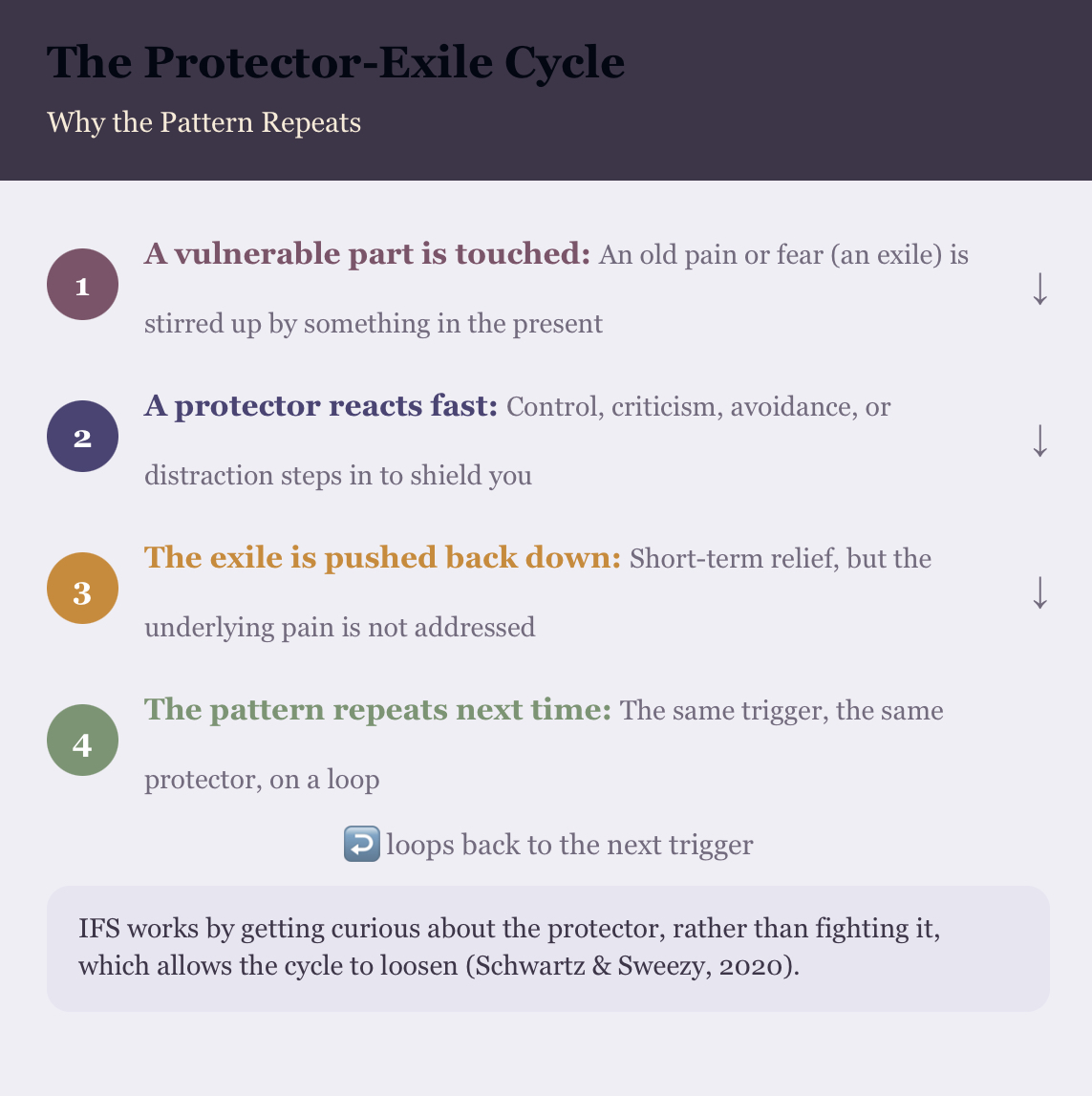
Internal Family Systems therapy, usually shortened to IFS, was developed by American family therapist Richard Schwartz after he noticed that many of his clients described their inner world in terms of distinct parts, each with its own perspective, feelings, and motivations, rather than as a single, unified voice. Rather than viewing this as a problem, IFS treats it as the ordinary structure of the mind. Some parts work to protect you, sometimes through control, striving, or vigilance, and sometimes through avoidance or distraction. Other, more vulnerable parts carry pain or fear connected to earlier experiences, and are often kept at a careful distance by the protector parts working to shield them.


Understanding where these patterns come from matters, because early experience shapes them more than most people realise. A 2025 nationally representative Australian study found that up to 42 per cent of Australians had been exposed to a potentially traumatic event before the age of 18, and that this kind of early adversity was associated with significantly higher odds of experiencing a mental disorder later in life (Barrett et al., 2025). IFS understands many protector and exile parts as having formed in response to exactly this kind of early experience, developing strategies that made sense at the time, even if they no longer fit the life you are living now.
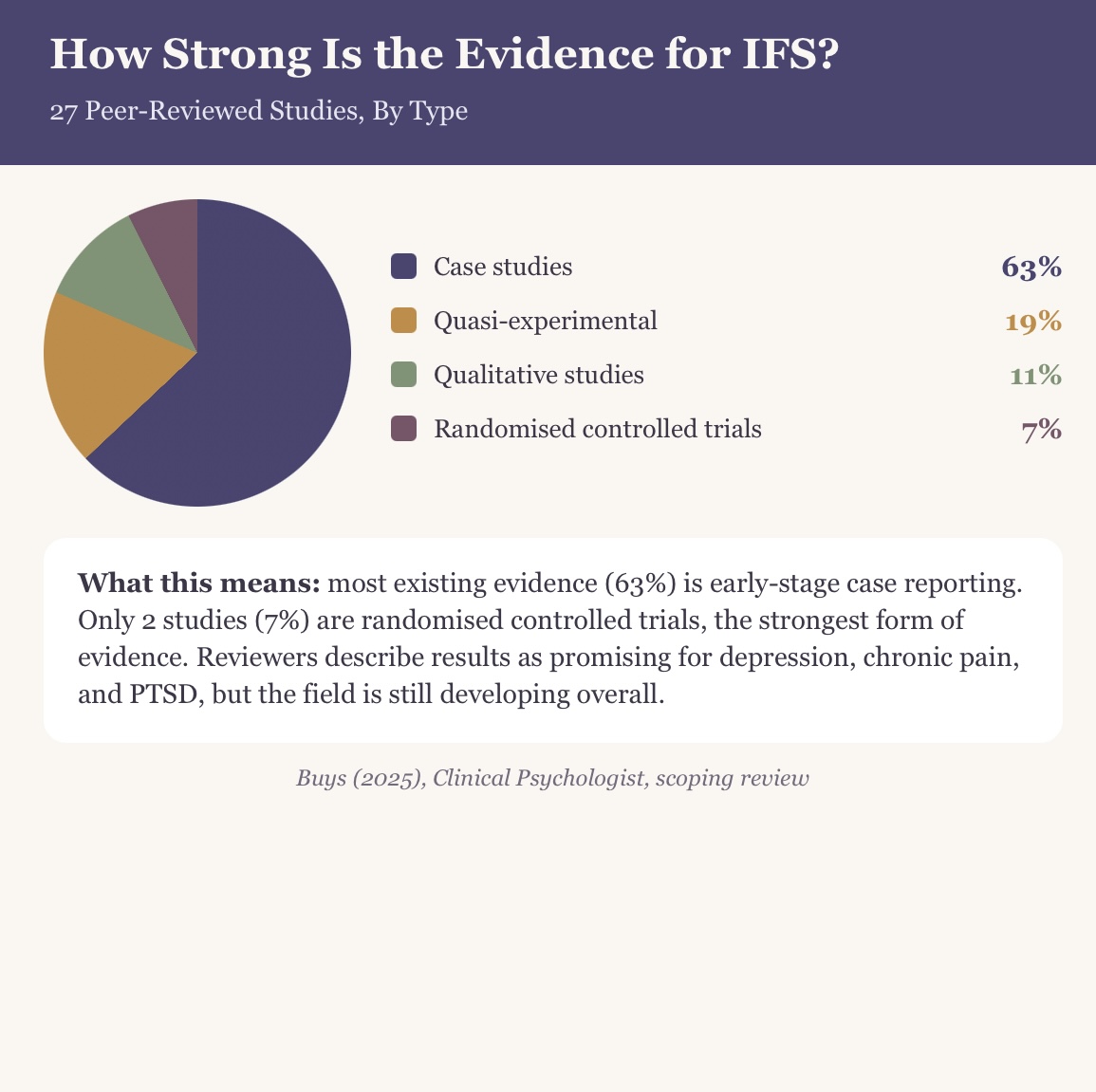
IFS is a newer therapeutic model, and a 2025 scoping review of the peer-reviewed literature found only 27 studies investigating it, most of which were case studies, with just two randomised controlled trials completed so far (Buys, 2025). The review described the existing evidence as promising, particularly for depression, chronic pain, and post-traumatic stress disorder, while noting clearly that more high-quality research is still needed. This does not mean the approach is without support, an early pilot trial found promising results for IFS as a treatment for depression (Haddock et al., 2016), but it does mean the evidence base is still developing, and your psychologist would usually discuss how it fits alongside more established approaches rather than using it alone.

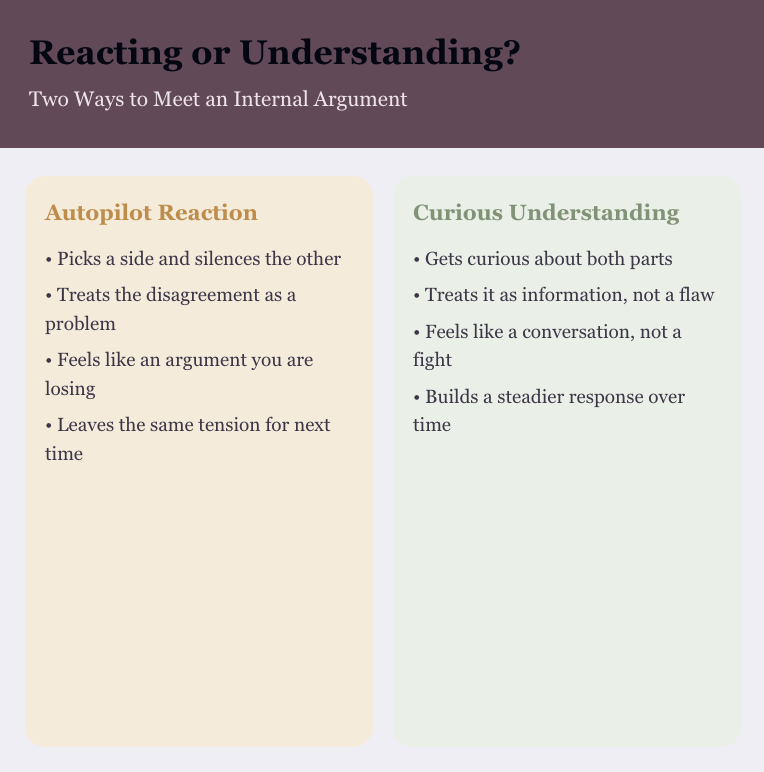
You do not need to formally map your own parts to start noticing this pattern. A useful starting point is simply naming the disagreement when it happens, noticing that one part wants one thing and another part wants something else, without immediately deciding which one is right. Slower, more curious attention to these moments, rather than trying to immediately resolve the disagreement, is itself part of what the approach is built around. Getting curious about what each part is trying to achieve, rather than trying to silence the less convenient one, tends to reduce the intensity of the internal argument, even before you have resolved anything.

This is not a replacement for professional support where internal conflict is significant, longstanding, or connected to a difficult history, particularly if strong reactions feel disproportionate to the present moment or seem to belong to a much younger version of yourself. In those situations, it may help to work through this with a psychologist who can guide the pace of that exploration.
You do not have to keep sitting through arguments between different versions of yourself alone. Chrysalis Psychology & Wellbeing offers Internal Family Systems therapy for adults navigating internal conflict, self-criticism, and the lasting effects of earlier experiences, face to face in Battery Point, Hobart, or via telehealth psychology across Australia. Call our reception team on (03) 6263 6319 to arrange an appointment, or visit our individual therapy page to learn more about the approaches our clinical team uses.
You do not have to keep sitting through arguments between different versions of yourself alone. Chrysalis Psychology & Wellbeing offers Internal Family Systems therapy for adults navigating internal conflict, self-criticism, and the lasting effects of earlier experiences, face to face in Battery Point, Hobart, or via telehealth psychology across Australia.
Call our reception team on (03) 6263 6319 to arrange an appointment, or visit our individual therapy page to learn more about the approaches our clinical team uses.